
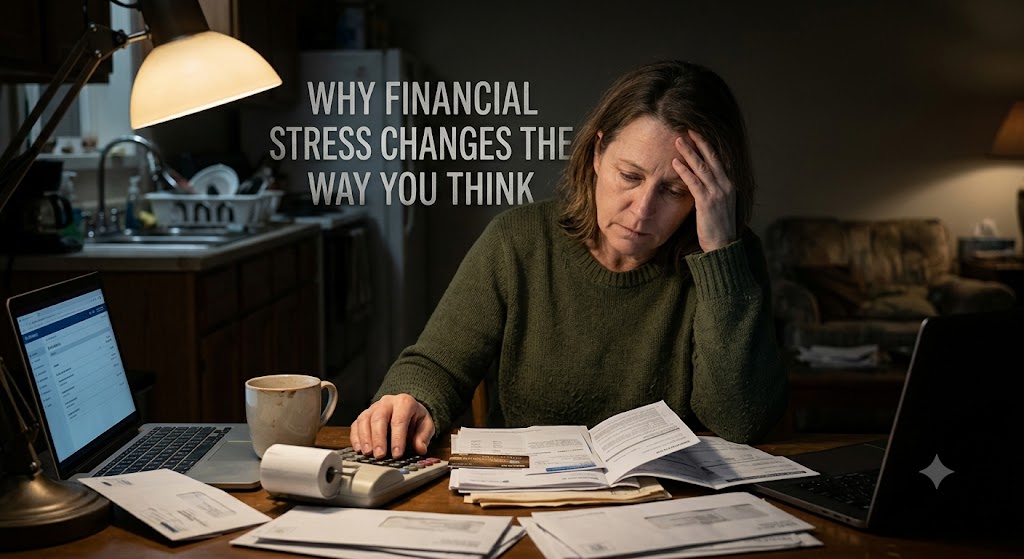
Financial stress does more than make you worry about money. It can change the way you think, the way you make decisions, the way you relate to other people and even the way you see your future. When money becomes a constant source of pressure, your mind can become consumed by immediate financial problems, leaving very little mental space for long term planning, creativity and rational decision making. This is one of the reasons financial stress can be so destructive. It does not simply affect your bank account. It can affect the person managing the bank account. Why Financial Stress Changes the Way You Think
Many people experiencing financial stress blame themselves for making poor decisions. They may wonder why they keep spending money they cannot afford, why they struggle to save, why they postpone important financial decisions or why they sometimes make choices they know are not in their best interest. What they may not realise is that prolonged financial pressure can influence cognitive processes and emotional responses. When the brain constantly perceives money problems as threats, attention naturally becomes focused on survival and immediate needs.
Financial stress is the emotional and psychological pressure that comes from struggling to meet financial responsibilities or feeling uncertain about your financial future. It can come from low income, unemployment, debt, rising living costs, unexpected expenses, family responsibilities, unstable employment or simply the fear that your current income will not be enough to handle tomorrow. Someone does not necessarily have to be completely broke to experience financial stress. Even a person earning a substantial income can experience intense financial anxiety if their expenses, obligations and expectations continually exceed what they feel capable of managing.
One of the biggest ways financial stress changes the way you think is by narrowing your attention. When you are worried about how to pay rent, school fees, a loan repayment, electricity bills, food expenses or an emergency medical bill, your mind naturally focuses on the immediate problem. This can make it difficult to think about goals that are months or years away. Retirement planning, investing, building a business, learning a new skill or creating an emergency fund can suddenly feel less important than solving the problem directly in front of you. Why Financial Stress Changes the Way You Think
This is sometimes described as a scarcity mindset. When something important feels limited, whether it is money, time, food or security, the mind becomes heavily focused on obtaining or protecting that scarce resource. Financial scarcity can therefore make people highly attentive to money while simultaneously making it harder to think strategically about money.
Consider someone who has only enough money to survive until the end of the month. Advising that person to invest for retirement may be financially sensible in theory, but emotionally and psychologically it may feel disconnected from reality. Their immediate concern is not what life will look like in twenty years. Their concern is whether they can get through the next two weeks. When the brain is occupied with urgent problems, long term thinking can become extremely difficult.
Financial stress can also increase impulsive decision making. When people feel overwhelmed, they may look for quick solutions that provide immediate relief. This can include borrowing money unnecessarily, making emotional purchases, gambling, taking expensive loans, ignoring bills, withdrawing investments prematurely or accepting financial arrangements they would normally reject.
Why Financial Stress Changes the Way You Think
The desire for immediate relief is understandable. If someone has been experiencing financial pressure for months, any opportunity to feel temporarily better can be attractive. The problem is that decisions made primarily to escape emotional discomfort can sometimes create larger financial problems later. A person may borrow money to solve today’s problem only to create tomorrow’s repayment problem. They may spend money on something unnecessary because buying it provides a brief feeling of control or happiness. Afterwards, the original financial stress returns, sometimes accompanied by guilt.
Financial stress can therefore create a frustrating cycle. Money problems create anxiety. Anxiety encourages short term decisions. Short term decisions can create additional financial problems. Those additional problems create more anxiety. The cycle continues until something interrupts it.
Another important effect of financial stress is reduced concentration. Constantly thinking about money can consume mental energy. You may be working, studying, driving, having a conversation or trying to sleep while part of your mind is calculating expenses, remembering debts or wondering where the next payment will come from. This mental load can make it difficult to concentrate fully on other responsibilities.
Imagine trying to complete an important task while receiving constant notifications on your phone. Even if you do not respond to every notification, knowing that they are waiting can interrupt your attention. Financial worries can work in a similar way. The unpaid bill, outstanding debt or uncertain income becomes a mental notification that keeps demanding attention.
This is particularly dangerous because reduced concentration can affect earning potential. A financially stressed employee may struggle to focus at work. A stressed entrepreneur may have difficulty thinking creatively about business opportunities. A student worried about money may struggle to concentrate on studying. The financial problem can therefore begin affecting the very activities that could help improve the person’s financial situation.
Financial stress can also influence how people perceive risk. Some people become extremely cautious when they are financially stressed. Others become unusually willing to take major risks because they desperately want to escape their situation. Both responses can create problems.
Someone who has experienced financial losses may become afraid to invest in anything, even when the opportunity is reasonable and properly researched. Another person may become attracted to schemes promising extraordinary returns because they desperately want to make money quickly. The stronger the desire for a financial breakthrough, the easier it can become for unrealistic promises to appear attractive.
This is why financial education is not only about learning how to calculate percentages, understand investments or create budgets. It is also about understanding your own behaviour under financial pressure. Knowing how your emotions influence your decisions can be just as important as knowing how money works.
Financial stress can also change how people view the future. When your present situation feels unstable, the future can become frightening rather than exciting. You may stop believing that things can improve. You may begin thinking that you will always struggle with money. You may even stop setting financial goals because previous attempts did not work.
This can create a dangerous form of financial hopelessness. A person may think, “What is the point of saving when there is never enough money?” Another may think, “I will never be able to afford a house anyway.” Someone else may believe, “People like me never become financially comfortable.” These beliefs can become self reinforcing because once someone stops believing improvement is possible, they may stop taking the actions required to create improvement.
Financial stress can also affect relationships. Money problems are one of the most common sources of tension within families and relationships because financial decisions rarely affect only one person. When there is not enough money, arguments about spending, borrowing, saving and responsibilities can become frequent.
A person experiencing financial stress may become irritable, withdrawn or defensive. They may interpret ordinary questions about money as criticism. A partner asking about an unpaid bill may be perceived as an attack. Parents may feel guilty because they cannot provide everything they want for their children. Friends may become difficult to socialise with because every outing feels expensive.
Over time, financial stress can create isolation. Someone may stop attending social events because they cannot afford them. They may avoid friends because they are embarrassed about their financial situation. They may refuse to discuss money because they fear being judged. Unfortunately, isolation can make financial stress feel even heavier.
Another way financial stress changes thinking is by affecting self worth. Society often connects money with success, status and personal achievement. People are constantly exposed to images of expensive houses, cars, holidays, businesses and lifestyles on social media. When someone is struggling financially, they may compare their reality with someone else’s carefully presented highlights.
The result can be shame. Instead of thinking, “I am currently experiencing financial difficulty,” a person may begin thinking, “I am a failure.” These statements are not the same. A financial situation is something that can change. Turning that situation into an identity can make change much harder.
Your current bank balance does not define your intelligence, character or potential. Financial difficulty can happen to hardworking and responsible people for many different reasons. Job loss, business failure, economic conditions, unexpected expenses, family obligations and poor financial decisions can all contribute to financial pressure. Recognising the problem without turning it into an identity is an important step towards recovery.
Financial stress can also make people avoid looking at their finances altogether. This may seem strange because financial problems require attention, but avoidance is a common response to overwhelming situations. Opening a bank statement may create anxiety. Checking a debt balance may feel terrifying. Looking at monthly expenses may produce guilt.
So the person avoids everything.
Unfortunately, avoiding financial information rarely makes financial problems disappear. Instead, uncertainty grows. A bill that could have been negotiated becomes overdue. A debt that could have been addressed becomes larger. A spending problem continues unnoticed. The fear of looking at the numbers becomes greater than the numbers themselves.
One of the most powerful ways to reduce financial stress is therefore to replace uncertainty with information. Knowing exactly how much you owe, how much you earn, what your essential expenses are and where your money is going can initially feel uncomfortable, but information gives you something that financial anxiety often takes away: a sense of control. Why Financial Stress Changes the Way You Think
You do not have to solve every financial problem in one day. Sometimes the first victory is simply understanding the situation. Write down your income. List your essential expenses. Identify your debts. Separate needs from wants. Look at recurring subscriptions and unnecessary expenses. Determine which financial problem requires immediate attention and which can be addressed later.
Breaking a large financial problem into smaller decisions can make it less overwhelming.
It is also important to understand that financial stress can affect your ability to plan, but planning can help reduce financial stress. Creating even a simple financial plan can give your brain a clearer path forward. You may not have enough money to achieve every goal immediately, but knowing what you are working towards can provide direction.
A financial plan does not need to be complicated. It can begin with basic priorities such as covering essential expenses, reducing expensive debt, creating a small emergency fund, increasing income and developing better spending habits. As your financial position improves, your plan can become more ambitious.
Building an emergency fund is particularly important because financial stress often comes from uncertainty. When every unexpected expense threatens your entire budget, even a small financial emergency can feel catastrophic. Having savings set aside for emergencies can provide a buffer between an unexpected problem and a financial crisis.
The amount does not have to be enormous at the beginning. The important thing is developing the habit of keeping money available for genuine emergencies rather than spending every naira that enters your account.
Increasing income can also be an important part of dealing with financial stress. While cutting unnecessary expenses matters, there is a limit to how much someone can reduce spending. Income, however, can potentially grow through acquiring valuable skills, improving professional qualifications, starting a side business, freelancing, negotiating better opportunities or developing additional sources of legitimate income.
The goal should not simply be to work harder until exhaustion. The goal is to increase your financial capacity while creating a sustainable relationship with money.
Another important step is learning to separate urgent financial problems from emotional emergencies. Not every financial problem requires an immediate emotional reaction. Sometimes the best decision is to pause before acting. If you suddenly feel tempted to borrow money, make a major purchase or invest in an opportunity because you are desperate for a quick solution, give yourself time to think.
Ask yourself what problem you are actually trying to solve. Is this decision improving your financial position or simply reducing your anxiety temporarily? What will the decision cost you next month? What happens if the expected result does not occur? Are you making the decision because it makes financial sense or because you are afraid?
These questions can create enough distance between emotion and action to prevent expensive mistakes.
Financial stress also becomes easier to manage when people stop trying to appear financially comfortable. Social pressure can encourage spending that does not match reality. People may buy expensive clothes, phones, cars, meals or experiences because they do not want others to know they are struggling.
But protecting an image can become expensive.
There is nothing wrong with living below your means, choosing affordable alternatives or telling friends that something is outside your budget. Financial independence often requires the ability to disappoint other people’s expectations. You cannot build wealth effectively if maintaining appearances continually consumes your resources.
The deeper lesson is that financial health is not only about how much money you make. It is also about the relationship between your money, your mind and your behaviour. Two people with identical incomes can experience completely different levels of financial stress depending on their debts, responsibilities, spending habits, expectations and beliefs about money.
This is why financial literacy should include financial psychology. Understanding compound interest is valuable. Knowing how to budget is valuable. Learning about investing is valuable. But understanding why you spend when you are stressed, why you avoid difficult financial conversations, why you compare yourself with others and why you sometimes prioritise immediate pleasure over long term security can be equally important.
Financial stress does not mean you are weak. It means you are responding to pressure. The important thing is learning how to respond differently when pressure appears.
You may not be able to control inflation, job markets, unexpected expenses or every financial circumstance around you. But you can gradually improve how you respond to financial pressure. You can seek information instead of avoiding your numbers. You can pause before making emotional decisions. You can create realistic goals instead of comparing your life with someone else’s. You can learn new skills, explore additional income opportunities and develop better financial habits.
Most importantly, you can remember that a difficult financial season is not necessarily a permanent financial identity.
Money problems can occupy enormous amounts of mental space, but they do not have to control your entire life. The first step towards changing your financial situation is often understanding what financial stress is doing to your thinking. Once you recognise how scarcity, fear, shame and uncertainty influence your decisions, you can begin creating systems that protect you from your most vulnerable moments.
The goal is not to become a person who never worries about money. Financial responsibility naturally involves thinking about money. The goal is to reach a point where money receives your attention without controlling your thoughts.
Financial freedom is therefore more than having enough money in the bank. It is also having enough clarity to make decisions without constant fear, enough discipline to delay unnecessary gratification, enough knowledge to recognise opportunities and enough confidence to plan for a future that you genuinely believe can be better.
Understanding why financial stress changes the way you think is an important part of building that freedom. When you understand the connection between your financial circumstances and your mental responses, you can stop treating every poor financial decision as evidence that something is wrong with you. Instead, you can identify the patterns, change the systems and gradually build a healthier relationship with money. Why Financial Stress Changes the Way You Think
Your financial situation may influence your thoughts, but it does not have to determine your future. Sometimes the first financial breakthrough is not receiving more money. It is learning to think more clearly about the money you already have, especially when life becomes difficult.

EarnSmartOnline.com.ng is dedicated to helping readers make smarter financial decisions through practical guides on online income, personal finance, technology, digital business, and wealth creation. Our goal is to provide reliable, easy-to-understand, and actionable content that empowers individuals to earn smarter, build sustainable income streams and achieve long-term financial success.
Recommended: Start Earning Online
- Ultimate Affiliate Marketing Program — learn affiliate marketing with a done-for-you sales system ($15). Check it out
- The Newbie Affiliate Guide — the beginner-friendly starter guide (~$6.68). Check it out
- Easy Dollar Maker — earn in dollars uploading AI images and videos from your phone ($17). Check it out
Disclosure: These are affiliate links. If you buy through them, I may earn a commission at no extra cost to you.



