
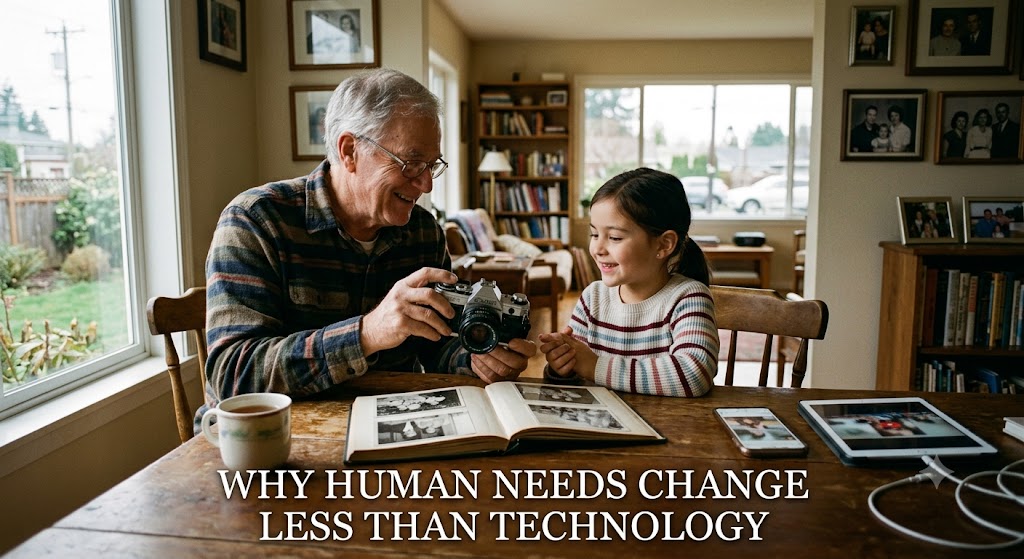
Why Human Needs Change Less Than Technology
Technology moves at a breathtaking pace. Every year brings faster smartphones, smarter artificial intelligence, more powerful computers, improved medical equipment, and new digital platforms that promise to transform the way we live and work. It often feels as though humanity is constantly reinventing itself because the tools around us are evolving so rapidly. Yet beneath all the innovation lies a surprising truth that many people overlook. While technology changes almost every day, human needs remain remarkably consistent across generations. Understanding this simple reality can change the way we view progress, business, relationships, education, and even our personal goals.
Thousands of years ago, people wanted food, shelter, safety, companionship, respect, purpose, and hope for the future. Today, despite living in a world filled with smartphones, cloud computing, virtual reality, and artificial intelligence, people still desire exactly those same things. The methods have changed, but the motivations have not. Technology may completely transform the tools we use, but it rarely changes the fundamental reasons we use them.
This explains why many technological breakthroughs become successful while others disappear almost as quickly as they arrive. The greatest innovations do not create entirely new human desires. Instead, they satisfy old desires more efficiently, more conveniently, or more affordably. Human beings still seek connection, entertainment, knowledge, achievement, comfort, and security. Technology simply offers new paths toward fulfilling those timeless needs.
Consider communication. Centuries ago, people wrote handwritten letters that took weeks or months to arrive. Later came the telegraph, telephone, email, text messaging, video calls, and instant messaging applications. Every generation believed it was experiencing revolutionary communication technology, and they were correct. However, the need driving each invention never changed. People have always wanted to stay connected with family, friends, colleagues, and loved ones. The tools evolved dramatically, but the emotional need remained exactly the same.
The same principle applies to entertainment. Ancient civilizations gathered around storytellers, musicians, and theatrical performances. Later generations embraced radio, television, cinema, streaming platforms, podcasts, and virtual reality. Technology completely reshaped how entertainment is delivered, but people still seek laughter, excitement, emotional release, inspiration, and escape from daily stress. Human psychology has remained surprisingly stable despite thousands of years of technological advancement.
Business leaders who understand this principle often build companies that survive technological shifts. They do not become obsessed with technology itself. Instead, they focus on the human problems technology can solve. Businesses that confuse technology with customer needs often struggle because they become fascinated by features instead of benefits. Customers rarely buy technology simply because it is advanced. They buy solutions to problems they already have.
This is one reason some companies disappear while others dominate entire industries. The businesses that endure consistently ask one important question. What human need are we satisfying? Whether selling software, clothing, transportation, healthcare, education, or financial services, successful organizations recognize that technology is merely the vehicle. Human need is the destination.
Artificial intelligence provides another excellent example. AI may automate countless tasks and transform entire industries, but its success still depends on fulfilling existing human needs. People use AI because they want faster answers, greater productivity, reduced costs, personalized experiences, improved creativity, and better decision making. Artificial intelligence itself is not the need. It is simply another tool helping people satisfy needs that have existed for generations.
Social media illustrates the same pattern. Many critics argue that social media has fundamentally changed humanity. While it has certainly influenced behavior, the underlying motivations remain ancient. People seek belonging, recognition, approval, friendship, influence, and self-expression. Long before the internet existed, individuals pursued these same desires through villages, religious communities, marketplaces, schools, workplaces, and families. Social media amplified these instincts rather than inventing them.
The need for security also remains constant. Early humans built shelters to protect themselves from harsh weather and dangerous animals. Modern society relies on alarm systems, cybersecurity software, insurance policies, encrypted communication, and surveillance technologies. The methods have changed dramatically, but the need to feel safe remains deeply rooted in human nature.
Healthcare demonstrates another timeless truth. Medical technology has advanced beyond anything previous generations could have imagined. Modern medicine includes robotic surgery, genetic testing, advanced imaging systems, wearable health monitors, and artificial intelligence for diagnosis. Yet the primary goal remains unchanged. People want to live longer, avoid pain, recover from illness, and enjoy healthier lives. Every medical innovation ultimately serves these enduring human priorities.
Education has experienced a similar transformation. Students once relied entirely on oral tradition, handwritten manuscripts, printed books, classrooms, and libraries. Today they have access to online courses, educational videos, virtual classrooms, interactive simulations, and AI tutors. Despite these remarkable changes, learners still pursue knowledge for familiar reasons. They want opportunity, confidence, competence, career advancement, and personal growth. Technology has expanded access to education without fundamentally changing why people learn.
This understanding becomes especially valuable for entrepreneurs. Many startups fail because they become captivated by technological novelty while ignoring genuine customer demand. A groundbreaking invention has little value if it does not solve a meaningful human problem. Entrepreneurs who begin by understanding human needs often discover better product ideas than those who begin with technology alone.
History repeatedly confirms this lesson. Numerous technologically superior products have failed because they solved problems people never cared about. Meanwhile, simpler solutions frequently dominate markets because they address genuine human frustrations. Consumers reward usefulness far more consistently than sophistication.
Marketing professionals also recognize the importance of stable human needs. Advertising strategies change with each generation, but successful campaigns consistently appeal to emotions rather than technology. They promise happiness, belonging, confidence, achievement, safety, love, convenience, or freedom. These emotional drivers remain powerful regardless of how communication channels evolve.
Even luxury markets reveal this pattern. Expensive watches, luxury vehicles, designer clothing, and premium real estate often incorporate advanced technology, but customers rarely purchase them solely because of technical specifications. They seek status, identity, prestige, confidence, and personal satisfaction. These motivations have existed throughout recorded history.
The workplace provides another fascinating example. Offices have evolved from paper files and typewriters to cloud computing, collaboration software, video conferencing, and artificial intelligence. Yet employees continue seeking fair compensation, meaningful work, career growth, recognition, autonomy, and job security. Technology has transformed workflows without replacing these enduring psychological needs.
Parents raising children today face challenges that appear entirely modern because of smartphones, gaming platforms, and social media. However, the deeper parenting goals remain familiar. Parents still want their children to be safe, healthy, educated, responsible, kind, and successful. Technology introduces new circumstances, but parental priorities remain remarkably consistent across generations.
Relationships offer perhaps the clearest evidence that human needs change slowly. Dating applications, social networking sites, and instant messaging have transformed how people meet and communicate. Nevertheless, individuals still desire trust, loyalty, affection, intimacy, companionship, and emotional support. Technology changes the pathway toward relationships but rarely changes what people hope to find within them.
Financial behavior also reflects timeless human priorities. Banking has evolved from physical cash and handwritten ledgers to digital wallets, cryptocurrency, online banking, and contactless payments. Yet people continue saving for security, investing for prosperity, spending for comfort, and seeking financial independence. The financial instruments evolve while the underlying motivations remain constant.
Understanding this distinction between changing technology and stable human needs helps individuals make wiser career decisions. Technical skills may become obsolete surprisingly quickly, but skills related to communication, leadership, empathy, creativity, critical thinking, negotiation, and problem solving remain valuable because they address enduring aspects of human interaction. Professionals who combine technological competence with timeless interpersonal abilities often enjoy longer and more resilient careers.
This principle also explains why certain books remain influential for decades or even centuries. Technology books become outdated rapidly because innovation moves quickly. Books exploring psychology, leadership, philosophy, relationships, ethics, decision making, and human behavior often remain relevant because the human condition changes much more slowly than the tools surrounding it.
The entertainment industry continues proving this point. Movie production technology improves every year through computer-generated imagery, advanced cameras, and digital editing. Yet the stories that capture audiences often revolve around love, courage, betrayal, sacrifice, ambition, family, friendship, revenge, redemption, and hope. These themes resonate because they reflect timeless human experiences rather than temporary technological trends.
Religion and spirituality further demonstrate humanity’s enduring needs. Throughout history, people have searched for meaning, purpose, hope, belonging, forgiveness, and understanding of life’s greatest questions. Technology has not eliminated these desires. In many ways, modern complexity has intensified them.
Consumer behavior repeatedly confirms that emotional value outweighs technological novelty. A product that makes people feel understood, respected, appreciated, or empowered often succeeds even if competing alternatives possess superior technical capabilities. Emotional resonance creates loyalty that specifications alone rarely achieve.
Governments also recognize stable human priorities. Regardless of technological advancement, citizens consistently expect security, justice, healthcare, education, infrastructure, and economic opportunity. Political systems evolve alongside technology, yet these expectations remain remarkably consistent.
The rapid development of artificial intelligence has renewed debates about humanity’s future. Some fear machines will eventually replace human value entirely. While automation will undoubtedly transform countless occupations, it remains unlikely to replace fundamental human needs. In fact, technological abundance may increase demand for qualities that machines struggle to replicate, including empathy, wisdom, moral judgment, authentic relationships, compassion, and emotional intelligence.
Content creators can learn an important lesson from this reality. Viral trends come and go, algorithms change constantly, and digital platforms rise and fall. However, audiences continue responding to stories that educate, inspire, entertain, encourage, challenge, or emotionally connect with them. Creators who understand lasting human interests are more likely to build enduring audiences than those chasing every temporary trend.
Businesses investing heavily in innovation should remember that technological leadership alone does not guarantee commercial success. Sustainable innovation occurs when companies align emerging technology with persistent human desires. Every groundbreaking invention ultimately succeeds because it helps people achieve something they already wanted.
Individuals planning their future can also benefit from focusing less on predicting specific technologies and more on understanding people. It is difficult to forecast exactly which devices, software, or platforms will dominate ten years from now. It is much easier to predict that people will still desire love, purpose, security, achievement, friendship, recognition, health, convenience, and opportunity.
This perspective encourages wiser investment decisions as well. Investors who understand enduring human needs often identify industries with lasting demand. Healthcare, education, communication, food production, financial services, housing, transportation, and entertainment continue evolving technologically because the underlying human demand remains constant.
The greatest entrepreneurs throughout history rarely succeeded by inventing completely new human needs. Instead, they discovered dramatically better ways to satisfy existing ones. Whether building search engines, online marketplaces, streaming services, payment systems, or artificial intelligence platforms, their lasting advantage came from understanding people before understanding machines.
Technology will undoubtedly continue accelerating. Future generations may experience innovations that seem impossible today, including advanced robotics, quantum computing, brain computer interfaces, autonomous transportation, personalized medicine, and entirely new forms of digital interaction. Yet even in such a future, people will likely continue searching for happiness, love, belonging, security, respect, freedom, purpose, and hope.
That is perhaps the most important lesson of all. Human civilization advances because technology changes, but society remains recognizable because human nature changes much more slowly. The devices in our hands may evolve every few years, but the hearts using them continue pursuing many of the same dreams our ancestors pursued thousands of years ago.
Recognizing this truth provides clarity in an age filled with constant innovation. Rather than becoming distracted by every technological trend, individuals, businesses, educators, leaders, and creators can focus on the timeless needs that truly drive human behavior. Those who understand people will almost always be better prepared for the future than those who understand technology alone.
In the end, technology is a powerful instrument, but it is not the destination. Every invention, application, algorithm, and machine ultimately exists to serve humanity rather than redefine it. As long as people continue seeking connection, security, purpose, growth, happiness, and meaning, the most successful innovations will always be those that honor these enduring needs. Technology may rewrite the methods, but human nature continues writing the story.

EarnSmartOnline.com.ng is dedicated to helping readers make smarter financial decisions through practical guides on online income, personal finance, technology, digital business, and wealth creation. Our goal is to provide reliable, easy-to-understand, and actionable content that empowers individuals to earn smarter, build sustainable income streams and achieve long-term financial success.
Recommended: Start Earning Online
- Ultimate Affiliate Marketing Program — learn affiliate marketing with a done-for-you sales system ($15). Check it out
- The Newbie Affiliate Guide — the beginner-friendly starter guide (~$6.68). Check it out
- Easy Dollar Maker — earn in dollars uploading AI images and videos from your phone ($17). Check it out
Disclosure: These are affiliate links. If you buy through them, I may earn a commission at no extra cost to you.



