
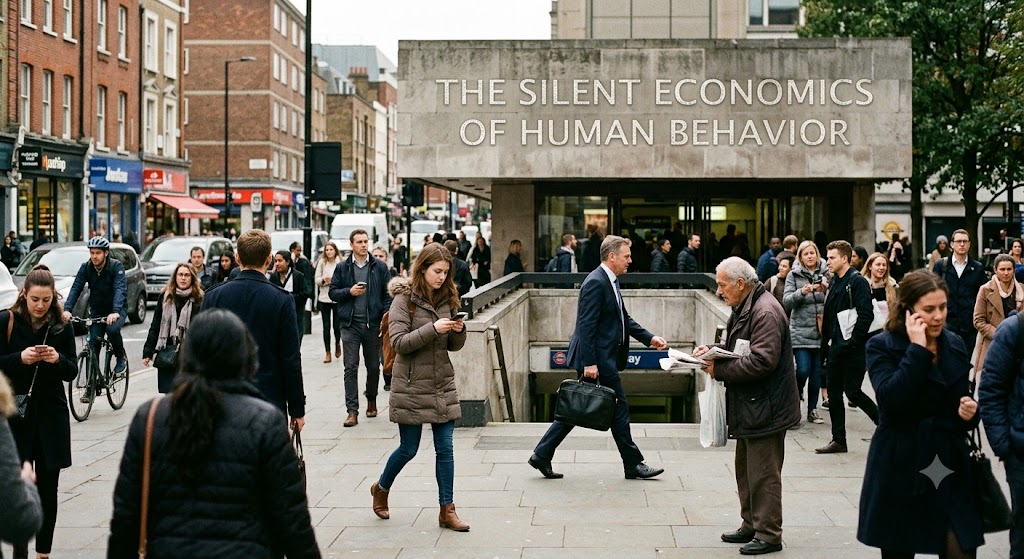
The Silent Economics of Human Behavior
Every day, billions of financial decisions are made across the world. Some involve businesses investing millions of dollars, while others involve an individual deciding whether to buy a cup of coffee, save a portion of their salary, or postpone a purchase until next week. On the surface, these decisions appear to be about money, but beneath every financial action lies something much more powerful. Human behavior silently shapes the economy long before money ever changes hands. This invisible force influences markets, creates industries, destroys businesses, determines personal wealth, and even decides which countries prosper over time. Understanding the silent economics of human behavior is one of the most valuable lessons anyone can learn because money rarely moves randomly. It follows patterns of thought, emotion, perception, incentives, and habits that often remain unnoticed.
Traditional economics assumes that people make rational decisions. According to this view, individuals carefully weigh costs and benefits before making choices that maximise their interests. Real life tells a different story. People frequently spend money they do not have on things they do not need simply to impress people they barely know. Investors panic during market declines and buy assets when prices are already at their highest. Consumers ignore cheaper alternatives because they associate expensive products with higher quality. Employees remain in jobs they dislike because uncertainty feels more frightening than dissatisfaction. These decisions are not irrational because people lack intelligence. They happen because human psychology constantly interacts with economics.
One of the strongest economic forces is perception. Value is rarely determined by objective facts alone. Two products with nearly identical features can sell at completely different prices simply because one has a stronger brand image. A luxury watch tells time just as accurately as a much cheaper alternative, yet millions willingly pay enormous premiums because the purchase satisfies emotional desires beyond functionality. People are not only buying products. They are buying confidence, identity, status, trust, comfort, exclusivity, and aspiration. Businesses that understand this hidden reality often outperform competitors who focus solely on technical superiority.
Scarcity is another silent economic driver deeply connected to human behavior. People naturally place greater value on things they believe are limited. This explains why limited edition products sell out within minutes, why exclusive memberships attract attention, and why collectors pay extraordinary amounts for rare items. Scarcity creates urgency, and urgency changes decision-making. Consumers who might hesitate for weeks suddenly purchase immediately when they believe an opportunity may disappear. The item itself may not have changed, but human perception certainly has.
Fear has enormous economic consequences. Entire industries exist because people fear loss, uncertainty, illness, failure, or insecurity. Insurance companies generate revenue by offering protection against unlikely events. Security firms thrive because individuals want peace of mind. Healthcare spending often increases when fear about future illness grows. Even financial markets respond dramatically to fear. A single negative headline can erase billions of dollars in market value within hours, while optimism can produce equally dramatic gains. Prices move because people react emotionally before they analyse logically.
Greed operates as fear’s opposite, yet its economic impact is equally powerful. During periods of economic expansion, people often become convinced that prosperity will continue forever. Investors borrow heavily, consumers increase spending, businesses expand aggressively, and financial risks appear smaller than they truly are. History repeatedly demonstrates that excessive optimism eventually creates bubbles. When reality catches up with unrealistic expectations, corrections follow. These cycles are not driven solely by mathematics. They are driven by recurring patterns of human emotion.
Habits quietly shape financial outcomes more than dramatic decisions ever do. A single expensive purchase rarely determines someone’s financial future, but daily habits certainly can. Consistently saving small amounts, avoiding unnecessary debt, investing regularly, improving skills, and making thoughtful purchasing decisions gradually compound into remarkable financial stability. Likewise, repeated overspending, procrastination, impulsive buying, and neglecting financial planning slowly create long-term hardship. Human behavior compounds just as money does.
Social influence represents another invisible economic force. People naturally observe those around them before making decisions. Restaurants appear more attractive when they are busy. Online products with thousands of positive reviews receive more attention than equally good products without reviews. Investors often follow market trends simply because everyone else appears confident. This phenomenon, commonly called herd behaviour, affects nearly every industry. Businesses spend billions on testimonials, endorsements, and customer reviews because people trust other people more than advertisements.
Status also influences purchasing behaviour far more than many realise. Throughout history, humans have used possessions to communicate success, belonging, achievement, and identity. Modern consumer markets frequently benefit from this instinct. Luxury cars, designer clothing, expensive homes, premium smartphones, exclusive clubs, and even certain educational qualifications often carry symbolic value beyond their practical usefulness. Consumers may believe they are buying superior quality, but many purchases are actually investments in social perception.
Convenience has become one of the strongest currencies of the digital economy. Consumers increasingly pay premiums not because products are better but because experiences require less effort. Food delivery applications, streaming platforms, online banking, same-day shipping, automated subscriptions, and digital payment systems all generate enormous revenues by reducing friction. Businesses compete not only on price but also on how easily customers can complete a transaction. Every unnecessary step reduces sales because human beings naturally prefer convenience.
Trust silently reduces economic friction. Every successful economy depends upon trust between buyers and sellers. Customers trust that products will perform as promised. Employees trust employers to pay salaries. Investors trust financial institutions to protect assets. Governments rely on public trust when collecting taxes or issuing currency. When trust declines, transaction costs increase dramatically. Contracts become more complicated, verification becomes more expensive, disputes become more frequent, and economic growth slows. Trust may appear intangible, but it produces measurable financial value.
Reputation functions as economic capital. Companies spend decades building reputations because credibility directly influences profitability. Individuals also benefit financially from strong reputations. Reliable professionals receive better opportunities, entrepreneurs attract more customers, and trusted leaders inspire greater cooperation. Reputation often takes years to build but only moments to destroy. The economic consequences of damaged credibility frequently extend far beyond immediate financial losses.
Attention has become one of the world’s most valuable economic resources. Every notification, advertisement, social media platform, streaming service, news website, and entertainment company competes for limited human attention. Since every individual possesses only twenty-four hours each day, attention remains permanently scarce. Businesses capable of capturing attention effectively often dominate markets. Digital platforms have transformed attention itself into a commercial asset sold to advertisers worldwide.
The internet has dramatically amplified behavioral economics. Algorithms now observe purchasing habits, browsing history, viewing preferences, and engagement patterns to predict future behaviour. Recommendations become increasingly personalised because companies recognise that human decisions follow identifiable patterns. Rather than waiting for customers to discover products independently, businesses increasingly anticipate desires before consumers consciously recognise them.
Emotions consistently influence spending decisions. Happiness encourages generosity and celebration. Sadness sometimes encourages comfort purchases. Stress frequently increases impulsive spending. Loneliness often motivates spending on entertainment or social experiences. Excitement reduces caution, while anxiety increases hesitation. Retailers carefully design shopping environments to trigger favourable emotional responses because purchasing decisions frequently occur emotionally before they are justified rationally.
Loss aversion remains one of the strongest psychological forces affecting financial behaviour. Most people experience the pain of losing money more intensely than the pleasure of gaining an equivalent amount. This explains why investors sometimes hold losing investments too long, hoping losses will reverse, while selling profitable investments prematurely. Businesses understand this principle through money-back guarantees, free trials, limited cancellation penalties, and loyalty programmes that make customers reluctant to abandon accumulated benefits.
Human beings consistently underestimate the power of delayed consequences. Immediate gratification feels tangible, whereas future outcomes appear distant and uncertain. This behavioural tendency explains why many struggle to save for retirement, maintain healthy lifestyles, invest consistently, or develop valuable skills despite fully understanding their long-term benefits. Economics constantly rewards individuals capable of sacrificing short-term pleasure for long-term gain.
Education itself reflects behavioural economics. Degrees alone rarely determine financial success. Curiosity, adaptability, persistence, communication skills, emotional intelligence, and continuous learning frequently generate greater long-term economic value. Modern labour markets increasingly reward individuals who evolve alongside changing technologies rather than those relying solely on existing qualifications.
Workplace productivity also depends heavily upon human behaviour. Motivated employees generally outperform disengaged workers despite possessing similar technical skills. Recognition, meaningful work, supportive leadership, autonomy, and opportunities for growth significantly influence performance. Employers who understand human psychology often achieve higher productivity than organisations relying exclusively on financial incentives.
Entrepreneurship demonstrates behavioural economics in action. Starting a business requires uncertainty tolerance, resilience, creativity, calculated risk-taking, and adaptability. These behavioural characteristics frequently separate successful entrepreneurs from those with equally strong technical knowledge. Markets reward execution more consistently than ideas because behaviour transforms concepts into economic reality.
Consumer loyalty develops through repeated positive experiences rather than isolated transactions. Customers return because businesses consistently satisfy expectations, resolve problems effectively, communicate honestly, and create emotional connections. Loyalty reduces marketing costs while increasing profitability because retaining existing customers usually costs far less than constantly acquiring new ones.
Innovation itself originates from observing human behaviour. The world’s most successful products often solve frustrations people experience daily. Entrepreneurs who carefully study behaviour frequently identify opportunities invisible to competitors focused solely on technology. Successful innovation rarely begins with asking what can be invented. It begins with understanding how people actually behave.
Culture influences economic behaviour across generations. Families transmit financial attitudes through observation long before children receive formal education. Saving habits, spending priorities, investment attitudes, work ethics, entrepreneurial ambitions, and risk tolerance frequently develop through everyday experiences within households and communities. These behavioural patterns often persist across decades, shaping both personal and national economic outcomes.
Governments also recognise the importance of behavioural economics. Public policies increasingly use behavioural insights to encourage beneficial actions such as tax compliance, retirement savings, vaccination participation, energy conservation, and healthier lifestyles. Small changes in how choices are presented frequently produce significant behavioural changes without requiring stricter regulations.
Technology continues reshaping human behaviour faster than ever before. Artificial intelligence, automation, personalised recommendations, digital assistants, wearable devices, and predictive analytics increasingly influence daily decisions. Businesses capable of understanding evolving behavioural patterns remain better positioned for long-term success than those relying exclusively on historical assumptions.
Financial independence ultimately depends less upon income than behaviour. Two individuals earning identical salaries can experience completely different financial futures because of spending habits, investment discipline, learning priorities, debt management, and decision-making consistency. Wealth accumulates quietly through behaviour repeated over many years rather than isolated moments of extraordinary income.
The same principle applies to organisations. Businesses rarely fail because customers suddenly disappear without warning. Failure usually begins with behavioural issues including poor leadership, resistance to change, complacency, declining customer focus, weak communication, or ignoring market feedback. These behavioural weaknesses gradually translate into declining financial performance.
The silent economics of human behavior reminds us that every market is ultimately a collection of people making decisions. Numbers, charts, profits, losses, inflation, employment statistics, and economic forecasts all originate from countless individual choices influenced by beliefs, emotions, incentives, habits, expectations, and relationships. Understanding these invisible forces provides an advantage that extends beyond personal finance. It improves leadership, strengthens businesses, enhances marketing, supports wiser investing, and encourages better daily decisions.
Those who recognise that economics is fundamentally about people rather than money begin viewing the world differently. Every purchase becomes a behavioural signal. Every business becomes a response to human needs. Every investment reflects expectations about future behaviour. Every successful innovation solves a behavioural problem. Every lasting fortune is built not merely through financial knowledge but through consistently making better behavioural choices than the average person.
Money itself possesses no emotions, ambitions, fears, or desires. People do. The economy simply reflects those human qualities on an enormous scale. Markets rise because people become optimistic. Markets fall because people become fearful. Businesses grow because they understand people. Families build wealth because they develop disciplined habits. Nations prosper because institutions encourage productive behaviour. Behind every economic outcome lies a behavioural cause waiting to be understood.
Ultimately, the greatest financial advantage does not belong to the person who predicts every market movement or discovers every investment opportunity. It belongs to the individual who understands human behavior, beginning with their own. Mastering emotions, controlling impulses, thinking long term, recognising incentives, building trust, remaining adaptable, and making disciplined decisions create economic advantages that compound throughout a lifetime. These silent behaviours rarely make headlines, yet they quietly determine who merely earns money and who creates lasting wealth, meaningful influence, and enduring prosperity.

EarnSmartOnline.com.ng is dedicated to helping readers make smarter financial decisions through practical guides on online income, personal finance, technology, digital business, and wealth creation. Our goal is to provide reliable, easy-to-understand, and actionable content that empowers individuals to earn smarter, build sustainable income streams and achieve long-term financial success.
Recommended: Start Earning Online
- Ultimate Affiliate Marketing Program — learn affiliate marketing with a done-for-you sales system ($15). Check it out
- The Newbie Affiliate Guide — the beginner-friendly starter guide (~$6.68). Check it out
- Easy Dollar Maker — earn in dollars uploading AI images and videos from your phone ($17). Check it out
Disclosure: These are affiliate links. If you buy through them, I may earn a commission at no extra cost to you.



