
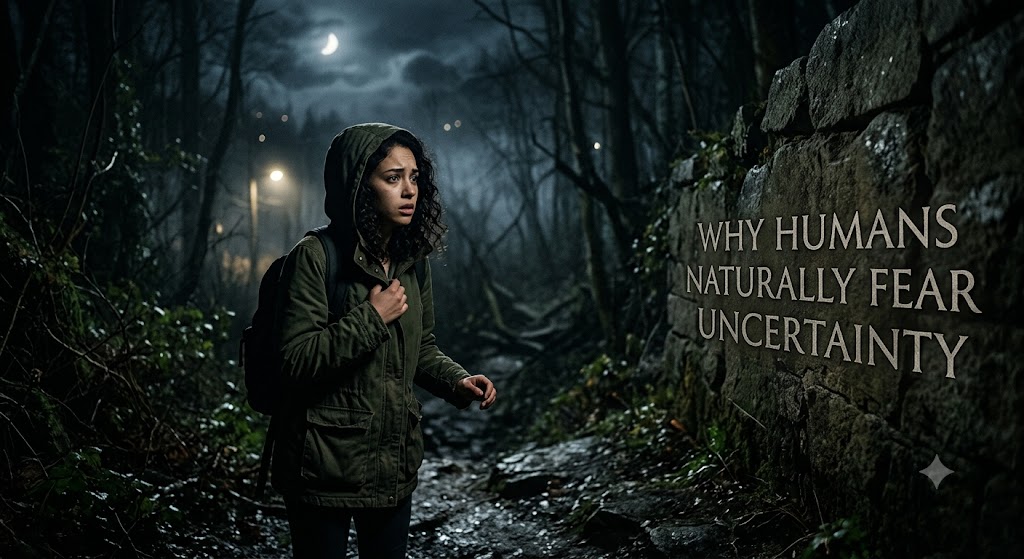
Why do humans naturally fear uncertainty? Why can an unknown future make us anxious even when nothing bad has actually happened? Why can waiting for an answer sometimes feel more stressful than receiving bad news? And why do people often choose familiar situations they dislike rather than stepping into situations they cannot predict?
The fear of uncertainty is one of the most deeply rooted aspects of human behaviour. From worrying about tomorrow to feeling nervous before a job interview, relationship conversation, medical appointment, financial decision or major life change, uncertainty can trigger powerful emotional reactions. We may not know exactly what we are afraid of, yet the feeling can still be overwhelming. The problem is often not the event itself but the fact that we cannot predict what will happen next.
Human beings naturally prefer some level of predictability. Our brains constantly collect information, recognise patterns and use past experiences to anticipate what might happen in the future. This ability has helped humans survive, make decisions and navigate complicated environments. However, the same mental system that helps us prepare for danger can also make uncertainty uncomfortable. When the brain does not have enough information to predict an outcome, it may respond by becoming more alert, cautious and anxious.
This explains why uncertainty can feel threatening even when there is no immediate danger. Imagine receiving a message from someone you care about that simply says, “We need to talk.” Nothing has actually happened yet. There is no confirmed bad news. There may be a perfectly harmless explanation. Yet many people immediately begin imagining the worst. The mind starts creating possible scenarios because it wants an answer. The uncertainty itself becomes the source of stress.
This reaction is not necessarily a sign of weakness. It is connected to the way the human brain has evolved to deal with potential threats. For much of human history, not knowing what was hiding beyond a particular location could have serious consequences. An unfamiliar sound in the darkness could represent an animal, an enemy or something else that required immediate attention. Being cautious when the outcome was uncertain could increase the chances of survival. Why Humans Naturally Fear Uncertainty
Modern life is very different, but the basic architecture of the human brain has not completely changed. Today, uncertainty might involve an email from your employer, an unexpected financial expense, a relationship problem, an upcoming examination, a business decision or uncertainty about the future. There may be no physical threat, but the brain can still interpret unpredictability as something that requires attention.
One of the reasons humans fear uncertainty is because uncertainty removes our sense of control. People generally feel more comfortable when they believe they understand what is happening and have some influence over the outcome. Even when a situation is difficult, knowing what to expect can make it easier to manage. When the outcome is unknown, however, that sense of control becomes weaker.
Consider the difference between knowing that you will face a difficult task tomorrow and having no idea what tomorrow will bring. The difficult task may be unpleasant, but at least you can prepare for it. Uncertainty makes preparation more complicated because there is no clear target. The mind has to consider multiple possibilities, and that can quickly become exhausting.
This is why people sometimes prefer certainty over happiness. Someone may remain in an unhappy job because they know how much they earn every month. Someone may remain in an unhealthy relationship because leaving would create an uncertain future. Someone may refuse to start a business because failure is possible. Someone may avoid learning a new skill because they are afraid of discovering that they are not immediately good at it.
In each case, the familiar situation provides something uncertainty cannot provide: predictability.
The familiar may not be pleasant, but it is known. The unknown may offer something much better, but the possibility of failure makes it frightening. This is one reason people often say they want change while simultaneously resisting the actions required to create it.
Why Humans Naturally Fear Uncertainty
Fear of uncertainty can also explain why humans tend to imagine negative outcomes. When information is incomplete, the mind often attempts to fill the gaps. Unfortunately, anxious thinking can fill those gaps with frightening possibilities. A delayed response becomes rejection. A business challenge becomes failure. A small physical sensation becomes a serious problem. A difficult conversation becomes the end of a relationship.
The brain is attempting to prepare for possibilities, but excessive anticipation can turn preparation into worry.
There is an important difference between preparing for uncertainty and obsessing over it. Preparation asks, “What can I reasonably do if this happens?” Anxiety often asks, “What if everything goes wrong?” Preparation has an endpoint. Once you have taken the necessary steps, there is something you can do. Worry can continue indefinitely because there is always another possible scenario to consider.
This is why uncertainty can consume so much mental energy. The human mind is extremely good at generating possibilities. If you give it an unanswered question, it can produce hundreds of possible answers. The problem is that not all possibilities deserve equal attention. Why Humans Naturally Fear Uncertainty
Another reason humans naturally fear uncertainty is that uncertainty can create a feeling of vulnerability. When you know what is happening, you can make plans. When you do not know what is happening, you may feel exposed. This vulnerability can be particularly powerful when the situation involves something important to your identity, security, relationships or future.
A person waiting to hear whether they got a job may feel vulnerable because the decision is outside their control. A student waiting for examination results may feel vulnerable because years of effort have been reduced to an outcome they cannot yet see. A business owner facing an unpredictable market may feel vulnerable because their income depends on factors they cannot completely control.
In situations like these, the emotional discomfort comes partly from having to wait.
Waiting is difficult because humans generally prefer action. When something goes wrong, we often want to fix it immediately. When we are worried, we want information immediately. When we ask a question, we want an answer immediately. But many important aspects of life cannot be resolved instantly.
Sometimes all we can do is wait.
And waiting forces us to confront one of the realities of being human: we cannot control everything.
This can be difficult for people who are accustomed to planning. Planning is useful, but it can also create the illusion that life can be completely controlled if we simply think hard enough. In reality, even the most carefully planned life contains unpredictable events. People change. Opportunities appear unexpectedly. Businesses succeed or fail for reasons nobody anticipated. Relationships evolve. Economies fluctuate. Circumstances change.
Uncertainty is not an error in life. It is part of life.
Yet modern society can sometimes make uncertainty even more uncomfortable. Technology has made information available almost instantly. We can check messages, track deliveries, monitor bank accounts, search for answers and receive updates within seconds. This convenience can create an expectation that we should always know what is happening.
When information is unavailable, the absence of answers can feel abnormal.
A person may repeatedly check their phone because someone has not replied. Someone may refresh a website waiting for an update. A business owner may constantly check sales figures. A person may search endlessly for information about a decision because they believe one more piece of information will finally eliminate all uncertainty.
But there is a point where more information does not create more certainty. It simply creates more things to think about.
This is particularly relevant in the age of social media. People constantly see other people’s achievements, relationships, lifestyles and plans. They may see someone announcing a new business, buying a house, getting married, travelling or achieving a career milestone. Meanwhile, their own future may feel unclear.
Comparison can make uncertainty feel like failure.
Someone may think, “Everyone else seems to know where they are going. Why don’t I?” But social media usually shows selected outcomes rather than the uncertainty behind them. The person celebrating today may have spent years wondering whether their efforts would work. The person who appears confident may have experienced enormous doubt privately.
Uncertainty is therefore not evidence that you are behind in life. Sometimes it is simply evidence that you are living through a period where the outcome has not yet become clear.
This is especially important during major transitions. Leaving school, starting a career, changing jobs, getting married, becoming a parent, moving to another place, starting a business or ending a relationship can all create uncertainty. These moments often involve entering territory where previous experience is no longer enough to guarantee what will happen.
That can be frightening.
It can also be where tremendous personal growth happens.
If humans always avoided uncertainty, nobody would start anything new. Every business would remain an idea. Every invention would remain undiscovered. Every journey would remain unmade. Every new relationship would be avoided because the outcome could not be guaranteed.
Progress requires a willingness to move without having complete certainty.
This does not mean people should ignore risks or make reckless decisions. Fear can sometimes provide useful information. If something is genuinely dangerous, uncertainty may be a reason to slow down, gather information and consider the consequences carefully. The goal is not to eliminate fear completely. The goal is to understand when fear is protecting you and when fear is preventing you from living.
One of the healthiest ways to deal with uncertainty is to focus on what you can control.
You may not control whether someone accepts your application, but you can control how well you prepare. You may not control whether a business succeeds, but you can control your research, discipline and response to setbacks. You may not control what another person thinks, but you can control how honestly and respectfully you communicate. Why Humans Naturally Fear Uncertainty
This shift is powerful because it moves attention away from an unknowable future and towards actions that are available in the present.
Another useful approach is learning to distinguish possibility from probability. Just because something could happen does not mean it is likely to happen. The anxious mind often treats every possibility as if it deserves equal attention. But reality does not work that way.
Your mind might tell you that a particular decision could lead to disaster. That may technically be possible. But there may also be dozens of more ordinary outcomes that are far more likely.
Learning to question catastrophic predictions can therefore reduce the emotional power of uncertainty.
It is also helpful to accept that some questions do not have immediate answers. Sometimes the healthiest response to uncertainty is simply, “I don’t know yet.”
Those three words can be surprisingly difficult to accept.
People often believe they need to know exactly what comes next before they can feel calm. But confidence does not always come from knowing the future. Sometimes it comes from trusting yourself to handle whatever the future brings.
This is a major psychological shift.
Instead of saying, “I will be okay only if everything goes according to plan,” a person can gradually learn to think, “I may not know what will happen, but I can respond when I know more.”
That mindset does not remove uncertainty. It changes your relationship with it.
The difference is significant. When you believe you must predict everything, uncertainty becomes an enemy. When you believe you can adapt, uncertainty becomes a condition you can live with.
Adaptability is one of the most valuable abilities a person can develop because life rarely follows a perfect plan. Sometimes the opportunity you wanted disappears and another one appears. Sometimes rejection redirects you somewhere better. Sometimes a failed plan reveals a better strategy. Sometimes the thing you feared turns out to be manageable.
You cannot know all of this in advance.
That is the frustrating part.
But it is also what makes life capable of surprising us.
Not all uncertainty produces negative outcomes. Some of the best moments in life begin with not knowing what will happen. Meeting a new person, discovering a new passion, starting a creative project, travelling somewhere unfamiliar or taking a chance on an opportunity all involve uncertainty.
The unknown can contain danger, but it can also contain possibility.
The challenge is that the human brain may notice the danger more quickly than the possibility. That is why developing emotional resilience matters. Resilience does not mean never feeling afraid. It means being able to feel fear without allowing fear to make every decision.
You can be uncertain and still move forward.
You can be nervous and still apply for the job.
You can be afraid of failure and still build the business.
You can be unsure about the future and still take the next step.
You can care deeply about an outcome without demanding a guarantee.
This is one of the most important lessons about uncertainty: certainty is not a requirement for action.
Many people postpone their lives while waiting to feel completely confident. They tell themselves they will start when they have more money, more knowledge, more connections, more time or more certainty. But complete certainty rarely arrives.
Eventually, you have to make decisions with incomplete information.
That is not a flaw in the human experience. It is the human experience.
Even successful people operate under uncertainty. Entrepreneurs cannot guarantee that customers will buy. Investors cannot guarantee market performance. Employees cannot guarantee job security. Couples cannot guarantee that every year of a relationship will be easy. Parents cannot guarantee what their children will become.
Yet people continue to build, love, create, invest, learn and dream.
They do so because life would be extremely limited if certainty were a prerequisite for participation.
Perhaps the goal, therefore, should not be to eliminate uncertainty but to become more comfortable navigating it.
Instead of constantly asking, “How can I make sure this will work?” ask, “What can I do to give this the best chance of working?”
Instead of asking, “What if everything goes wrong?” ask, “If something goes wrong, what could I do next?”
Instead of demanding certainty before taking a step, ask whether you have enough information to take the next reasonable step.
These questions create movement.
Fear wants guarantees. Growth often requires courage without guarantees.
Understanding why humans naturally fear uncertainty can also make us more compassionate towards ourselves and others. Someone who appears indecisive may actually be overwhelmed by the possibility of making the wrong choice. Someone who constantly seeks reassurance may be struggling with the discomfort of not knowing. Someone who refuses to change may not necessarily be lazy or stubborn. They may simply feel safer with the familiar.
Recognising this does not mean excusing every unhealthy behaviour. It simply helps us understand the emotional forces behind human decisions.
Ultimately, uncertainty is not something humans can completely escape. No matter how much money we have, how carefully we plan or how much information we gather, there will always be things we cannot predict.
Tomorrow will always contain something we do not know today.
That can be frightening.
But it can also be freeing.
If you accept that uncertainty is unavoidable, you no longer have to spend your entire life trying to eliminate it. You can prepare where preparation is useful, make informed decisions where information is available, accept what remains outside your control and continue moving forward.
The future does not need to be completely predictable for your life to have meaning.
You do not need to know exactly where every road leads before taking the next step.
Sometimes courage is not the absence of uncertainty. Sometimes courage is simply deciding that not knowing what comes next will not stop you from moving.
Humans naturally fear uncertainty because the unknown challenges our desire for safety, control and predictability. Our minds want answers because answers make the world feel easier to navigate. But uncertainty is also where possibility lives. Every new opportunity carries some unknown. Every meaningful change requires some risk. Every new chapter begins before we know how the story will end.
The healthiest response is therefore not to demand certainty from life but to build confidence in our ability to handle uncertainty.
You may not know what tomorrow will bring.
Nobody does.
But you can decide what kind of person you want to be when tomorrow arrives.

EarnSmartOnline.com.ng is dedicated to helping readers make smarter financial decisions through practical guides on online income, personal finance, technology, digital business, and wealth creation. Our goal is to provide reliable, easy-to-understand, and actionable content that empowers individuals to earn smarter, build sustainable income streams and achieve long-term financial success.
Recommended: Start Earning Online
- Ultimate Affiliate Marketing Program — learn affiliate marketing with a done-for-you sales system ($15). Check it out
- The Newbie Affiliate Guide — the beginner-friendly starter guide (~$6.68). Check it out
- Easy Dollar Maker — earn in dollars uploading AI images and videos from your phone ($17). Check it out
Disclosure: These are affiliate links. If you buy through them, I may earn a commission at no extra cost to you.



