
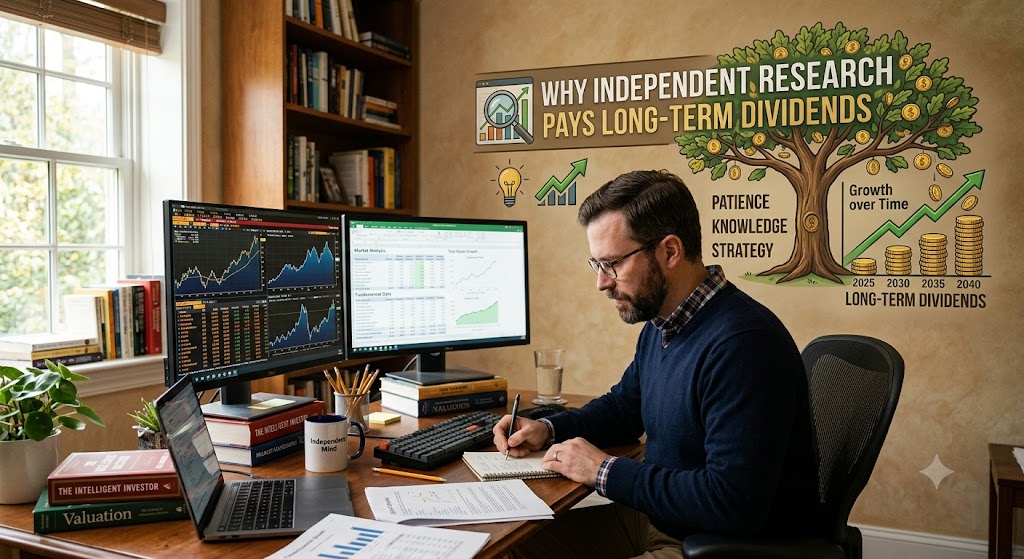
Why Independent Research Pays Long-Term Dividends
Every day, people make decisions that shape their future. Some decisions are small and disappear without leaving any noticeable mark. Others quietly influence careers, finances, relationships, businesses, and personal growth for years. One of the greatest differences between people who consistently make good decisions and those who repeatedly regret their choices is not intelligence, education, or even experience. It is the habit of independent research.
Independent research is the willingness to investigate facts before accepting opinions. It is the discipline of asking questions instead of assuming. It is the ability to look beyond headlines, social media trends, advertisements, influencers, and popular beliefs to discover what is actually true. In a world where information spreads faster than ever before, independent research has become one of the most valuable skills anyone can develop.
Many people believe research belongs only in universities, laboratories, or scientific institutions. They imagine professors surrounded by books, scientists wearing white coats, or students writing lengthy dissertations. While those are forms of research, independent research is much broader than that. It is something ordinary people can practise every single day.
Whenever you compare products before buying one, you are doing research. Whenever you verify a news story before sharing it, you are researching. Whenever you study a business opportunity before investing your money, you are researching. Whenever you learn about a health condition before choosing a treatment, you are researching. These simple habits may not seem significant today, but over many years they create enormous advantages.
One of the greatest long-term rewards of independent research is better decision-making. Every major decision carries consequences. The wrong investment can wipe out years of savings. The wrong business partner can destroy a company. The wrong career choice can leave someone frustrated for decades. The wrong information can waste countless hours and resources. Independent research reduces these risks because it replaces assumptions with evidence.
People who rely entirely on other people’s opinions often inherit other people’s mistakes. Someone may recommend a business simply because it worked for them, without considering your different circumstances. A friend may discourage an opportunity because they failed at it, even though they approached it incorrectly. Another person may praise an investment because they entered early, while newcomers may face completely different conditions. Independent research helps you separate personal experiences from universal truths.
The internet has made knowledge more accessible than at any other point in history. Within minutes, anyone can learn about history, finance, science, technology, health, psychology, marketing, or virtually any other topic. Yet the same internet also spreads misinformation, rumours, manipulated content, and biased opinions. This means access to information alone is no longer enough. The real advantage belongs to those who know how to evaluate information critically.
Independent researchers rarely accept the first answer they find. Instead, they compare multiple sources. They look for patterns. They identify contradictions. They consider who produced the information and why. They examine evidence instead of emotional claims. This careful approach leads to more reliable conclusions over time.
Financial success often rewards those who research independently. Countless people lose money because they follow hype instead of facts. They invest because everyone else seems excited. They buy businesses they barely understand. They purchase expensive courses promising instant wealth without checking whether previous students actually achieved meaningful results. They trust strangers simply because they sound confident.
Independent researchers approach money differently. Before investing, they study the market. Before buying a business, they examine its financial records. Before purchasing equipment, they compare alternatives. Before entering partnerships, they investigate the reputation and history of those involved. These habits may require extra time, but they often prevent expensive mistakes that would take years to recover from.
Long-term investors understand this principle well. They rarely buy assets based on excitement alone. They study company performance, market trends, industry developments, competition, management quality, and long-term potential. While nobody predicts the future perfectly, careful research significantly improves the odds of making profitable decisions.
Business owners also benefit enormously from independent research. Every successful business exists because it solves a problem. Understanding those problems requires listening to customers rather than making assumptions. Entrepreneurs who research their markets discover what customers actually need instead of what they personally think customers want.
Many businesses fail because their owners fall in love with ideas instead of facts. They create products nobody requested. They set prices customers cannot afford. They ignore competitors who already dominate the market. They spend heavily on advertising before confirming demand. Independent research helps avoid these costly errors by providing evidence before significant resources are committed.
Technology changes rapidly, making research even more valuable. Software, artificial intelligence, digital marketing, cybersecurity, and online platforms evolve constantly. Someone who stops learning quickly falls behind. Independent researchers adapt because they continuously update their knowledge. They understand that yesterday’s best practice may already be outdated today.
Career growth also depends heavily on research. Many professionals limit themselves by relying solely on what employers teach them. Meanwhile, others independently explore new tools, emerging trends, industry reports, certifications, and advanced skills. Over several years, this difference becomes enormous. Independent learners often become the experts others seek for guidance.
Employers increasingly value people who solve problems independently. Employees who constantly wait for instructions become replaceable. Those who investigate challenges, discover solutions, and present informed recommendations become valuable assets. Independent research builds exactly this kind of thinking.
Education extends far beyond classrooms. Formal education provides structure, but self-directed learning never truly ends. Many of history’s most influential innovators spent countless hours researching beyond their official education. They read widely, experimented constantly, questioned accepted ideas, and remained curious throughout their lives.
Curiosity is the fuel that powers independent research. Curious people naturally ask why things work the way they do. They are not satisfied with surface-level explanations. They enjoy understanding processes rather than memorising conclusions. This mindset opens doors to discoveries that others completely overlook.
Independent research also strengthens confidence. Confidence based on popularity is fragile because it depends on other people’s approval. Confidence built on knowledge is far more stable because it rests on understanding. Someone who has thoroughly researched a topic can explain their reasoning, defend their conclusions, and adjust their views when presented with stronger evidence.
This flexibility is another hidden advantage. Independent researchers are usually more willing to change their minds because they care more about discovering truth than protecting their ego. They recognise that learning often requires admitting previous mistakes. Ironically, this willingness to change makes their thinking stronger over time.
Health decisions illustrate the importance of independent research perfectly. Every year, countless people follow health advice they discovered through viral posts, celebrities, or sensational headlines. Some advice proves useful, while other recommendations are ineffective or even dangerous. Independent research encourages people to examine credible medical sources, consult qualified professionals, and understand the evidence before making important health choices.
The same principle applies to parenting. Every family receives endless advice about raising children. Relatives, neighbours, influencers, books, and online communities all offer conflicting opinions. Parents who research independently can better distinguish evidence-based guidance from personal preference or outdated traditions.
Relationships also benefit from thoughtful research. Understanding communication, emotional intelligence, conflict resolution, and human psychology helps people build stronger connections. Reading books, studying relationship experts, examining scientific findings, and reflecting on personal experiences all contribute to healthier relationships over time.
Independent research improves problem-solving because it exposes people to multiple perspectives. Instead of viewing every challenge through a single lens, researchers explore alternative explanations and solutions. This broader understanding increases creativity and leads to better outcomes in both personal and professional situations.
History repeatedly demonstrates the value of questioning accepted beliefs. Many breakthroughs occurred because someone refused to accept conventional wisdom without investigation. Scientific discoveries, technological innovations, medical advancements, and business revolutions often began with individuals asking questions others ignored.
This does not mean rejecting expert knowledge. True independent research respects expertise while recognising that experts also rely on evidence. Independent researchers listen carefully to qualified professionals but still seek to understand the reasoning behind conclusions rather than accepting claims blindly.
Blind acceptance creates vulnerability. Unscrupulous individuals exploit people who never verify information. Fraudsters promise unrealistic investment returns. Scammers create convincing stories. Manipulative marketers exaggerate benefits while hiding limitations. Independent research serves as a powerful defence against deception.
One remarkable benefit of consistent research is compound knowledge. Just as compound interest allows money to grow exponentially over time, knowledge compounds as well. Every new concept connects with previous understanding, making future learning faster and more meaningful.
Someone who researches economics understands business more deeply. Business knowledge improves investing decisions. Investing experience enhances financial planning. Financial knowledge supports entrepreneurship. Entrepreneurship develops leadership. Leadership strengthens communication. These interconnected skills reinforce one another throughout life.
Reading widely plays a central role in independent research. Books provide depth that short articles and social media posts rarely achieve. While quick content offers convenience, books often explain ideas more thoroughly, present historical context, and examine complex issues from multiple angles.
However, modern researchers benefit from combining traditional and digital resources. Academic journals, industry reports, podcasts, interviews, documentaries, official statistics, professional organisations, and reputable online publications all contribute valuable insights. The goal is not to depend exclusively on one source but to gather information from diverse perspectives.
Keeping notes dramatically increases the value of research. Human memory fades surprisingly quickly. Recording important insights, useful quotations, interesting statistics, personal observations, and practical applications transforms temporary learning into long-term knowledge. Many successful people maintain journals or digital note systems precisely because organised information becomes increasingly valuable over time.
Independent research also develops patience. Modern culture celebrates speed. People expect immediate answers, instant success, and overnight results. Research teaches a different lesson. Valuable understanding often requires time. Reading multiple sources, comparing evidence, testing ideas, and reflecting carefully cannot always be rushed. This patience produces stronger conclusions.
Another long-term dividend is improved communication. People who research thoroughly explain ideas more clearly because they genuinely understand them. Instead of repeating memorised phrases, they can answer questions, provide examples, and adapt explanations for different audiences. This ability proves valuable in leadership, teaching, sales, consulting, and everyday conversations.
Research also reduces unnecessary fear. Many fears grow from uncertainty rather than reality. Learning about financial markets reduces investment anxiety. Understanding health conditions eases unnecessary panic. Studying technology removes fear of innovation. Knowledge rarely eliminates all uncertainty, but it replaces imaginary threats with realistic understanding.
Decision fatigue becomes easier to manage when supported by research. Instead of repeatedly questioning every choice, informed people develop reliable frameworks for evaluating opportunities. They know which questions to ask, which evidence matters most, and which warning signs deserve attention. This structured thinking simplifies future decisions.
One fascinating aspect of independent research is that it encourages lifelong humility. The more someone learns, the more they recognise how much remains unknown. This awareness prevents overconfidence while maintaining curiosity. Rather than pretending to know everything, effective researchers continue asking better questions.
Businesses increasingly rely on data-driven decision-making for exactly this reason. Companies that carefully analyse customer behaviour, sales trends, operational efficiency, and market conditions generally outperform those relying purely on intuition. Individuals can apply the same principle in their own lives by gathering relevant information before making important decisions.
Independent research is particularly valuable during periods of uncertainty. Economic downturns, technological disruption, changing regulations, and shifting consumer behaviour create confusion. Those who investigate carefully often identify opportunities hidden within uncertainty while others react emotionally.
Students who cultivate research habits gain advantages extending far beyond examinations. Memorising information may produce good grades, but researching independently develops analytical thinking. Employers consistently value people who analyse problems, evaluate evidence, and propose practical solutions.
Content creators, bloggers, and writers also benefit tremendously from research. Original, accurate, and well-supported content earns greater trust than recycled opinions. Readers increasingly recognise thoughtful work backed by careful investigation. Over time, credibility becomes one of the most valuable assets any creator can build.
Independent research strengthens critical thinking by encouraging scepticism without becoming cynical. Healthy scepticism asks for evidence while remaining open to convincing arguments. Cynicism rejects everything automatically. The difference matters because productive research seeks understanding rather than constant disagreement.
Social media algorithms often reinforce existing beliefs by showing users content similar to what they already consume. Independent researchers intentionally seek alternative viewpoints to avoid living inside informational echo chambers. Understanding opposing perspectives improves reasoning even when disagreements remain.
Time invested in research rarely produces immediate excitement. The rewards appear gradually. Better decisions accumulate. Fewer mistakes occur. Opportunities become easier to recognise. Confidence increases. Skills expand. Networks improve. Financial choices strengthen. Professional credibility grows. These small improvements compound year after year until the difference becomes extraordinary.
Many successful entrepreneurs credit their achievements not to secret formulas but to relentless learning. They study customers, competitors, industries, psychology, negotiation, leadership, technology, and marketing continuously. Their businesses improve because their understanding never stops expanding.
Independent research also protects personal independence. People who depend entirely on others for information become vulnerable to manipulation. Those who verify facts themselves maintain greater control over their decisions, beliefs, and future. This intellectual independence becomes increasingly valuable in an age overflowing with competing narratives.
Young people especially benefit from developing research habits early. A teenager who learns how to evaluate information carefully enters adulthood with a significant advantage. They are less likely to fall for scams, misinformation, unrealistic promises, or harmful trends. Instead, they build decisions upon evidence and thoughtful analysis.
Parents and teachers can encourage this mindset by rewarding questions rather than merely rewarding correct answers. Curiosity deserves encouragement because today’s curious child may become tomorrow’s innovator, entrepreneur, scientist, leader, or problem solver.
Research also reveals unexpected opportunities. Someone exploring one subject often discovers related fields they never previously considered. A person researching digital marketing may become interested in psychology. Someone studying programming may discover cybersecurity. Another researching agriculture may identify profitable business opportunities. Knowledge frequently opens doors beyond its original purpose.
Failure becomes more valuable when combined with research. Instead of viewing mistakes as permanent defeats, researchers analyse what happened, identify contributing factors, and adjust future strategies. Every setback becomes another source of information rather than merely a disappointment.
Independent research encourages ownership of personal growth. Instead of waiting for schools, employers, governments, or mentors to provide every answer, individuals take responsibility for their own education. This proactive attitude consistently produces better long-term outcomes than passive dependence.
As artificial intelligence continues transforming industries, the ability to research independently becomes even more essential. AI can summarise information rapidly, but people still need critical thinking to evaluate accuracy, identify bias, interpret context, and apply knowledge wisely. Technology enhances research, but thoughtful human judgement remains indispensable.
The most successful people rarely stop asking questions. They remain students regardless of age, wealth, or experience. Every accomplishment simply becomes the starting point for learning something new. This endless curiosity creates continuous improvement throughout life.
Independent research is not about proving yourself right. It is about discovering what is right. Sometimes the evidence confirms existing beliefs. Sometimes it completely changes them. Either outcome represents progress because truth matters more than pride.
Looking back after ten or twenty years, the benefits become unmistakable. Better financial decisions preserve wealth. Better career choices create greater opportunities. Better health knowledge improves quality of life. Better business understanding increases profitability. Better relationships enrich daily living. Better critical thinking protects against manipulation. None of these advantages appear overnight, yet together they create an extraordinary foundation for lasting success.
The world rewards those who think independently, learn continuously, and verify information carefully. While others rush to follow trends, independent researchers quietly build wisdom. While others react emotionally, they respond thoughtfully. While others chase shortcuts, they invest in understanding. Those investments rarely produce instant applause, but they generate returns that continue paying dividends for decades.
Independent research is ultimately an investment in yourself. Unlike possessions that wear out or trends that disappear, knowledge grows stronger each time it is used. Skills sharpen with practice. Understanding deepens through experience. Wisdom develops through reflection. Every hour spent investigating, learning, questioning, and thinking critically becomes part of an intellectual asset that nobody can steal. That is why independent research is not simply an academic exercise. It is one of the most profitable lifelong habits anyone can cultivate, and its dividends continue multiplying long after the original effort has been forgotten.

EarnSmartOnline.com.ng is dedicated to helping readers make smarter financial decisions through practical guides on online income, personal finance, technology, digital business, and wealth creation. Our goal is to provide reliable, easy-to-understand, and actionable content that empowers individuals to earn smarter, build sustainable income streams and achieve long-term financial success.
Recommended: Start Earning Online
- Ultimate Affiliate Marketing Program — learn affiliate marketing with a done-for-you sales system ($15). Check it out
- The Newbie Affiliate Guide — the beginner-friendly starter guide (~$6.68). Check it out
- Easy Dollar Maker — earn in dollars uploading AI images and videos from your phone ($17). Check it out
Disclosure: These are affiliate links. If you buy through them, I may earn a commission at no extra cost to you.



