
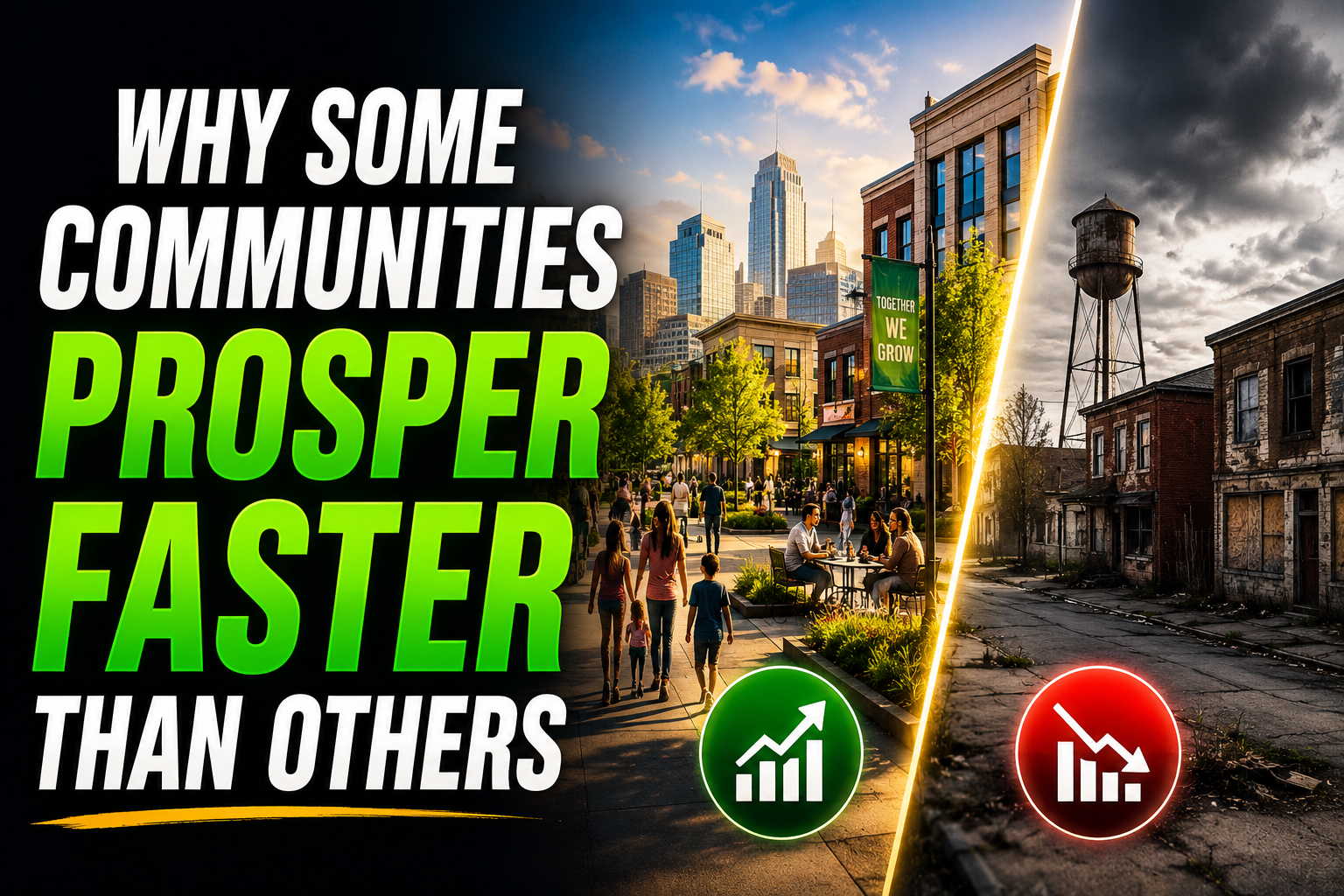
Why Some Communities Prosper Faster Than Others
Prosperity rarely spreads evenly across societies, even when people have access to similar resources, technology, or opportunities. In many cases, two communities may exist within the same country, under the same laws, and even with comparable levels of education, yet one progresses rapidly while the other struggles for decades. The difference is not always obvious at first glance because it is not only about money, infrastructure, or government support. It is deeply tied to behavior patterns, shared beliefs, and the invisible systems that shape how people think and act together over time.
One of the most important factors behind faster-growing communities is the strength of trust within them. Where trust is high, transactions happen faster, cooperation is easier, and people are more willing to take collective risks. In such environments, individuals do not spend excessive energy protecting themselves from being cheated or exploited. Instead, they can focus their attention on building, creating, and expanding value. When trust is low, however, every interaction becomes cautious and defensive. People demand excessive guarantees, avoid partnerships, and often miss opportunities simply because they cannot rely on one another. Over time, this slows down every aspect of development.
Closely connected to trust is the presence of shared norms that encourage responsibility and discourage destructive behavior. In fast-growing communities, there is often an unspoken agreement about what is acceptable and what is not. People are expected to honor commitments, repay debts, and respect shared spaces. Even without strict enforcement, social pressure ensures that individuals behave in ways that support collective progress. In slower-developing communities, these norms are often weaker or inconsistent, which leads to repeated breakdowns in cooperation and increased friction in everyday life. When reliability is not consistent, economic activity becomes unpredictable, and unpredictability discourages investment and long-term planning.
Another powerful driver of community prosperity is the level of value placed on productivity and skill development. Communities that grow quickly tend to reward competence, problem-solving, and initiative. People are encouraged to learn practical skills that directly improve their ability to contribute to the economy. There is a strong link between effort and reward, which motivates individuals to continuously improve themselves. In contrast, communities that grow slowly often fail to clearly connect skill with reward. Sometimes social status, connections, or short-term gains matter more than actual productivity. This creates a situation where effort does not always translate into progress, which reduces motivation for long-term development.
Education also plays a different role depending on how it is valued and applied. In prosperous communities, education is not limited to formal schooling. It extends to practical knowledge, financial literacy, and continuous learning. People are constantly exposed to ideas that help them understand systems, manage resources, and make better decisions. In slower-growing communities, education may exist in structure but lack depth in application. People may acquire certificates without gaining real-world problem-solving skills. As a result, they struggle to convert knowledge into meaningful outcomes, which slows down both personal and collective progress.
Access to information and openness to new ideas also influence how quickly a community develops. Fast-growing communities tend to be more open to innovation and external influence. They are willing to adopt new technologies, experiment with new systems, and adapt quickly to change. This flexibility allows them to respond to global shifts more effectively. Communities that resist change or view new ideas with suspicion often fall behind. When innovation is discouraged or slow to be accepted, progress becomes limited to traditional methods, which may no longer be effective in a changing world.
Another key factor is the quality of leadership and decision-making structures within the community. Leadership does not always refer only to political figures but also includes business leaders, educators, and informal influencers. In prosperous environments, leadership tends to be more accountable and performance-driven. Decisions are often guided by long-term thinking and practical outcomes. In slower communities, leadership may be influenced by short-term interests, personal gain, or lack of accountability. Poor decision-making at the top often creates ripple effects that slow down development at every level of society.
Economic behavior within a community also plays a major role. In faster-growing environments, there is usually a stronger culture of investment rather than pure consumption. People are more likely to reinvest their earnings into businesses, education, or assets that generate future returns. Even small levels of savings are often directed toward productive use. In contrast, communities that grow slowly tend to focus more on immediate consumption. Money is often spent quickly on liabilities or short-term comfort rather than long-term growth. Over time, this difference in financial behavior creates a widening gap in wealth accumulation and economic stability.
Another often overlooked factor is the strength of collaboration networks. Prosperous communities tend to have strong informal and formal networks where individuals support each other’s growth. Business partnerships, mentorship relationships, and cooperative groups emerge naturally because people understand the value of working together. These networks reduce the cost of doing business and increase access to opportunities. In weaker communities, individuals often operate in isolation, which makes growth slower and more difficult. Without networks, people must rely solely on personal effort, which limits scalability and impact.
Cultural attitudes toward failure also shape how quickly communities progress. In fast-growing environments, failure is often treated as part of the learning process. People are encouraged to take risks, experiment, and try again after setbacks. This creates a dynamic environment where innovation can thrive. In slower-growing communities, failure is often stigmatized, which discourages risk-taking. People become more conservative in their decisions and avoid opportunities that carry uncertainty. While this may reduce short-term mistakes, it also significantly limits long-term growth and innovation.
Demographics and population structure also contribute to differences in development speed. Communities with a younger, more active population often experience faster growth because there is more energy, adaptability, and willingness to embrace change. Younger populations are generally more open to technology and entrepreneurship, which drives innovation. However, this advantage only becomes effective when combined with opportunity and proper systems. Without structure, even a young population may struggle to convert potential into progress.
Infrastructure and resource distribution matter as well, but they are not always the deciding factor. Many communities with limited resources still grow rapidly because they optimize what they have through efficiency, innovation, and strong cooperation. On the other hand, some resource-rich communities grow slowly because of mismanagement, dependency, or lack of coordination. This shows that resources alone do not guarantee prosperity. The ability to organize and utilize those resources effectively is often more important than their quantity.
Time orientation is another subtle but powerful difference. Communities that grow faster tend to think long term. People make decisions based on future outcomes rather than immediate gratification. This influences everything from education to business investment to personal habits. In slower-growing environments, short-term thinking dominates. Immediate needs and desires often take priority over long-term planning, which limits sustained development. Over time, this difference in mindset creates significantly different economic trajectories.
Finally, adaptability is one of the strongest predictors of how fast a community can prosper. The world is constantly changing due to technology, globalization, and shifting economic conditions. Communities that can quickly adjust their behaviors, systems, and expectations tend to stay ahead. Those that resist adaptation eventually fall behind even if they were once successful. Adaptability ensures that progress continues even when external conditions change.
In the end, the difference between fast-growing and slow-growing communities is not determined by a single factor. It is the result of many interconnected elements including trust, education, leadership, cultural values, financial behavior, adaptability, and social structure. When these elements align in a positive direction, growth accelerates naturally and sustainably. When they are misaligned, progress becomes slow and inconsistent regardless of external support or resources. Understanding these hidden dynamics is essential for anyone who wants to improve not just individual success, but the development of entire societies.

EarnSmartOnline.com.ng is dedicated to helping readers make smarter financial decisions through practical guides on online income, personal finance, technology, digital business, and wealth creation. Our goal is to provide reliable, easy-to-understand, and actionable content that empowers individuals to earn smarter, build sustainable income streams and achieve long-term financial success.
Recommended: Start Earning Online
- Ultimate Affiliate Marketing Program — learn affiliate marketing with a done-for-you sales system ($15). Check it out
- The Newbie Affiliate Guide — the beginner-friendly starter guide (~$6.68). Check it out
- Easy Dollar Maker — earn in dollars uploading AI images and videos from your phone ($17). Check it out
Disclosure: These are affiliate links. If you buy through them, I may earn a commission at no extra cost to you.



