
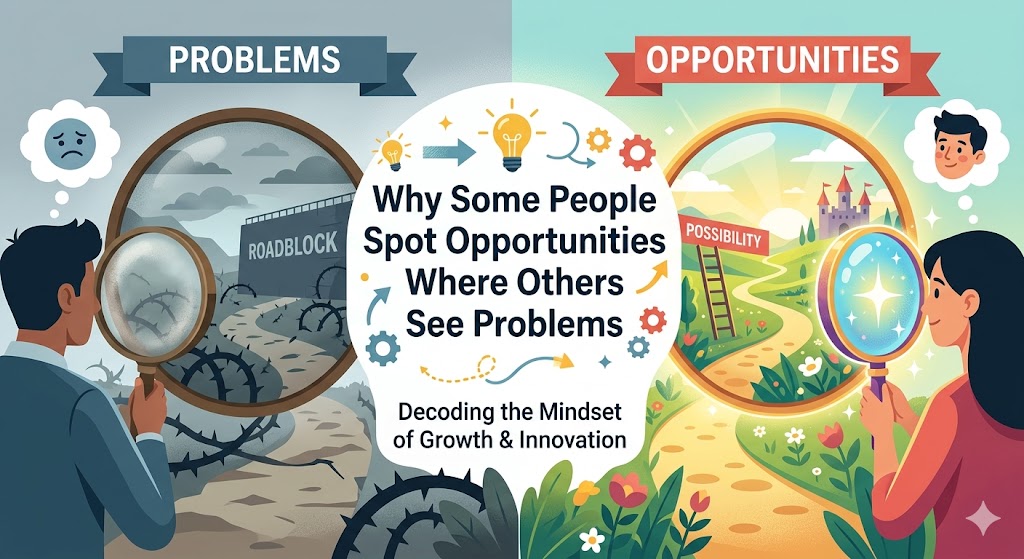
Why Some People Spot Opportunities Where Others See Problems
There is a strange difference in how people experience the same situation. One person walks into a broken system, a struggling business, or a chaotic environment and immediately feels discouraged. They see inconvenience, failure, or limitation. Another person enters the exact same space and starts noticing openings, gaps, and possibilities. What looks like a problem to one becomes a potential opportunity to the other. This difference is not luck. It is not intelligence alone. It is a combination of mindset, perception, exposure, and the way the brain is trained to interpret reality.
At the core of this difference is perception. Human beings do not see reality as it is. They see reality through filters built from experience, beliefs, education, and environment. If someone has been raised in a setting where problems were always treated as threats, their mind learns to avoid complexity. They begin to associate difficulty with danger. So when they encounter a broken system, their first instinct is withdrawal. But when someone has been conditioned to solve problems, they associate difficulty with potential reward. Their brain begins to ask different questions such as what is missing here, what can be improved, and what can be created from this situation.
Another major factor is exposure. People who consistently spot opportunities are often those who have been exposed to environments where problem solving is rewarded. For example, in business environments, inefficiency is not just a frustration, it is a signal that value can be created. A delayed service, a poor product, or a frustrated customer is not just a complaint, it is evidence that something can be built, fixed, or improved. Over time, individuals in such environments develop a habit of scanning for gaps instead of focusing only on flaws. This habit becomes automatic.
In contrast, many people are trained to consume systems rather than question them. They grow up as users, employees, or passive participants in structures they did not design. In such environments, problems are often discussed but not acted upon. This creates a mental habit of observation without creation. When a problem appears, the natural reaction is frustration rather than curiosity. Over time, this emotional response becomes deeply rooted, and opportunity becomes invisible.
Another important layer is emotional response. Seeing opportunity where others see problems requires emotional control. Many people are emotionally overwhelmed by difficulty. When they encounter uncertainty, they feel stress, confusion, or fear. These emotions block analytical thinking. Opportunity recognition requires calm observation. It requires the ability to sit with discomfort long enough to understand what is happening beneath the surface. People who develop emotional stability are able to look past surface level issues and identify structural patterns underneath.
Curiosity also plays a major role. Curious minds do not accept situations at face value. They dig deeper. When something breaks, they ask why it broke. When a system fails, they ask how it was built in the first place. This type of thinking naturally leads to discovery. Opportunity is often hidden in the details that most people ignore. Curiosity turns ordinary problems into interesting puzzles, and puzzles often contain solutions that can be monetized or improved upon.
There is also the influence of scarcity versus abundance thinking. People who operate from scarcity tend to believe that opportunities are rare. So when they encounter problems, they interpret them as evidence of limitation. They believe resources are too limited to fix or improve the situation. On the other hand, people who operate from abundance see problems as signals of unmet demand. They understand that wherever there is pain, confusion, or inefficiency, there is also potential value waiting to be unlocked. This shift in thinking completely changes how reality is interpreted.
Another key factor is skillset. Opportunity recognition is not only about mindset, it is also about capability. Two people may see the same problem, but only one recognizes what can be done about it because they possess the relevant knowledge or skills. For example, someone with technical skills may see a broken digital system and immediately think of solutions. Someone without those skills may only see confusion. This shows that perception is partly shaped by ability. The more skills a person develops, the more dimensions of opportunity they can recognize.
Experience also plays a critical role. People who have solved problems before are more likely to recognize new ones as opportunities. This is because their brain has a reference library of successful outcomes. They remember that problems can be transformed into results. On the other hand, people with limited experience tend to generalize failure. If they have failed before or seen others fail, they assume similar outcomes will repeat. This limits their willingness to engage with complexity.
Social environment reinforces all of these patterns. If someone is surrounded by people who constantly complain about problems without attempting to solve them, that becomes the dominant mindset. Conversations shape perception. However, if someone is surrounded by builders, innovators, and problem solvers, they begin to internalize a different way of thinking. They start to see challenges as normal and solvable. Environment either trains the mind to avoid problems or to engage with them productively.
It is also important to understand the role of attention. People only notice what they are trained to look for. The brain filters information constantly. If someone is trained to look for danger, they will find danger everywhere. If someone is trained to look for inefficiencies, they will notice gaps everywhere. Opportunity spotting is therefore a trained form of attention. It is not random awareness. It is selective perception developed over time.
Another overlooked factor is ownership thinking. People who see opportunities tend to think as owners rather than users. A user asks how something works. An owner asks how something can be improved or expanded. This shift in thinking changes everything. Owners naturally think in terms of systems, scale, and improvement. Users think in terms of consumption and satisfaction. Opportunity becomes visible when the mind shifts from using systems to imagining how those systems can evolve.
Time perception also influences opportunity recognition. Some people are trapped in immediate thinking. They focus only on short term discomfort or inconvenience. In contrast, opportunity thinkers often evaluate situations over longer time horizons. They ask what this problem could become in the future, or what value could be built from solving it. This long term thinking allows them to see potential that is invisible to short term thinkers.
Finally, belief in personal agency is crucial. People who believe they have the ability to influence outcomes are more likely to see opportunities. They believe their actions matter. This belief encourages experimentation and engagement. People who feel powerless, on the other hand, tend to disengage. They assume problems are fixed and unchangeable, so they never attempt to explore solutions. Without action, opportunity remains invisible.
In the end, the difference between those who see opportunities and those who see problems is not in the external world. It is in the internal framework through which reality is processed. The same situation can produce frustration in one person and inspiration in another. One sees an obstacle, the other sees a doorway. One sees failure, the other sees raw material for creation. The ability to recognize opportunity is not a gift reserved for a few. It is a trained way of thinking that develops through curiosity, exposure, skill building, emotional control, and a shift in mindset from consumption to creation.
When people begin to consciously change how they interpret problems, their entire experience of life begins to shift. Problems stop being dead ends and start becoming entry points. And in that shift, opportunity stops being rare and starts becoming visible everywhere.

EarnSmartOnline.com.ng is dedicated to helping readers make smarter financial decisions through practical guides on online income, personal finance, technology, digital business, and wealth creation. Our goal is to provide reliable, easy-to-understand, and actionable content that empowers individuals to earn smarter, build sustainable income streams and achieve long-term financial success.
Recommended: Start Earning Online
- Ultimate Affiliate Marketing Program — learn affiliate marketing with a done-for-you sales system ($15). Check it out
- The Newbie Affiliate Guide — the beginner-friendly starter guide (~$6.68). Check it out
- Easy Dollar Maker — earn in dollars uploading AI images and videos from your phone ($17). Check it out
Disclosure: These are affiliate links. If you buy through them, I may earn a commission at no extra cost to you.



