
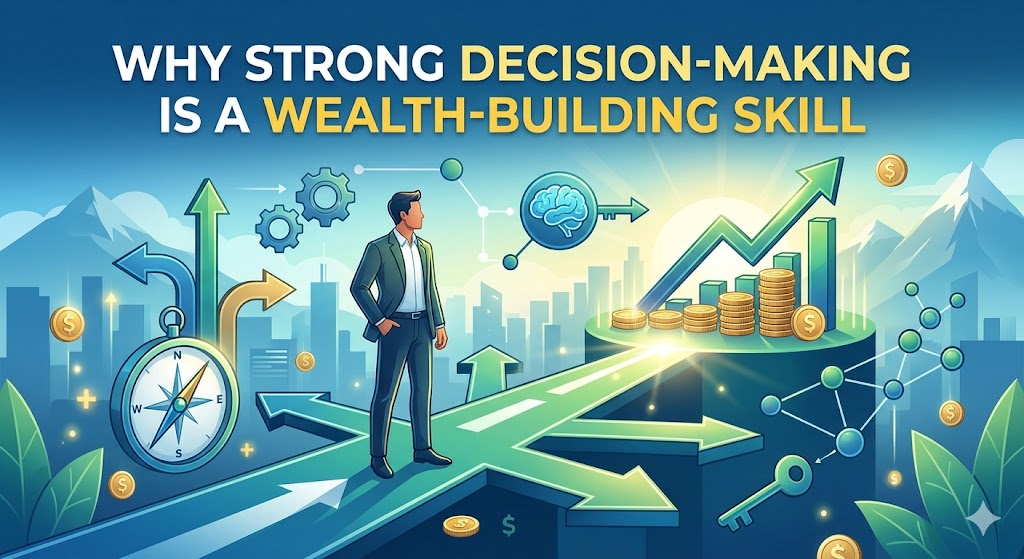
Why Strong Decision-Making Is a Wealth-Building Skill
Most people assume wealth is primarily the result of income, luck, or access to opportunities. While those factors do matter, they are not the foundation. The real foundation is something far less visible and far more powerful: the quality of decisions a person makes repeatedly over time. Wealth is not created in a single moment. It is the cumulative result of thousands of small and large decisions that either compound or cancel each other out. Strong decision making is therefore not just a life skill, it is a wealth building skill that quietly determines who grows financially and who remains stuck.
Every financial outcome you see today is the echo of past decisions. The job someone chose, the habits they formed, the expenses they approved, the risks they avoided or embraced, and even the people they surrounded themselves with all trace back to decision making. Two people can earn the same income and live in the same environment, yet end up in completely different financial realities simply because one makes more deliberate and structured decisions while the other operates on impulse or emotion. This difference compounds quietly until it becomes obvious over time.
Strong decision making begins with clarity. Many people make financial decisions without fully understanding what they are optimizing for. Some optimize for comfort in the short term, others for social approval, and some for immediate pleasure. However, wealth building requires optimizing for long term value. When decisions are guided by short term emotions, money tends to leak in ways that feel small individually but become significant collectively. A subscription here, an impulse purchase there, a rushed investment decision, or a delayed opportunity all seem minor in isolation. Yet together they shape financial direction.
A strong decision maker learns to slow down internal reactions before acting. This does not mean being slow in execution, but being deliberate in evaluation. Wealth rarely responds well to impulsive behavior. Impulse leads to inconsistency, and inconsistency disrupts compounding. Whether it is saving, investing, learning a skill, or building a business, compounding only works when decisions remain aligned over time. One of the hidden truths of wealth is that it rewards consistency of judgment more than occasional brilliance.
Another critical aspect of decision making is understanding trade offs. Every financial choice involves sacrificing something else. Spending money today is not just a purchase, it is a decision to forgo future growth of that money. Taking comfort today can mean sacrificing opportunity tomorrow. Strong decision makers are not people who avoid trade offs, but people who understand them clearly. They do not pretend that choices are free. They evaluate what each decision costs not just in money, but in time, energy, and future flexibility.
Many people struggle financially not because they lack income, but because they underestimate opportunity cost. Opportunity cost is what you lose by choosing one option over another. For example, spending time on low value activities is not just wasted time, it is lost time that could have been invested into learning a skill, building a business, or improving productivity. The ability to consistently evaluate opportunity cost is one of the strongest indicators of financial maturity.
Strong decision making also requires emotional discipline. Money decisions are rarely purely logical. Emotions like fear, greed, anxiety, and excitement often influence outcomes more than facts. People buy when they feel pressured, sell when they feel afraid, save when they feel secure, and spend when they feel rewarded. Without emotional discipline, financial decisions become reactive instead of strategic. Wealth building demands the opposite. It requires responding based on principles rather than temporary emotional states.
A person with strong decision making ability learns to separate feeling from action. They acknowledge emotion but do not surrender control to it. This is especially important in investing, entrepreneurship, and career development. Many financial setbacks happen not because people lack knowledge, but because they abandon their own knowledge under emotional pressure. The ability to remain consistent under emotional fluctuation is a defining trait of financially successful individuals.
Another dimension of decision making that impacts wealth is information filtering. Not all information is useful, and not all advice is relevant. People who struggle financially often consume too much unstructured information and too little actionable understanding. Strong decision makers learn to filter noise and focus only on information that improves judgment. They do not chase every trend or react to every opinion. Instead, they build internal frameworks that guide their choices regardless of external pressure.
Wealth also depends heavily on delayed gratification, which is ultimately a decision making skill. Choosing to delay pleasure in favor of future gain requires constant internal negotiation. Every time a person chooses to save instead of spend, invest instead of consume, or learn instead of relax, they are strengthening their decision making muscle. Over time, these repeated choices build not just financial assets, but mental discipline that supports further wealth creation.
One of the most overlooked aspects of decision making is identity alignment. People often make decisions that conflict with the identity they claim to want. Someone who wants to be financially free but consistently makes decisions like a short term spender creates internal conflict that prevents progress. Strong decision makers align their actions with the identity they are building. They understand that identity is not what you say, but what your decisions repeatedly confirm.
Wealth building is also deeply connected to decision speed and accuracy. While impulsive decisions are harmful, overly delayed decisions can also be costly. Opportunities often have timing windows. Strong decision makers learn when to act quickly and when to slow down. They develop judgment that allows them to distinguish between reversible and irreversible decisions. Reversible decisions can be made faster, while irreversible ones require deeper evaluation. This balance improves both efficiency and outcome quality.
Another important factor is learning from previous decisions. Many people repeat financial mistakes because they do not systematically reflect on outcomes. Strong decision makers treat experience as data. They analyze what worked, what failed, and why. Over time, this reflection improves their decision accuracy. Wealth is not just built through making decisions, but through improving the quality of future decisions based on past results.
Environment also plays a major role in decision making. People tend to make decisions that are normal in their environment. If the environment encourages consumption, debt, or short term thinking, individuals are more likely to adopt those patterns. Strong decision makers are aware of this influence and actively shape their environment. They choose influences, communities, and information sources that reinforce better financial decisions rather than weaken them.
Ultimately, strong decision making creates financial leverage. When a person consistently makes high quality decisions, their time, money, and effort begin to produce better returns. They waste less, risk more intelligently, and recognize opportunities earlier. Over time, this creates a gap between them and those who make inconsistent or emotional decisions. That gap is what people often perceive as luck, when in reality it is accumulated decision quality.
Wealth is not just about what you earn, but what you choose to do with what you earn. Two people can have identical incomes, but completely different financial futures based solely on decision patterns. One may consistently allocate resources toward growth, while the other disperses them toward short term satisfaction. Over years, this difference becomes exponential.
In the end, strong decision making is not a single ability but a system of thinking. It combines clarity, discipline, emotional control, opportunity awareness, reflection, and environmental influence. It is a skill that can be developed, refined, and strengthened over time. And unlike external factors, it is fully within individual control.
Those who learn to master their decisions do not just improve their financial life, they fundamentally change their trajectory. Because wealth does not respond to effort alone. It responds to direction. And direction is determined by the quality of decisions made every day.

EarnSmartOnline.com.ng is dedicated to helping readers make smarter financial decisions through practical guides on online income, personal finance, technology, digital business, and wealth creation. Our goal is to provide reliable, easy-to-understand, and actionable content that empowers individuals to earn smarter, build sustainable income streams and achieve long-term financial success.
Recommended: Start Earning Online
- Ultimate Affiliate Marketing Program — learn affiliate marketing with a done-for-you sales system ($15). Check it out
- The Newbie Affiliate Guide — the beginner-friendly starter guide (~$6.68). Check it out
- Easy Dollar Maker — earn in dollars uploading AI images and videos from your phone ($17). Check it out
Disclosure: These are affiliate links. If you buy through them, I may earn a commission at no extra cost to you.



