
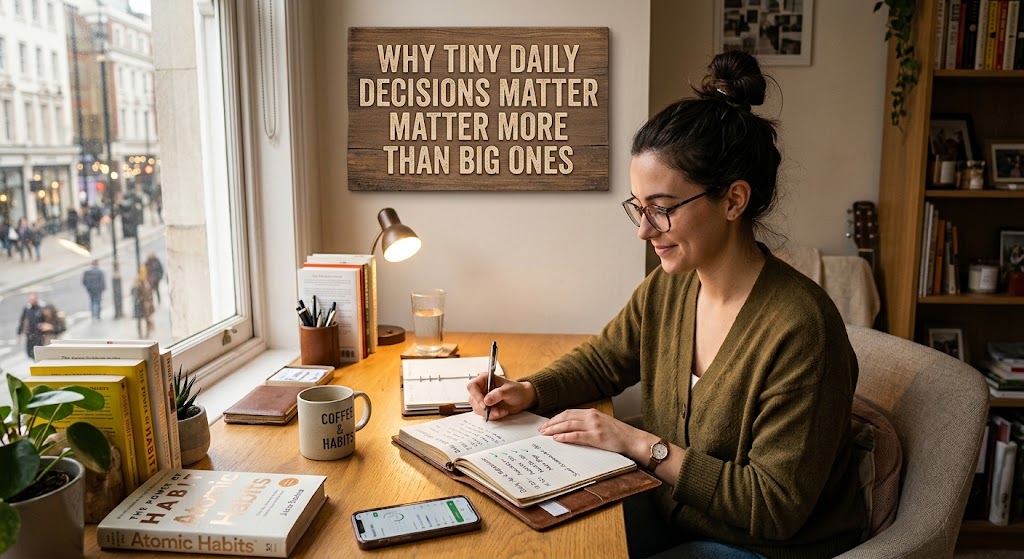
Most people believe that the biggest moments in life are created by the biggest decisions. We imagine that success begins with a dramatic breakthrough, a major career opportunity, a huge investment, a life changing idea, or one courageous decision that suddenly changes everything. While major decisions certainly matter, much of what eventually becomes our reality is shaped somewhere far less dramatic. It happens in the small decisions we make every ordinary day. Why Tiny Daily Decisions Matter More Than Big Ones.
This is why Why Tiny Daily Decisions Matter More Than Big Ones is a question worth taking seriously. The choices that seem insignificant today can become extremely significant when they are repeated consistently over weeks, months and years. A decision to read ten pages instead of scrolling for thirty minutes may appear small. Choosing to save a little money instead of spending it impulsively may feel insignificant. Going for a short walk, learning one new skill, making one important phone call, refusing to respond angrily, waking up when the alarm rings, or spending a few minutes planning the day may not look like the kind of behaviour that changes a life. Yet these tiny decisions can quietly build the person, habits, finances, relationships and future that eventually become visible to everyone.
The problem is that small decisions rarely produce immediate and spectacular results. If you save a small amount today, you may not feel richer tomorrow. If you exercise today, your body may not look dramatically different the next morning. If you study for thirty minutes today, you may not suddenly become an expert. If you choose patience during an argument, nobody may applaud you. If you spend an hour developing a useful skill, you may still feel like a beginner when you finish.
This delayed reward makes people underestimate small choices.
Human beings naturally notice dramatic events. We remember the day someone gets a promotion, launches a successful business, buys a house, becomes famous or achieves a major goal. What we often do not see are the thousands of small decisions that happened before that moment. We see the result, but we rarely see the repetition that produced it.
A successful person may appear to have made one brilliant decision, but that decision was often supported by hundreds or thousands of smaller decisions. They decided to learn instead of remain ignorant. They decided to practise instead of make excuses. They decided to save instead of spend everything. They decided to continue after failure. They decided to show up when motivation disappeared. They decided to improve their work when nobody was watching.
The major result was simply the visible evidence of many invisible decisions.
This is one of the most important reasons Why Tiny Daily Decisions Matter More Than Big Ones. Big decisions happen occasionally, but tiny decisions happen constantly. You may decide once to start a business, but you decide every day whether you will work on that business. You may decide once to become financially responsible, but you repeatedly decide whether to save, invest, budget or spend. You may decide that you want to become healthier, but every meal, bedtime and activity presents another opportunity to support or undermine that decision.
The big decision establishes direction. The tiny decisions determine whether you actually travel in that direction.
Think about a person who decides to write a book. The decision itself may take five minutes. The book, however, may require months of writing. The person must repeatedly decide to sit down and write even when inspiration is absent. They must decide to edit another paragraph, research another subject, correct another mistake and continue when progress feels painfully slow.
Why Tiny Daily Decisions Matter More Than Big Ones
Eventually, the finished book may look like one major achievement. In reality, it is the accumulated result of countless small decisions.
The same principle applies to almost every area of life.
Consider money. People often dream about becoming financially secure through one enormous opportunity. They hope for a massive salary increase, a successful business idea, an investment that multiplies their money or some unexpected financial breakthrough. There is nothing wrong with pursuing major opportunities, but financial stability is often built through much less exciting behaviour.
It can begin with the decision to track expenses. Then comes the decision to stop buying things simply because they are on sale. Then comes the decision to save before spending. Then the decision to learn about investing. Then the decision to avoid unnecessary debt. Then the decision to increase income by developing a valuable skill.
None of these decisions may make someone wealthy overnight. Together, however, they can completely change the direction of a person’s financial life.
The opposite is also true.
Financial problems can develop through tiny decisions. One unnecessary purchase may not matter. One impulsive subscription may not matter. One missed payment may not matter. One careless borrowing decision may not matter. But repeated over time, these choices can create a financial situation that becomes extremely difficult to escape.
This demonstrates something powerful. Small decisions do not need to be dramatic to be dangerous or beneficial. They only need to be repeated.
Your habits are essentially your repeated decisions becoming automatic.
Every time you choose to exercise instead of remain inactive, you reinforce a particular pattern. Every time you choose to study instead of procrastinate, you strengthen another pattern. Every time you choose anger instead of self control, you make anger easier to access next time. Every time you choose discipline over convenience, discipline becomes slightly more familiar.
Eventually, you may stop thinking about the decision altogether.
That is when small choices become powerful.
A person does not usually wake up one morning and suddenly become disciplined. Discipline is often constructed through countless ordinary moments. It is built when you decide to finish what you started. It is built when you keep your promise to yourself. It is built when you do the task even though nobody is checking. It is built when you refuse to let temporary discomfort dictate your behaviour.
The same applies to character.
Character is not created only during dramatic crises. It is revealed and developed through ordinary decisions. How you speak to people when you are frustrated matters. Whether you keep a promise when breaking it would be easier matters. Whether you admit a mistake when nobody can force you to matters. Whether you treat people with respect when you believe they cannot help you matters.
Tiny decisions repeatedly tell you who you are becoming.
This is why people should stop waiting for massive opportunities before taking themselves seriously. You do not need to change your entire life today. You need to make today’s choices slightly better.
Read instead of scrolling for a few minutes.
Save instead of spending a little unnecessarily.
Walk instead of remaining completely inactive.
Learn instead of complaining.
Create instead of endlessly consuming.
Listen instead of immediately reacting.
Start instead of waiting for perfect conditions.
Finish one important task instead of creating another list of unfinished plans.
These decisions appear ordinary. Their cumulative effect is anything but ordinary.
One of the greatest mistakes people make is believing that tiny progress is meaningless. They look at what they can accomplish today and compare it with the enormous distance between where they are and where they want to be. The distance feels overwhelming, so they do nothing.
But progress does not require you to complete the entire journey today.
It requires you to move.
If you are trying to improve your finances, you do not need to become wealthy today. Make one financially intelligent decision today.
If you want to become healthier, you do not need to transform your body today. Make one healthier choice today.
If you want to become knowledgeable, you do not need to master everything today. Learn something today.
If you want to build a business, you do not need to create a massive company today. Do one meaningful piece of work today.
If you want to repair a relationship, you may not be able to fix everything immediately. Start by communicating honestly.
The power is in repetition.
A tiny improvement repeated consistently can eventually outperform an enormous effort that happens once and disappears.
This principle also explains why motivation is unreliable. Motivation feels powerful, but it comes and goes. Some mornings you will feel inspired. Other mornings you will feel tired, distracted or completely uninterested.
If your progress depends entirely on feeling motivated, your progress will be inconsistent.
Small daily decisions provide another path.
You do not have to feel motivated to make a good decision. You simply have to decide what matters more than your temporary feelings.
There will be days when you do not want to exercise. There will be days when you do not want to study. There will be days when you do not want to work on your business. There will be days when you want to spend money you should save. There will be days when you want to react emotionally instead of thoughtfully.
Those moments are important because they reveal whether your goals are controlled by your feelings or by your values.
You do not need extraordinary discipline every minute of every day. You need enough discipline to keep making small decisions that support the direction you have chosen.
Another reason tiny daily decisions matter is that they shape identity.
Suppose you repeatedly tell yourself that you want to become a writer but rarely write. Eventually, part of you begins to doubt the statement. But if you write something every day, even something small, you begin to see yourself differently.
You become someone who writes.
If you consistently save money, you begin to see yourself as financially responsible.
If you consistently exercise, you begin to see yourself as someone who takes care of your body.
If you consistently learn, you begin to see yourself as a learner.
Identity and behaviour constantly influence each other.
Your actions provide evidence to your mind about the type of person you are becoming.
This is why one tiny decision can matter far beyond the immediate result. It can strengthen a belief about yourself.
The decision to wake up early once does not transform you. But repeatedly keeping your commitment to wake up early can change how you perceive yourself. The decision to read one book does not make you an expert. But developing a habit of reading can turn learning into part of your identity.
Over time, your identity influences your future decisions.
This creates a powerful cycle.
You make a small positive decision. The decision reinforces a useful habit. The habit strengthens your identity. Your identity makes future positive decisions easier. Those decisions create more progress. The progress strengthens your confidence.
The cycle continues.
Unfortunately, the reverse cycle also exists.
A small negative decision can become a habit. The habit can influence identity. Identity can make the behaviour feel normal. The behaviour then becomes easier to repeat.
That is why procrastination can become dangerous. One postponed task is harmless. Constantly postponing important tasks creates a pattern. Eventually, procrastination stops feeling like a behaviour and starts feeling like part of who you are.
The good news is that the cycle can be interrupted.
You do not need to destroy your entire life and rebuild it in one weekend. You can begin with one decision.
Today.
That is the beauty of tiny decisions.
They are accessible.
A major life transformation can feel intimidating because it requires enormous energy, resources and commitment. A tiny decision feels manageable. You can make it even when you are tired. You can make it even when circumstances are not perfect. You can make it without having your entire future figured out.
You can choose the next right action.
And sometimes that is enough.
Another important lesson is that tiny decisions create momentum. Momentum is one of the most underestimated forces in personal development.
Imagine trying to push a heavy object that has been sitting still for years. The first movement may require tremendous effort. Once it starts moving, however, continued movement can become easier.
Your life can work similarly.
Starting may be difficult. The first workout is difficult. The first article is difficult. The first savings deposit is difficult. The first business idea is difficult. The first serious conversation is difficult.
But once you begin proving to yourself that you can act, the psychological resistance can decrease.
One small action creates another.
One completed task makes the next task less intimidating.
One saved amount makes saving feel more normal.
One day of consistency makes another day possible.
That is why you should never underestimate a small beginning.
People often ask, “What is the fastest way to change my life?”
Sometimes the better question is, “What small decision can I repeat long enough to change my life?”
The first question searches for a breakthrough.
The second searches for a system.
Breakthroughs are exciting, but systems are reliable.
A person who constantly searches for the next big opportunity may overlook the small opportunities available today. There may be an hour available for learning. There may be a conversation that needs to happen. There may be an expense that can be eliminated. There may be a skill that can be developed. There may be a piece of work that can be completed.
The opportunity may not look impressive.
Do it anyway.
Your future is not built only during extraordinary moments. It is built on ordinary Tuesdays, quiet mornings, boring afternoons and evenings when nobody is watching.
The decisions you make when there is no audience are particularly important because they reveal your true priorities.
Anyone can become excited about a new goal. The difficult part is continuing when the excitement disappears.
Anyone can announce a new beginning. The difficult part is maintaining it after several weeks.
Anyone can talk about wanting success. The difficult part is making the small decisions that success demands repeatedly.
This is where real transformation happens.
It is also important to understand that tiny decisions do not mean tiny ambitions. You can dream enormously while acting incrementally.
You can want financial freedom while making one intelligent financial decision today.
You can dream of owning a successful company while spending today improving one small part of your business.
You can want to write a bestselling book while writing one page today.
You can want to become exceptionally fit while making one healthier choice today.
Your vision can be enormous while your next action remains small.
That combination is powerful.
The mistake is not thinking big. The mistake is thinking that big thinking requires big action every single day.
Sometimes the smartest action is surprisingly small.
There is another reason Why Tiny Daily Decisions Matter More Than Big Ones: small decisions happen more frequently, giving them more opportunities to shape outcomes. A person might face only a handful of major decisions in a year, but they face hundreds of everyday choices each week.
What time will I sleep?
What will I eat?
What will I spend?
What will I watch?
What will I learn?
What will I avoid?
Who will I listen to?
What will I do with my free time?
How will I respond to criticism?
Will I finish what I started?
Will I keep my promise?
These questions may not feel important individually. Collectively, they can define a life.
This does not mean every small decision needs to become an exhausting calculation. You should not become obsessed with perfection. Nobody makes the right decision every time.
The goal is not perfection.
The goal is direction.
A bad day does not erase months of progress. One poor decision does not define your entire character. One missed workout does not destroy your health. One unnecessary purchase does not ruin your financial future.
What matters is what happens next.
This is another tiny decision.
You can make a mistake and decide to continue.
You can fail and decide to learn.
You can lose money and decide to become wiser.
You can waste a day and decide not to waste tomorrow.
You can fall behind and decide to take the next step.
Recovery itself is often built through tiny decisions.
Ultimately, your life is not merely the product of the decisions you make during major turning points. It is the accumulated result of thousands of ordinary choices that seemed too small to matter at the time.
The phone call you made.
The book you opened.
The expense you avoided.
The workout you completed.
The apology you offered.
The boundary you established.
The skill you practised.
The temptation you resisted.
The opportunity you pursued.
The negative thought you challenged.
The task you finished.
The morning you got up even though you did not feel like it.
Nobody may celebrate these moments individually.
But they count.
They are deposits into the person you are becoming.
So, if your life currently feels far away from where you want it to be, do not automatically conclude that you need one gigantic decision to fix everything. Look closer.
What tiny decision could you make today?
Could you spend thirty minutes learning something valuable?
Could you save a small amount?
Could you stop one unnecessary expense?
Could you write the first paragraph?
Could you make the phone call?
Could you apologise?
Could you organise your workspace?
Could you put down your phone and focus?
Could you go to bed earlier?
Could you begin the task you have been avoiding?
The decision may feel too small.
Make it anyway.
Because Why Tiny Daily Decisions Matter More Than Big Ones ultimately comes down to a simple truth: your future is being constructed in small pieces every day.
Big decisions can change your direction, but tiny daily decisions determine your distance.
A single choice may not transform your life.
A repeated choice can.
And one of the most encouraging things about that truth is that you do not have to control your entire future to improve it. You only need to influence what you do next.
Your next decision is small.
Your next decision is also powerful.
Choose carefully.
Then choose again tomorrow.
And again the day after that.
Eventually, the tiny decisions will no longer look tiny. They will look like your habits, your character, your relationships, your skills, your financial position, your health, your confidence and your life.
That is the quiet power of consistency.
The future rarely arrives as one enormous event. More often, it grows silently from decisions that looked insignificant while you were making them.
So do not wait for the big moment.
Make the small decision.
Then make another.
Your life may be changing long before you notice it.

EarnSmartOnline.com.ng is dedicated to helping readers make smarter financial decisions through practical guides on online income, personal finance, technology, digital business, and wealth creation. Our goal is to provide reliable, easy-to-understand, and actionable content that empowers individuals to earn smarter, build sustainable income streams and achieve long-term financial success.
Recommended: Start Earning Online
- Ultimate Affiliate Marketing Program — learn affiliate marketing with a done-for-you sales system ($15). Check it out
- The Newbie Affiliate Guide — the beginner-friendly starter guide (~$6.68). Check it out
- Easy Dollar Maker — earn in dollars uploading AI images and videos from your phone ($17). Check it out
Disclosure: These are affiliate links. If you buy through them, I may earn a commission at no extra cost to you.



