
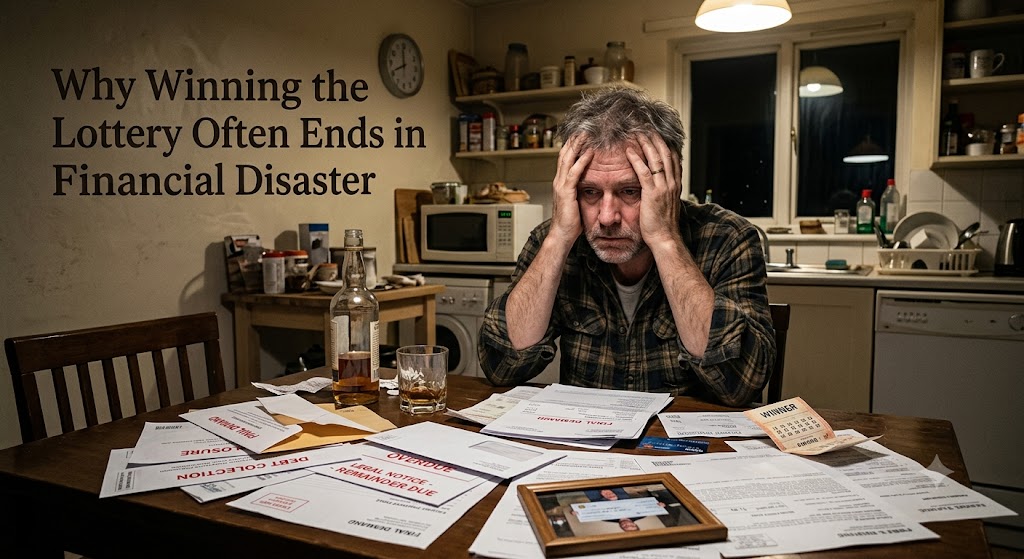
Winning the lottery sounds like the ultimate financial breakthrough. One moment, you are worrying about bills, rent, school fees, debt, business expenses, or an empty bank account. The next moment, you are staring at a life changing amount of money that could potentially eliminate your financial struggles forever. For millions of people, the dream of winning the lottery represents freedom, security, luxury, and the opportunity to finally live the life they have always imagined. But behind the excitement of sudden wealth lies a much less glamorous reality. Why winning the lottery often ends in financial disaster is a question that deserves serious attention because receiving a huge amount of money does not automatically make someone financially intelligent.
The common assumption is that anyone who suddenly receives millions will automatically become wealthy for the rest of their life. Unfortunately, money does not work that way. Wealth is not simply about how much money enters your bank account. It is also about how effectively you manage, protect, invest, and preserve that money. Someone can receive an enormous fortune and still become financially broke years later. In some cases, the problem does not begin with the lottery win itself. It begins with the sudden change in lifestyle, relationships, expectations, spending habits, and responsibilities that follow the win.
One of the biggest reasons why winning the lottery often ends in financial disaster is that many winners have never managed large amounts of money before. Imagine someone who has spent years earning an ordinary income suddenly receiving millions. Their financial experience may have been limited to managing monthly salaries, household expenses, rent, transportation, food, and occasional savings. Suddenly, they have access to an amount of money that is completely outside their previous experience. The skills required to manage a large fortune are very different from the skills required to survive on a modest income.
Sudden wealth can create a psychological shock. The winner may begin to think differently about money because money no longer appears scarce. Before winning, spending ₦50,000 on something unnecessary might have required serious consideration. After winning millions, that same amount can suddenly feel insignificant. This is where lifestyle inflation begins. A person who once lived in a modest apartment may decide to buy a luxury home. A person who drove an ordinary car may purchase several expensive vehicles. Designer clothes, expensive holidays, restaurants, gadgets, parties, jewellery, private events, and other luxuries can quickly become normal.
The danger is that expensive purchases are rarely limited to one occasion. Buying a luxury car is not simply about paying for the car. There are maintenance costs, insurance, fuel, repairs, security, registration, and other recurring expenses. A large house can come with enormous maintenance bills, security costs, utilities, furnishings, renovations, and property taxes or other applicable charges. A lifestyle that costs millions every year can eventually consume even a fortune that initially appeared impossible to spend.
Another reason lottery winners can experience financial disaster is the pressure to help family and friends. In many communities, particularly where extended family relationships are strong, suddenly becoming wealthy can create expectations. People who have not spoken to the winner for years may suddenly reappear. Relatives may have business ideas. Friends may have emergencies. Someone may need money for school fees. Another person may need money for medical treatment. Someone else may ask for capital to start a business. The winner may genuinely want to help, but without boundaries, generosity can become financially destructive.
The problem becomes even more complicated when the winner feels guilty about saying no. A person who struggled financially for years may believe that having money creates an obligation to solve everybody else’s problems. They may begin distributing money without establishing limits. Before long, dozens of people may depend on them financially. The winner becomes less like a wealthy individual and more like a private bank that everybody expects to remain open.
Unfortunately, giving money to people does not always produce gratitude. Sometimes it creates entitlement. Once someone receives money repeatedly, they may begin to consider the support a permanent responsibility of the winner. If the winner eventually refuses to provide more money, relationships can become hostile. This can create emotional pressure, family conflict, manipulation, and even isolation.
Poor investment decisions are another major reason why winning the lottery often ends in financial disaster. Sudden wealth attracts investment opportunities, but not every opportunity is legitimate or profitable. A person who suddenly becomes wealthy may receive proposals from people promising extraordinary returns. They may be told about a new business, property project, cryptocurrency opportunity, agricultural scheme, import business, entertainment venture, or technology company that supposedly cannot fail.
Why Winning the Lottery Often Ends in Financial Disaster
The problem is that having money does not make someone an experienced investor. A lottery winner may have millions but lack the knowledge required to evaluate investments properly. If they invest large amounts based on emotion, friendship, pressure, or unrealistic promises, they can lose substantial portions of their fortune.
Some winners may also become victims of fraud. Scammers understand that sudden wealth creates vulnerable targets. They may approach winners pretending to be financial advisers, business partners, investment experts, lawyers, consultants, or even friends. The promise of making the winner even richer can be extremely tempting. Someone who has just received millions may begin believing that the money can easily become tens or hundreds of millions.
This is why financial education becomes incredibly important after receiving a large windfall. The first goal should not necessarily be to turn the money into more money. The first goal should be to prevent the money from disappearing.
Another problem is the belief that the money is unlimited. A large balance can create a false sense of security. Someone who receives ₦500 million may feel unimaginably rich. But if they begin spending ₦50 million every year while making poor investment decisions, the fortune can shrink rapidly. If inflation is also taken into account, the purchasing power of the remaining money may decline over time.
This demonstrates an important financial principle. Wealth can disappear much faster than it was created. A person can spend years building a fortune and lose it within a relatively short period because spending is easier than wealth creation.
Debt can also become a problem. Some lottery winners assume that because they now have money, they can afford large loans. They may borrow to purchase businesses, luxury properties, vehicles, or other assets. The danger is that a sudden fortune can create overconfidence. The winner may take financial risks they would never have considered before becoming wealthy.
Relationships can also contribute to financial disaster. Sudden wealth can change the way people interact with the winner. Romantic relationships may become complicated because it becomes difficult to determine whether someone genuinely loves the person or is attracted to their wealth. Marriage can become more complicated. Friendships can become transactional. Even family relationships can become strained.
The winner may also begin attracting people who are interested primarily in what they can obtain. This can make it difficult to trust others. Some winners respond by spending more money to maintain relationships, throwing extravagant parties, paying for expensive trips, or constantly demonstrating their generosity. Unfortunately, this can create a cycle in which their social circle becomes increasingly expensive to maintain.
There is also the psychological effect of sudden wealth. People who have lived with financial limitations for many years may struggle to adjust to their new circumstances. Money can remove certain problems while introducing entirely new ones. Decisions become more complicated. Everyone has an opinion. Everyone wants something. The winner may feel overwhelmed by financial responsibilities they never expected to have.
Some people also spend aggressively because they believe they deserve to enjoy the money after years of hardship. This thinking is understandable. After struggling for years, finally having money can feel like permission to enjoy everything that was previously impossible. The problem occurs when enjoyment becomes the primary financial strategy.
There is nothing inherently wrong with enjoying wealth. The problem is enjoying it without a sustainable plan.
A lottery win should therefore be treated as an opportunity to build long term financial security rather than as an invitation to permanently increase spending. The winner needs to understand the difference between wealth and consumption. Buying expensive things may make someone look wealthy, but owning productive assets and maintaining financial stability are much stronger indicators of lasting wealth.
Another issue is the lack of professional financial guidance. Someone who suddenly receives a large amount of money should not assume they can manage everything alone. However, professional advice should also be approached carefully. The winner needs trustworthy, properly qualified professionals who can help with financial planning, taxation, estate planning, investment decisions, legal matters, and risk management.
The key word is trustworthy. Having a professional does not mean blindly handing over control of the money. The winner still needs enough financial knowledge to understand what is happening with their wealth.
Privacy is another important consideration. Publicly revealing sudden wealth can attract unwanted attention. The more people who know about a person’s financial situation, the more opportunities there may be for manipulation, exploitation, fraud, or unreasonable demands. Maintaining appropriate privacy can therefore become an important part of protecting sudden wealth.
Winners also need to understand that money does not solve every problem. Someone who was unhappy before winning may not automatically become happy afterwards. Money can provide comfort, opportunities, security, and access, but it cannot guarantee meaningful relationships, purpose, discipline, or emotional stability.
In fact, sudden wealth can expose problems that were previously hidden. Someone who lacked financial discipline before winning may become even less disciplined afterwards. Someone who struggled with impulsive decisions may make larger impulsive decisions. Someone who had difficulty saying no may suddenly find themselves surrounded by people asking for money.
This is why the most important asset a lottery winner can develop is not another house, car, or business. It is financial discipline.
Financial discipline means understanding that every naira has a purpose. It means creating spending limits even when money appears abundant. It means distinguishing between assets and liabilities. It means avoiding unnecessary financial risks. It means understanding taxes and legal obligations. It means maintaining emergency reserves. It means diversifying investments appropriately. Most importantly, it means recognising that the goal is not simply to look rich but to remain financially secure.
The story of lottery winners provides a powerful lesson for everyone, even people who will never win a lottery. You do not need millions to develop good financial habits. In fact, the habits you develop while earning a modest income may determine what happens if your income eventually increases dramatically.
If someone cannot manage ₦100,000 responsibly, receiving ₦100 million may not automatically solve the underlying problem. The numbers become bigger, but the behaviour remains the same. If a person spends everything they earn, they may eventually spend everything they receive.
This is why financial education should begin before wealth arrives. People should learn about budgeting, saving, investing, compound growth, diversification, debt management, risk, taxes, insurance, and wealth preservation long before they suddenly receive a large amount of money.
Winning the lottery can absolutely change someone’s life, but whether that change is positive or negative depends heavily on what happens after the winning announcement. The money itself is only the beginning. The real challenge is turning sudden wealth into lasting wealth.
A responsible winner would have a very different approach from someone who immediately begins spending. Instead of rushing into luxury purchases, they might first secure the money, understand their financial obligations, establish a realistic budget, seek qualified professional advice, and create a long term wealth preservation strategy. They might decide how much can be enjoyed, how much can be invested, how much can be reserved for emergencies, and how much can be given to others.
They would also recognise that generosity needs boundaries. Helping people is admirable, but sustainable generosity is better than uncontrolled generosity. Giving someone enough money to become financially independent may be more valuable than repeatedly rescuing them from the same financial problems.
The most important lesson behind why winning the lottery often ends in financial disaster is that money magnifies behaviour. If someone is disciplined, sudden wealth can give them greater opportunities. If someone is reckless, sudden wealth can give them bigger opportunities to be reckless. If someone is generous without boundaries, wealth can make them vulnerable to exploitation. If someone is financially educated, sudden wealth can become a foundation for long term security.
The lottery therefore does not necessarily destroy people financially. In many cases, it simply exposes the difference between having money and knowing how to manage money.
A fortune can disappear when spending becomes more important than planning. It can disappear when every relative becomes an obligation, every friend becomes a business partner, every investment sounds irresistible, and every luxury becomes a necessity. It can disappear when the winner believes the money will never run out.
But the opposite is also possible. A large financial windfall can provide security for generations when it is handled carefully. The difference is not necessarily the size of the winning ticket. The difference is what the winner does with the money afterwards.
Perhaps the biggest lesson is that financial freedom is not achieved merely by having a lot of money. Financial freedom comes from having enough resources, discipline, knowledge, and systems to ensure that your money continues working for you instead of disappearing through uncontrolled spending.
For anyone dreaming of winning the lottery, the dream should therefore go beyond the moment of receiving the money. Imagine what happens five years later. Imagine what happens ten years later. Imagine whether the money is still there, whether it has produced income, whether your relationships remain healthy, and whether your financial future is more secure.
Winning money can be exciting. Keeping it requires wisdom.
That is ultimately why winning the lottery often ends in financial disaster for some people. Sudden wealth can create extraordinary opportunities, but without financial discipline, proper planning, healthy boundaries, and informed decision making, those opportunities can quickly become extraordinary expenses. The real victory is not receiving a huge amount of money. The real victory is having the knowledge and discipline to make that money last.
For anyone who suddenly becomes wealthy, the smartest question is not, “What can I buy now?” It is, “How can I make sure this money continues to improve my life for decades to come?” That single change in mindset can be the difference between a temporary fortune and lasting financial freedom.
The uncomfortable truth is that winning the lottery can be one of the most dangerous financial events in a person’s life if they have never learned how to handle serious money.
The headline sounds like a dream: “Local man wins ₦500 million.” But the real story begins after the celebration. Suddenly, everyone has a business idea. Relatives need help. Friends remember your phone number. Someone wants a car. Someone needs school fees. Someone has a “guaranteed” investment. And the winner starts spending because, for the first time, money feels unlimited.
That is where the trap begins.
The lottery does not magically create financial intelligence. It creates access to money. If the person receiving that money has poor financial habits, those habits now operate on a much larger scale.
Someone who previously wasted ₦20,000 can suddenly waste ₦20 million. Someone who struggled to say no to friends can now have hundreds of people asking for money. Someone who never invested before can suddenly be presented with investment opportunities worth tens of millions.
The frightening part is that losing a fortune rarely feels like losing a fortune at first.
It happens gradually.
One expensive car becomes three. One house becomes several properties. One holiday becomes a lifestyle. One family member becomes ten. One “small” investment becomes another. A few years later, the winner looks around and wonders where the money went.
The lesson is brutally simple: having money and understanding money are two completely different things.
A lottery winner who understands that difference can turn sudden wealth into generational wealth.
A winner who does not may simply experience a very expensive temporary vacation from poverty.
And that is the real reason the lottery should never be viewed as a financial plan. The real jackpot is not getting rich overnight. It is knowing how to stay rich after everyone else has stopped celebrating.

EarnSmartOnline.com.ng is dedicated to helping readers make smarter financial decisions through practical guides on online income, personal finance, technology, digital business, and wealth creation. Our goal is to provide reliable, easy-to-understand, and actionable content that empowers individuals to earn smarter, build sustainable income streams and achieve long-term financial success.
Recommended: Start Earning Online
- Ultimate Affiliate Marketing Program — learn affiliate marketing with a done-for-you sales system ($15). Check it out
- The Newbie Affiliate Guide — the beginner-friendly starter guide (~$6.68). Check it out
- Easy Dollar Maker — earn in dollars uploading AI images and videos from your phone ($17). Check it out
Disclosure: These are affiliate links. If you buy through them, I may earn a commission at no extra cost to you.



