
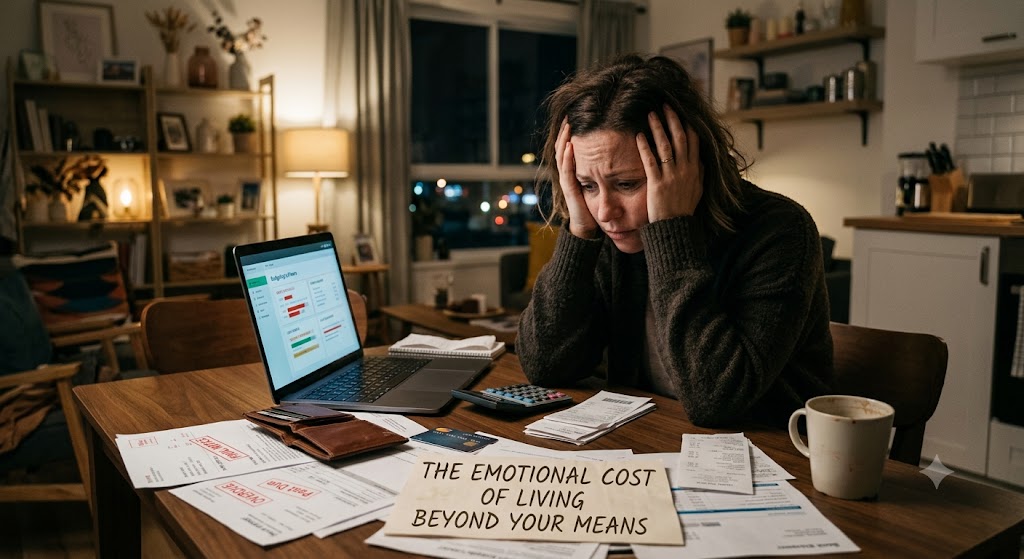
Living beyond your means is often described as a financial problem, but the damage rarely stops at your bank account. Spending more than you can comfortably afford can affect your peace of mind, relationships, confidence, sleep, decision making and even the way you see yourself. A person can appear financially successful on the outside while privately struggling with anxiety, debt and constant fear about what might happen when the next bill arrives. The emotional cost of living beyond your means is therefore deeper than simply having less money at the end of the month.
Modern society makes this problem particularly difficult to recognise. We live in a world where appearances can be carefully managed. Social media constantly exposes people to expensive holidays, new cars, designer clothes, impressive houses, restaurants, gadgets and lifestyles that appear effortless. It becomes easy to compare your ordinary life with someone else’s carefully selected highlights. Before long, spending can become less about meeting genuine needs and more about proving something to yourself or to other people.
The emotional cost of living beyond your means is therefore deeper than simply having less money at the end of the month. It can create a cycle where emotional discomfort leads to unnecessary spending, unnecessary spending creates financial pressure, financial pressure creates more emotional discomfort, and that discomfort then encourages even more spending. What initially feels like a temporary escape can gradually become a lifestyle that is difficult to maintain.
One of the first emotional consequences is persistent financial anxiety. When your monthly expenses consistently exceed your income, money stops feeling like a tool and starts feeling like a threat. You may wake up thinking about bills, go to sleep calculating how much is left in your account, or feel nervous whenever your phone displays a banking notification. Even when nothing is immediately wrong, you may still experience a constant sense that something could go wrong at any moment.
Financial anxiety can be exhausting because it follows you everywhere. You may be at work but thinking about your rent. You may be having dinner with friends while worrying about your credit card balance. You may receive your salary and feel temporary relief, only for that relief to disappear within days as bills, repayments and other obligations consume the money. The problem is not simply that you have financial commitments. The deeper problem is that your lifestyle has created commitments that your income cannot comfortably support.
Living beyond your means can also create a dangerous dependence on future income. Instead of asking whether you can afford something today, you begin thinking about whether you will be able to afford it later. You tell yourself that next month’s salary will solve the problem. Then another expense appears. You borrow again. You use credit again. You postpone another payment. Eventually, your future income is already committed before you receive it.
This creates a psychological feeling of being trapped. Your salary may increase, but your freedom does not necessarily increase with it because your spending rises alongside your income. This is one reason lifestyle inflation can be so dangerous. When people earn more money, they often upgrade their lifestyle instead of strengthening their financial foundation. A better salary becomes a more expensive apartment, a newer car, more expensive entertainment, bigger social obligations and more subscriptions. The person earns more but somehow still feels broke.
Another emotional cost is shame. Financial difficulties are often difficult to discuss because money is connected to identity and social status. Someone may be comfortable admitting that they are tired, stressed or unhappy, but they may struggle to admit that they cannot afford the lifestyle they are presenting to others.
This can lead to secrecy. A person may hide debts from friends, family members or even a spouse. They may avoid checking their account balance because they are afraid of what they will see. They may ignore messages from lenders or creditors. They may pretend that everything is fine because admitting the truth feels embarrassing.
The longer the financial reality remains hidden, the heavier the emotional burden becomes. You are not only dealing with the financial problem. You are also carrying the pressure of maintaining a version of yourself that may no longer be financially sustainable.
Living beyond your means can also damage self esteem. This may seem strange because spending money can sometimes make people feel confident. A new outfit can make you feel attractive. A new phone can make you feel successful. A nice car can make you feel important. An expensive meal can make you feel accomplished. The problem begins when these purchases become the primary source of confidence.
When self worth becomes connected to possessions, financial limitations can feel like personal failures. You may begin judging yourself based on what you cannot afford. You may feel inferior when someone else has a bigger house, better car or more expensive lifestyle. Instead of asking whether a purchase is financially sensible, you start asking whether it will make you feel good enough.
That is a dangerous question to use when making financial decisions.
Money can buy comfort, convenience and opportunities, but it cannot permanently repair an unhealthy relationship with self worth. The emotional boost from a purchase often fades. The repayment obligation remains. This is why emotional spending can become particularly destructive.
The Emotional Cost of Living Beyond Your Means
Emotional spending occurs when people use shopping or spending as a way to manage feelings rather than fulfil genuine needs. Someone feels lonely, so they order something online. Someone feels stressed, so they go out and spend money. Someone feels unsuccessful, so they purchase something expensive to convince themselves that they are doing well. Someone feels rejected, so they reward themselves with an unnecessary purchase.
There is nothing inherently wrong with enjoying your money. The problem occurs when spending becomes your emotional coping mechanism.
If every uncomfortable emotion produces a financial transaction, your bank account can eventually become the place where your unresolved emotions leave their fingerprints. You may not even remember why you purchased certain things, but you remember the debt when the bill arrives.
Living beyond your means can also increase irritability. Financial pressure reduces mental space. When you constantly have to calculate what you can afford, small problems can feel much larger than they really are. A delayed payment, unexpected transport cost, medical bill, family request or household repair can trigger disproportionate frustration because there is already very little financial breathing room.
This pressure can affect relationships. Money problems are among the issues that can create serious tension between couples, families and friends. When one person feels that another person spends irresponsibly, resentment can grow. When a partner hides debt, trust can deteriorate. When family members repeatedly ask for financial assistance from someone who is already struggling, frustration can build.
Sometimes the conflict is not actually about money. It is about security, trust, responsibility and expectations.
A person who earns a reasonable income but consistently spends everything may feel frustrated by a partner who wants to save. The partner who wants to save may feel frustrated because they believe they are the only one thinking about the future. Both people may argue about individual purchases while the deeper issue is that they have different beliefs about money.
Living beyond your means can also create social pressure. You may feel obligated to attend expensive events because you are afraid of appearing unsuccessful. You may spend money during celebrations because everyone else is spending. You may buy gifts you cannot afford because you do not want to look cheap. You may contribute financially to situations simply because you are afraid of what people will say if you do not. The emotional cost of living beyond your means
This is particularly relevant in communities where social expectations around generosity, appearances and family responsibilities are strong. Helping people is valuable, but financial generosity becomes dangerous when you repeatedly destroy your own financial stability to maintain an image of being financially capable.
You do not have to prove your financial worth by becoming financially unstable.
Another emotional consequence is the loss of freedom. This is perhaps one of the most overlooked costs of living beyond your means. People often think financial freedom means having a huge amount of money. In reality, part of financial freedom is having choices.
When your expenses consume almost everything you earn, your choices become limited. You may dislike your job but feel unable to leave because you have too many monthly obligations. You may want to start a business but cannot save enough capital. You may want to relocate but cannot afford the transition. You may want to take time off but feel trapped by debt.
The expensive lifestyle that was supposed to represent success can eventually become the very thing preventing you from pursuing the life you actually want.
This is why financial freedom is not simply about earning more. It is also about controlling your expenses and keeping enough distance between your income and your obligations.
Living within your means creates something that money itself cannot always provide: breathing room.
Breathing room means having money left after your essential expenses. It means being able to handle an unexpected bill without immediately borrowing. It means being able to say no to a purchase without feeling deprived. It means knowing that your entire salary is not already promised to someone else before you receive it.
That breathing room can dramatically improve your emotional wellbeing.
Another hidden emotional cost of overspending is decision fatigue. When money is tight because of excessive commitments, ordinary decisions become unnecessarily complicated. Can you afford to repair the car? Should you pay this bill now or later? Should you borrow money? Should you use your savings? Can you attend the event? Can you help your family member? Should you delay the payment?
The more financial pressure you carry, the more mental energy you spend making these calculations.
This can reduce your ability to focus on work, relationships, creativity and long term planning. Your financial situation occupies mental space that could otherwise be used to build your future.
There is also the emotional burden of constantly starting over. Some people repeatedly promise themselves that they will change their spending habits. They receive their income, overspend, regret it, promise to do better next month and then repeat the same pattern. Over time, repeated failure can create hopelessness.
They begin thinking, “This is just how I am with money.”
It is not.
Financial behaviour is influenced by habits, beliefs, environment and emotions. Habits can change. Your relationship with money can change. Your lifestyle can change. But meaningful change usually begins when you stop treating overspending as merely a mathematics problem and start examining the emotions behind it. The emotional cost of living beyond your means
Ask yourself what you are actually trying to achieve when you spend money unnecessarily. Are you trying to impress people? Are you trying to feel successful? Are you trying to escape stress? Are you trying to compensate for something you feel you lack? Are you afraid of being perceived as poor? Are you spending because everyone around you spends?
The answers can reveal more about your financial behaviour than a budget spreadsheet ever will.
One of the most powerful changes you can make is learning to separate your identity from your possessions. You are not your car. You are not your phone. You are not the size of your house. You are not the restaurant you can afford. You are not the designer clothes you wear. These things may contribute to your lifestyle, but they do not determine your value.
Once you understand this, living within your means becomes less embarrassing. It becomes strategic.
There is nothing shameful about choosing a cheaper car because you want to save. There is nothing embarrassing about living in a modest home while building wealth. There is nothing wrong with wearing affordable clothes. There is nothing wrong with declining an expensive invitation because it does not fit your budget. The emotional cost of living beyond your means
In fact, being able to say “I cannot afford that right now” can be a sign of financial maturity.
The goal is not to live a miserable life. Living within your means does not mean refusing yourself every pleasure. It means creating a lifestyle that your income can support without constantly borrowing from your future.
You can enjoy your money and still save. You can travel and still invest. You can buy nice things and still maintain an emergency fund. You can celebrate important moments without turning every celebration into debt. The objective is balance.
The difference between enjoying money and being controlled by money is often intentionality.
Before making a significant purchase, it can help to ask a simple question: “Will this purchase improve my life, or am I buying it to improve how I feel about myself?”
Sometimes the answer will be both. That is normal. But if you repeatedly discover that your spending is primarily an attempt to escape negative emotions, the problem deserves deeper attention.
Another important step is to create financial goals that are emotionally meaningful. Saving money simply because someone says you should save may not be motivating enough. Saving for six months of living expenses, freedom from debt, a business, a home, education or the ability to support your family can create a stronger emotional connection to financial discipline.
When you have something meaningful to protect, saying no to unnecessary spending becomes easier.
It is also important to stop comparing your financial life with appearances. You rarely know the full financial story behind someone’s lifestyle. The expensive car may be financed. The holiday may have been paid for with debt. The designer clothes may have been purchased on credit. The impressive business may be struggling behind the scenes.
Comparison becomes dangerous when you compare your financial reality with someone else’s visible consumption.
Instead of asking, “Why don’t I have what they have?” ask, “Is the life I am building sustainable?”
That question can completely change your financial decisions.
The emotional cost of living beyond your means is ultimately the cost of sacrificing peace today and freedom tomorrow for appearances, temporary pleasure or emotional relief. Every unnecessary financial commitment may appear small on its own, but repeated decisions eventually create a lifestyle. That lifestyle can either give you freedom or take it away.
The good news is that financial pressure does not have to be permanent. You can begin by becoming honest about your numbers. Know what you earn. Know what you spend. Know what you owe. Know which expenses are essential and which ones are connected to habits, pressure or emotional triggers. The emotional cost of living beyond your means
Then begin making changes gradually.
You do not need to transform your entire financial life overnight. You need to stop digging the hole deeper and start moving in the opposite direction. Reduce unnecessary expenses. Pay down expensive debt. Build an emergency fund. Create realistic spending limits. Save before spending what remains. Learn to delay purchases. And most importantly, develop the emotional strength to tolerate the temporary discomfort of not having everything you want immediately.
Financial discipline can feel restrictive at first because you are breaking habits that previously gave you instant gratification. But over time, discipline produces something far more valuable than instant pleasure.
It produces peace.
Imagine receiving your income without immediately feeling that it has already disappeared. Imagine having savings available when an unexpected expense arrives. Imagine being able to make career decisions without worrying about how you will pay next month’s bills. Imagine saying no to social pressure without guilt. Imagine looking at your bank account without fear.
That is the emotional reward of living within your means.
True financial success is not simply being able to afford expensive things. It is being able to afford your life without sacrificing your peace of mind to maintain it.
The person who earns a modest income but sleeps peacefully, saves consistently, avoids destructive debt and has control over their spending may be financially healthier than someone earning several times more while drowning in obligations.
Your lifestyle should serve your life, not imprison it.
There will always be something more expensive to buy, somewhere more impressive to visit and someone who appears to be doing better than you. If you build your financial life around keeping up with everyone else, you will never arrive. The emotional cost of living beyond your means
But if you build it around your values, priorities and long term freedom, you can create something far more valuable than an impressive appearance.
You can create peace.
And sometimes, the smartest financial decision is not earning more money.
It is simply refusing to spend money you do not have to impress people who are not responsible for your future.

EarnSmartOnline.com.ng is dedicated to helping readers make smarter financial decisions through practical guides on online income, personal finance, technology, digital business, and wealth creation. Our goal is to provide reliable, easy-to-understand, and actionable content that empowers individuals to earn smarter, build sustainable income streams and achieve long-term financial success.
Recommended: Start Earning Online
- Ultimate Affiliate Marketing Program — learn affiliate marketing with a done-for-you sales system ($15). Check it out
- The Newbie Affiliate Guide — the beginner-friendly starter guide (~$6.68). Check it out
- Easy Dollar Maker — earn in dollars uploading AI images and videos from your phone ($17). Check it out
Disclosure: These are affiliate links. If you buy through them, I may earn a commission at no extra cost to you.



