
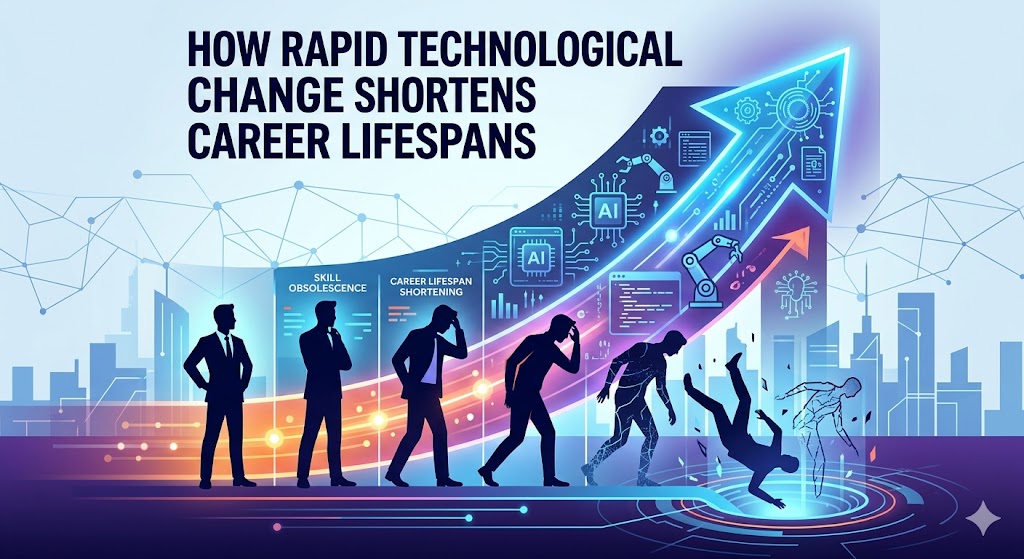
How Rapid Technological Change Shortens Career Lifespans
Every generation likes to believe that the rules of work are stable, that once you choose a career path and acquire the right education, you can simply build on it for decades without major disruption. That idea used to be partially true in slower economic eras where industries evolved over long cycles and the tools of work remained familiar for most of a lifetime. Today that assumption is breaking down quickly. Rapid technological change is not just improving how we work, it is reshaping what work even means, and in the process it is quietly shortening the lifespan of entire careers.
A career lifespan can be understood as the period during which a specific set of skills remains valuable in the labor market without requiring major reinvention. In the past, a single skillset could remain relevant for twenty to thirty years. A person trained in accounting, engineering, teaching, or administration could rely on relatively stable tools and methods for most of their working life. The core knowledge aged slowly, and updates came gradually. Now the same stability no longer exists. The acceleration of technology has compressed that window, making many skills valuable for shorter periods before they require significant adaptation or complete replacement.
One of the main forces behind this shift is the speed at which digital tools evolve. Software updates no longer happen every few years, they happen continuously. Entire systems are replaced before workers fully master the previous version. For example, industries that once relied on manual bookkeeping have transitioned into cloud based accounting platforms that automate much of the work. Professionals who did not adapt early found themselves competing with software that could perform tasks faster, cheaper, and with fewer errors. The role did not disappear entirely, but its structure changed so much that the old skillset alone became insufficient.
Another major driver is automation. Machines and algorithms are increasingly capable of performing tasks that were once considered safe from technological disruption. This includes data entry, basic customer service, scheduling, report generation, and even aspects of legal and medical analysis. When a machine can complete a task with higher efficiency, the economic value of human labor in that area decreases. This does not always eliminate jobs immediately, but it reduces the long term demand for those specific skills, effectively shortening their career lifespan.
Artificial intelligence has intensified this trend further. Unlike earlier technologies that replaced physical labor or repetitive tasks, AI is beginning to affect cognitive work. Writing, design, analysis, coding assistance, and decision support are now partially automated. This means that even knowledge based careers are no longer immune to rapid change. A skill that took years to develop can now be partially replicated by a system trained on vast datasets. As a result, professionals are no longer just competing with other humans but also with systems that learn and improve at a much faster rate.
The internet has also contributed to this acceleration by increasing global competition. Before digital connectivity, many jobs were geographically limited. A professional might compete only within their city or country. Now, remote work and digital platforms have opened labor markets globally. This means that if a skill becomes outdated in one region, it can quickly be replaced by someone elsewhere who has already adapted to newer tools. The global nature of competition compresses the time window in which skills remain profitable.
Another factor shortening career lifespans is the constant shift in consumer expectations. Technology does not only change how work is done, it changes what people expect from services and products. Customers now demand faster delivery, higher personalization, and seamless digital experiences. Businesses that cannot meet these expectations are forced to upgrade their systems or lose relevance. This creates pressure on workers to continuously learn new platforms, tools, and methods. A skill that was sufficient five years ago may feel outdated simply because user expectations have moved forward.
Education systems also play a role in this shift. Traditional education often operates on fixed curricula that take years to update. By the time students graduate, parts of what they learned may already be outdated. This creates a mismatch between academic preparation and real world technological demands. As a result, many professionals enter the workforce already needing additional training. The gap between education and industry has become wider, contributing to the shortening of effective career lifespans.
The psychological impact of this change is also important. Many workers experience what can be described as skill anxiety, a constant awareness that what they know today may not be enough tomorrow. This pressure forces continuous learning but also creates fatigue. Instead of building a single stable identity around a profession, individuals are now expected to evolve repeatedly across their working life. This shift changes the emotional relationship people have with work, making careers feel less like stable paths and more like ongoing adaptation cycles.
Economic systems also reinforce this acceleration. Companies are incentivized to adopt technologies that reduce cost and increase efficiency. If a new tool allows a business to reduce workforce size or increase output, it is quickly adopted to stay competitive. This means that technological change is not optional for businesses, it is necessary for survival. Workers within those systems must therefore adapt at the same pace or risk becoming obsolete within their roles.
Another subtle but powerful factor is the rise of platforms and ecosystems. In many industries, a few dominant platforms now control the tools and infrastructure that workers depend on. Whether it is social media, e commerce, software development, or digital marketing, these platforms can change rules, algorithms, and requirements at any time. When this happens, entire skill sets can lose relevance overnight. A strategy that worked for years can become ineffective due to a single platform update, forcing professionals to constantly adjust.
At the same time, the half life of knowledge itself is shrinking. Information becomes outdated faster than before because new discoveries, tools, and methods emerge continuously. This means that learning is no longer a one time investment but an ongoing requirement. The ability to learn quickly has become more valuable than the knowledge itself. Those who cannot keep up with this pace find their skills depreciating faster than they can replace them.
Despite all these challenges, this does not mean careers are disappearing. Instead, they are becoming modular. Rather than one long stable career, individuals are increasingly moving through multiple micro careers, each defined by a different set of skills and tools. A person might start in one role, shift into another after technological disruption, and continue evolving across several domains. The modern career is less like a straight line and more like a series of adaptations.
This shift also creates opportunities for those who understand it. When career lifespans shorten, adaptability becomes a form of economic security. People who learn how to learn, who stay curious and flexible, can continuously reposition themselves in changing markets. In this environment, the most valuable skill is not mastery of a single tool but the ability to transition across tools, industries, and systems.
The key challenge is not the existence of technological change but the speed of it. When change was slow, individuals could adjust once or twice in a lifetime. Now they must adjust repeatedly within the same decade. This requires a different mindset, one that accepts instability as a normal condition rather than an exception. Those who resist this reality often find themselves locked into declining skill sets, while those who embrace it remain relevant.
In the end, rapid technological change is shortening career lifespans by constantly redefining what is valuable in the labor market. It replaces old systems faster than they can stabilize, compresses learning cycles, and increases global competition. It forces workers to evolve continuously rather than settle into fixed roles. While this creates uncertainty, it also rewards flexibility, curiosity, and continuous growth. The future of work will not belong to those who mastered a single system, but to those who can repeatedly reinvent themselves as systems change around them.

EarnSmartOnline.com.ng is dedicated to helping readers make smarter financial decisions through practical guides on online income, personal finance, technology, digital business, and wealth creation. Our goal is to provide reliable, easy-to-understand, and actionable content that empowers individuals to earn smarter, build sustainable income streams and achieve long-term financial success.
Recommended: Start Earning Online
- Ultimate Affiliate Marketing Program — learn affiliate marketing with a done-for-you sales system ($15). Check it out
- The Newbie Affiliate Guide — the beginner-friendly starter guide (~$6.68). Check it out
- Easy Dollar Maker — earn in dollars uploading AI images and videos from your phone ($17). Check it out
Disclosure: These are affiliate links. If you buy through them, I may earn a commission at no extra cost to you.



