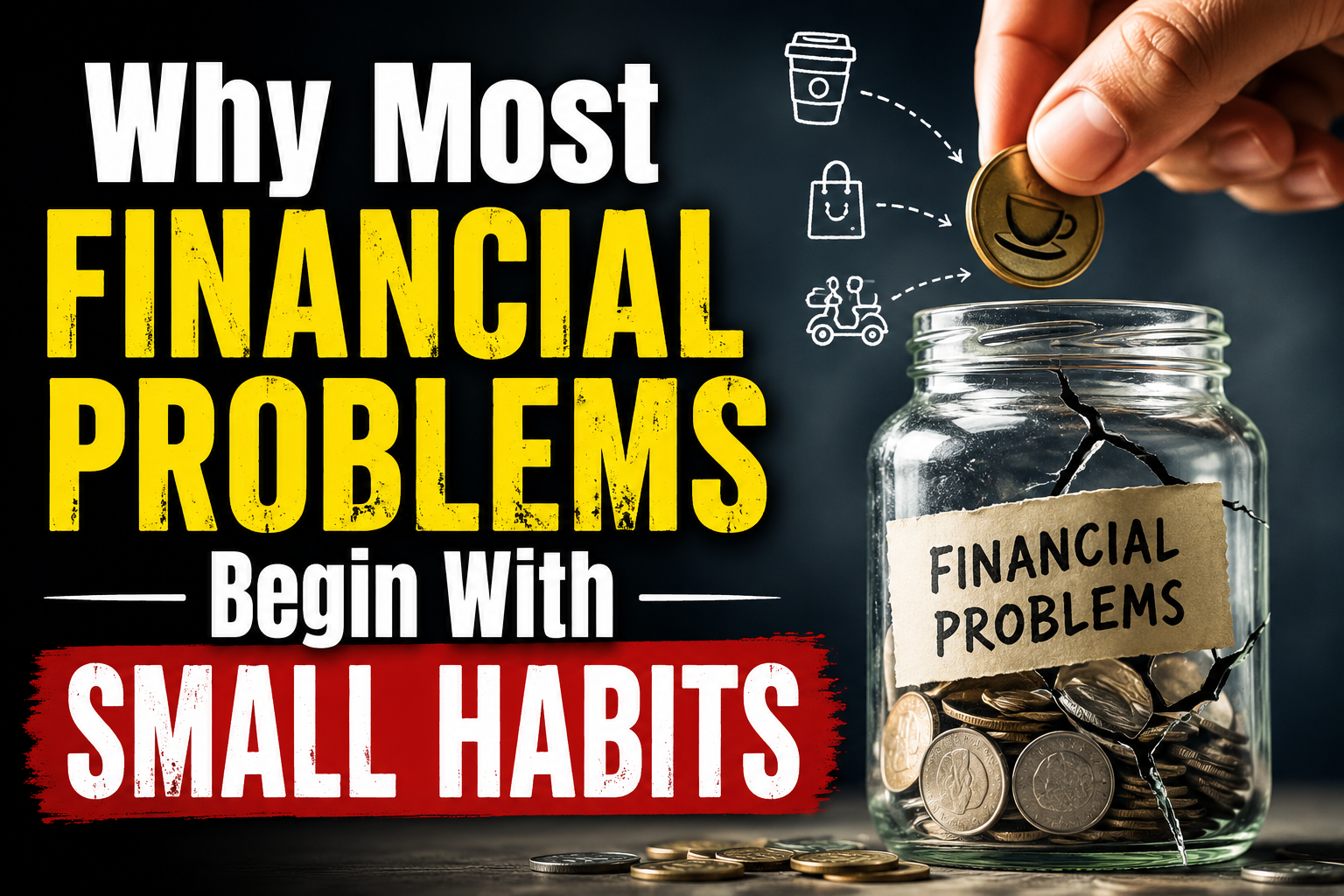
Why Most Financial Problems Begin With Small Habits
Most financial problems people face in adulthood do not begin with big dramatic events. They rarely start with losing everything overnight or making one massive wrong investment. Instead, they begin quietly, almost invisibly, through small daily habits that seem harmless at first. A cup of this, a subscription there, a quick impulse purchase, or a casual “I deserve it” mindset slowly builds into something far more serious over time. The uncomfortable truth is that financial collapse is usually not sudden, it is accumulated.
One of the biggest misunderstandings about money is that people assume wealth or poverty is determined by income alone. While income plays a role, habits determine what happens to that income. Two people can earn the same amount of money and end up in completely different financial realities simply because of how they handle everyday decisions. One person consistently tracks spending, saves a portion, avoids unnecessary debt, and thinks long term. The other spends impulsively, ignores budgeting, and normalizes financial leakage in small amounts. Over time, the gap between both becomes massive.
Small habits are powerful because they do not feel dangerous. Spending a small amount daily does not trigger concern. Missing a minor saving opportunity does not feel like loss. Ignoring a budget for one week does not look like failure. But money responds to patterns, not isolated events. When these small actions repeat, they form a financial direction. That direction eventually becomes a lifestyle, and lifestyle becomes destiny in financial terms.
One of the most common habits that leads to financial problems is consistent impulse spending. It often begins with emotional triggers such as stress, boredom, comparison, or the desire for comfort. People buy things not because they need them, but because they want a temporary emotional lift. The problem is that emotional spending does not solve emotional problems, it only delays them while draining financial resources. Over time, this creates a cycle where money disappears faster than it is earned.
Another silent habit is ignoring small expenses. Many people underestimate how damaging “small money” can be. Transport extras, food delivery fees, micro subscriptions, data top ups, casual online purchases, and daily unnecessary snacks seem insignificant on their own. However, when combined over weeks and months, they often exceed major expenses. The brain tends to dismiss small amounts, but the account balance does not. Financial stability requires respecting even the smallest leakages.
Debt accumulation also starts from small habits rather than large decisions. It begins when people repeatedly borrow for things that are not emergencies. At first, it might be a small loan to cover a shortfall, then another to manage lifestyle pressure, and gradually it becomes a dependency. The danger is not just the debt itself but the habit of normalizing borrowing as a lifestyle tool. Once borrowing becomes routine, financial pressure becomes permanent.
Another habit that quietly creates financial problems is the lack of planning. Many people live financially reactive lives instead of intentional ones. They wait for money to arrive before deciding what to do with it. There is no structured allocation for savings, expenses, investments, or emergencies. Without a plan, money naturally follows emotion and urgency. Urgency is rarely aligned with long term financial health, which leads to constant instability.
Lifestyle inflation is another powerful habit that starts subtly. As income increases, people naturally upgrade their lifestyle without considering sustainability. A slightly better income leads to better food, better clothes, better housing, and increased social spending. While improvement is not bad, the problem occurs when expenses rise at the same rate as income. In such cases, financial progress becomes invisible even when earnings increase significantly.
Procrastination also plays a major role in financial struggles. Many people delay financial decisions that could improve their situation. They postpone saving, delay learning about investing, avoid budgeting, and ignore debt management. The habit of “later” creates a compounding disadvantage. Money grows through time and consistency, so delaying action often means losing the advantage of compounding entirely.
Poor financial awareness is another habit disguised as ignorance. Many people do not intentionally reject financial education, they simply never prioritize it. They spend years working hard but never spend time understanding how money works. This leads to repeated mistakes such as bad loans, poor investments, and weak financial planning. In the modern world, earning money without understanding money is one of the fastest paths to instability.
Another subtle habit is comparing financial status with others. Social comparison influences spending behavior more than people realize. When individuals constantly compare themselves to friends, colleagues, or social media lifestyles, they begin to make financial decisions based on appearance rather than reality. This leads to unnecessary spending and financial pressure that is not aligned with actual income capacity.
The habit of ignoring emergency planning is also a major contributor to financial crises. Many people live without financial buffers, assuming life will remain stable. However, emergencies are not exceptions, they are part of life. When there is no savings cushion, even a small unexpected expense can trigger debt, panic, and instability. The absence of preparation is itself a habit, not just a situation.
Financial problems also grow from inconsistency. Some people save occasionally, budget randomly, or invest without structure. Inconsistency weakens financial systems because money management requires repetition. A habit that is not consistent cannot produce reliable results. Wealth building is less about intensity and more about steady, repeated actions over time.
One overlooked habit is the inability to delay gratification. Many people prioritize immediate comfort over future stability. They choose short term satisfaction instead of long term benefit. This mindset affects everything from spending to saving to investing. The inability to wait often becomes the foundation of financial struggle because wealth requires patience before reward.
Even something as simple as not tracking money can become a destructive habit. When people do not know where their money goes, they lose control over it. Financial awareness begins with visibility. Without tracking, spending becomes unconscious, and unconscious spending leads to leakage that is difficult to detect until it becomes serious.
The good news is that just as small habits create financial problems, small habits can also solve them. Financial recovery does not always require dramatic changes. It often begins with simple actions like tracking expenses, saving a small percentage consistently, avoiding unnecessary purchases, and building awareness around spending patterns. Over time, these small actions reverse the damage created by negative habits.
Ultimately, financial life is shaped more by daily behavior than by occasional decisions. People often look for big solutions to financial problems, but the real answer lies in small consistent habits repeated over time. The same way financial problems are built quietly, financial stability is also built quietly. The difference is simply the direction of the habits.
Understanding this truth changes how people view money. It removes the illusion that financial success is about luck or sudden opportunity. Instead, it reveals that financial outcomes are the result of repeated behavior. When small habits are corrected early, they prevent large problems later. When they are ignored, they grow silently until they become difficult to manage.

EarnSmartOnline.com.ng is dedicated to helping readers make smarter financial decisions through practical guides on online income, personal finance, technology, digital business, and wealth creation. Our goal is to provide reliable, easy-to-understand, and actionable content that empowers individuals to earn smarter, build sustainable income streams and achieve long-term financial success.
Recommended: Start Earning Online
- Ultimate Affiliate Marketing Program — learn affiliate marketing with a done-for-you sales system ($15). Check it out
- The Newbie Affiliate Guide — the beginner-friendly starter guide (~$6.68). Check it out
- Easy Dollar Maker — earn in dollars uploading AI images and videos from your phone ($17). Check it out
Disclosure: These are affiliate links. If you buy through them, I may earn a commission at no extra cost to you.