
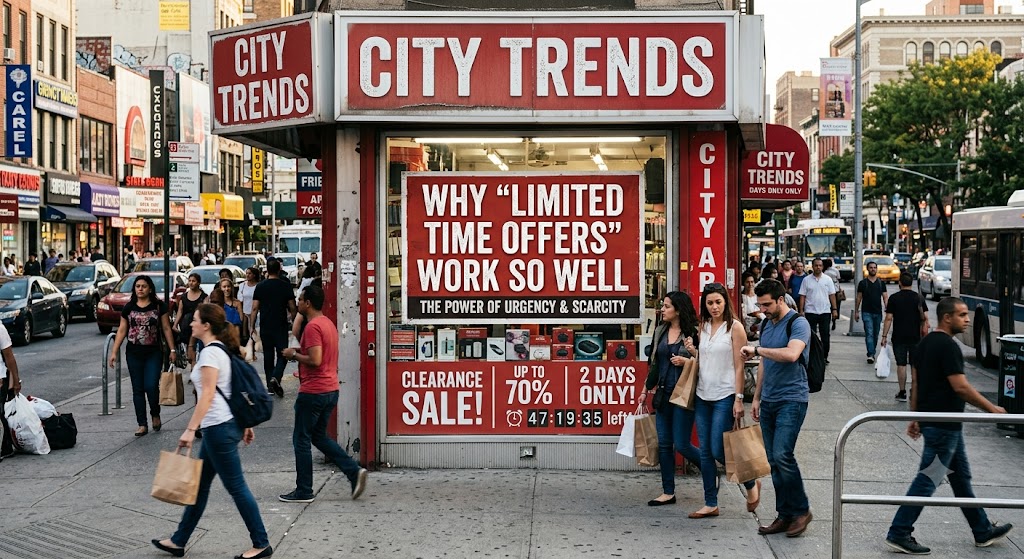
There is something strangely powerful about seeing the words “limited time offer” when you are shopping. You may have had no intention of buying anything that day. You may not even have been looking for the product. Yet suddenly, you start thinking about whether you should take advantage of the opportunity before it disappears. A product that seemed ordinary five minutes ago can suddenly feel important. A discount that was not even on your mind becomes difficult to ignore. You begin asking yourself questions like, “What if the price goes back up tomorrow?” “What if I miss this opportunity?” or “What if they never offer this deal again?” Why “Limited Time Offers” Work So Well.
This is exactly why limited time offers work so well.
Businesses have used urgency and scarcity for generations because they understand something fundamental about human behaviour. People do not always make decisions based purely on what they need. Our decisions are also influenced by timing, emotion, perceived opportunity, fear of missing out and the feeling that we might lose something valuable if we wait too long. A limited time offer combines several of these psychological triggers into one simple message: act now because the opportunity may not be available later.
The interesting thing is that a limited time offer does not necessarily make a product better. It changes how the customer perceives the decision. The same product can look completely different when it is available indefinitely compared with when the customer is told that the opportunity expires tonight.
Imagine walking into a shop and seeing a pair of shoes priced at ₦50,000. You look at them, consider the price and decide that you will think about it. There is no pressure because you believe the shoes will still be there next week. Now imagine seeing the exact same shoes with a message saying, “₦50,000 today only. Regular price ₦70,000 from tomorrow.”
Suddenly, the decision feels different.
You may begin calculating how much you would save. You may start imagining yourself wearing the shoes. You may even convince yourself that buying them now is financially sensible because you are “saving” ₦20,000. The product itself has not changed. Your perception of the opportunity has changed.
This is the psychological power behind limited time offers.
One of the biggest reasons these offers work is urgency. Without a deadline, people can postpone decisions indefinitely. They can say they will buy tomorrow, next week or next month. Unfortunately for businesses, “I will think about it” often means “I will probably forget about it.”
A deadline changes that.
When customers know that an opportunity has an ending point, they are encouraged to make a decision within a specific period. Instead of asking whether they should buy eventually, they begin asking whether they should buy now. That is a completely different question.
The difference between “Do I want this?” and “Do I want this before the offer ends?” can be surprisingly powerful.
Time creates pressure because people understand that opportunities can disappear. When something is always available, it feels less valuable because there is no reason to act immediately. When availability is temporary, the brain pays closer attention.
This is closely connected to the psychological principle of scarcity. Humans tend to place greater value on things that appear limited or difficult to obtain. A product available to everyone at any time may not generate much excitement. The same product presented as available for only a short period can suddenly attract much more attention.
Why “Limited Time Offers” Work So Well
Think about an ordinary sale.
“Discount available.”
That sounds nice, but it does not necessarily make you move.
Now compare it with:
“50 percent off until midnight.”
The second message creates a clock in your mind.
You immediately understand that waiting has a consequence. If you do nothing, the opportunity may disappear. That possibility makes the offer feel more important.
Limited time offers therefore do more than reduce prices. They reduce the amount of time available for decision making.
This is particularly important in a world where consumers are constantly distracted. People receive messages, notifications, advertisements, emails, social media updates and promotional offers throughout the day. Businesses are competing not only for people’s money but also for their attention.
A limited time offer gives people a reason to pay attention now.
Without urgency, an advertisement can easily become something people scroll past and tell themselves they will revisit later. With urgency, the message becomes more difficult to ignore because the customer understands that delaying may have a cost.
Another reason limited time offers work so well is the fear of missing out, commonly known as FOMO. Nobody likes the feeling that other people benefited from an opportunity while they were watching from the sidelines.
Suppose a website announces that a course normally costs ₦100,000 but is available for ₦40,000 until Sunday. You might initially decide that the course is not necessary. But then you see people commenting that they have already enrolled. Someone posts that they saved ₦60,000. Another person says the course has helped them learn a valuable skill.
Now your brain is no longer evaluating the course in isolation.
You are comparing your situation with the possibility of what others may gain.
The question changes from “Do I need this?” to “Am I missing something that other people are taking advantage of?”
That shift can be extremely persuasive.
Social media has made this even more powerful. Businesses can combine limited time offers with social proof by showing the number of people who have purchased, enrolled or claimed an offer. When scarcity, urgency and social proof appear together, customers can feel a strong pressure to act.
However, there is another psychological factor that is easy to overlook: loss aversion.
People often feel the pain of losing something more strongly than the pleasure of gaining something of equal value. This means that customers may respond more strongly to the possibility of losing a discount than to the possibility of receiving that discount.
Consider the difference between these two messages.
“Save ₦20,000 when you buy today.”
“Your ₦20,000 discount disappears at midnight.”
Both messages communicate essentially the same financial benefit. Yet the second one introduces the possibility of loss. It tells the customer that something they currently have access to may be taken away.
That possibility can make the decision feel more urgent.
This explains why phrases such as “last chance”, “offer ends tonight”, “final hours”, “ending soon” and “while stocks last” appear so frequently in marketing. They are not random phrases. They are designed to make the customer aware that waiting is itself a decision.
And that is an important point.
Not making a decision is still a decision when time is limited.
If a customer knows that an offer expires at midnight, choosing not to buy before midnight means accepting that the special price may no longer exist afterwards. The deadline forces the customer to confront the consequences of waiting.
Limited time offers can also help customers overcome analysis paralysis.
Modern consumers have access to enormous amounts of information. They can compare prices, read reviews, watch videos, ask friends, check competitors and research alternatives. While information is useful, too much information can make decisions harder.
A deadline simplifies the situation.
Instead of endlessly comparing every possible option, the customer has to decide whether the current opportunity is good enough. The deadline provides a natural stopping point for the decision making process.
This is one reason flash sales are so effective in online commerce. A customer may spend days browsing products without buying anything. Then a notification appears saying the product is discounted for the next six hours. “What if I miss this opportunity?” or “What if they never offer this deal again?” Why “Limited Time Offers” Work So Well.
Suddenly, browsing becomes buying.
The countdown timer often makes this even more powerful. Seeing “05:42:19 remaining” creates a visible representation of time disappearing. The customer does not merely understand that the offer is temporary. They can see the deadline moving closer.
This can create a sense of momentum.
The same principle applies outside traditional retail. Restaurants use limited time menus. Streaming platforms promote temporary deals. Hotels offer special rates for specific booking periods. Online educators offer enrolment discounts. Software companies provide introductory pricing. Event organisers sell early bird tickets. Even service providers sometimes offer discounts to customers who book within a specific period.
The underlying psychology remains remarkably similar.
The customer is being given a reason to act now rather than later.
Limited time offers can also make customers feel that they are getting privileged access. When an offer is presented as something available only to a specific group or for a specific period, it can create a feeling of exclusivity.
People generally like feeling that they have access to something special.
This is why phrases such as “exclusive offer”, “members only”, “early access”, “special weekend price” and “first 100 customers” can be so effective. They transform an ordinary transaction into something that feels like an opportunity.
But there is an important distinction between effective urgency and dishonest pressure.
A legitimate limited time offer should actually have a meaningful deadline or genuine limitation. If a business claims that an offer ends tonight every night for six months, customers may eventually notice the manipulation. Once people realise that the urgency is fake, trust begins to disappear.
Good marketing creates urgency without destroying credibility.
Businesses therefore need to be careful about how they use scarcity. The goal should not be to frighten customers into buying something they do not need. The goal should be to help genuinely interested customers make a decision instead of endlessly postponing it.
This distinction matters because consumers are becoming more sophisticated. People have seen countdown timers that mysteriously reset. They have seen “last chance” sales that somehow return the following week. They have seen products supposedly selling out only to become available again immediately.
When urgency is abused, it stops being persuasive and starts becoming irritating.
Trust is one of the most valuable assets any business can build, and no temporary increase in sales is worth destroying it.
For customers, understanding the psychology behind limited time offers is equally important.
Once you understand why these offers work, you become less vulnerable to impulsive decisions.
When you see “only three hours left”, you can pause and ask yourself a simple question: “Would I still want this if there were no deadline?”
That question is powerful because it separates genuine desire from artificial urgency.
If you genuinely need the product and the offer provides real value, the deadline may simply help you act. But if you never wanted the product until you saw the countdown timer, there is a good chance that the urgency is influencing you more than the product itself.
Another useful question is, “Am I buying because this is valuable, or because I am afraid of missing the discount?”
Those are not necessarily the same thing.
A ₦20,000 discount does not automatically mean you saved ₦20,000. If you spend ₦80,000 on something you did not need, you have not necessarily made a smart financial decision simply because the seller reduced the price.
Sometimes the best bargain is the money you never spend.
This is especially important when limited time offers involve larger purchases. A customer might become emotionally attached to the idea of getting a “great deal” and forget to consider whether the purchase fits their actual needs or budget.
The urgency of the offer should never replace rational evaluation.
Businesses can also use limited time offers to encourage existing customers to take action. Someone who has already shown interest in a product may simply need a reason to complete the purchase. A temporary discount can provide that final push.
For example, someone may have added an item to their online shopping basket but abandoned the purchase. A reminder offering a small discount for the next 24 hours can bring them back. The customer already had some interest. The limited time incentive simply gives them a reason to stop postponing.
This is why urgency often works best when combined with genuine value.
A weak product with a countdown timer may attract attention temporarily, but it is unlikely to create long term customer loyalty. A valuable product presented with a clear and honest deadline can create both immediate sales and satisfied customers.
The strongest limited time offers therefore answer two questions at the same time.
Why should I want this?
Why should I act now?
The first question communicates value. The second communicates urgency.
Without value, urgency can feel like pressure. Without urgency, even a valuable offer may be postponed. When both are present, customers have a clear reason to make a decision.
There is also an interesting effect called the deadline effect. As a deadline approaches, people often become more motivated to complete a task. A person who has ignored an assignment for weeks may suddenly become extremely productive the night before it is due.
The same psychological pattern can appear in shopping behaviour.
A customer who has been considering a purchase for several days may finally act when the deadline approaches. The approaching deadline concentrates attention and encourages action.
This is one reason the final hours of a promotion can be particularly important.
Businesses may send reminder emails, notifications or social media posts as the deadline gets closer. These reminders are effective because customers who were interested but distracted are brought back into the decision process.
Of course, not every limited time offer works equally well. The perceived value of the offer, the credibility of the seller, the size of the discount, the relevance of the product and the length of the deadline all matter.
If a customer does not care about the product, urgency will not magically create genuine interest. If the discount is insignificant, the deadline may not matter. If the seller lacks credibility, the customer may suspect that the offer is simply a marketing trick.
The most effective limited time offers are usually specific.
Instead of saying “Big discount available soon”, a business might say exactly what is being offered, how much the customer can save and when the offer ends.
Clarity reduces uncertainty.
For example, “Save ₦25,000 when you register before 11:59 pm on Sunday” is much more powerful than “Special discount available now”.
The customer understands the benefit and the deadline immediately.
Limited time offers also work because they create a narrative. There is a beginning, a middle and an ending. The promotion starts. Customers discover it. People respond. The deadline approaches. The opportunity closes.
That story gives the campaign momentum.
Without an ending, a promotion can feel ordinary. With an ending, it becomes an event.
This is why businesses often turn sales into occasions. Black Friday, anniversary sales, birthday promotions, weekend deals, end of season sales and launch offers all create a sense that something is happening now.
Customers do not simply feel that they are buying a product. They feel that they are participating in an opportunity that exists at a particular moment.
That feeling can be incredibly powerful.
Ultimately, limited time offers work because they interact with some of the deepest parts of human decision making. We pay attention to scarce things. We dislike losing opportunities. We respond to deadlines. We compare ourselves with others. We sometimes postpone decisions until circumstances force us to act.
Smart marketers understand these tendencies and use them to make offers more compelling.
Smart consumers understand them and use that knowledge to make better decisions.
The real lesson is not that limited time offers are manipulative or that every promotion should be ignored. The lesson is that urgency changes behaviour. Once you recognise that, you can approach these offers with greater awareness.
The next time you see “Only 2 hours left”, stop for a moment.
Ask yourself whether the product is genuinely worth the price.
Ask yourself whether you would still want it tomorrow.
Ask yourself whether you are buying because you need it or because you are afraid of losing the opportunity.
And then ask the question that may save you the most money: “If this offer did not expire today, would I still buy it?”
If the answer is yes, the limited time offer may simply be helping you make a decision you were already prepared to make.
If the answer is no, the countdown may be doing more work than the product itself.
That is the fascinating power of limited time offers. They do not necessarily change what people want. They change how urgently people feel they need to decide.
And sometimes, the most powerful thing a marketer can sell is not the product.
It is the fear that tomorrow may be too late.

EarnSmartOnline.com.ng is dedicated to helping readers make smarter financial decisions through practical guides on online income, personal finance, technology, digital business, and wealth creation. Our goal is to provide reliable, easy-to-understand, and actionable content that empowers individuals to earn smarter, build sustainable income streams and achieve long-term financial success.
Recommended: Start Earning Online
- Ultimate Affiliate Marketing Program — learn affiliate marketing with a done-for-you sales system ($15). Check it out
- The Newbie Affiliate Guide — the beginner-friendly starter guide (~$6.68). Check it out
- Easy Dollar Maker — earn in dollars uploading AI images and videos from your phone ($17). Check it out
Disclosure: These are affiliate links. If you buy through them, I may earn a commission at no extra cost to you.



