
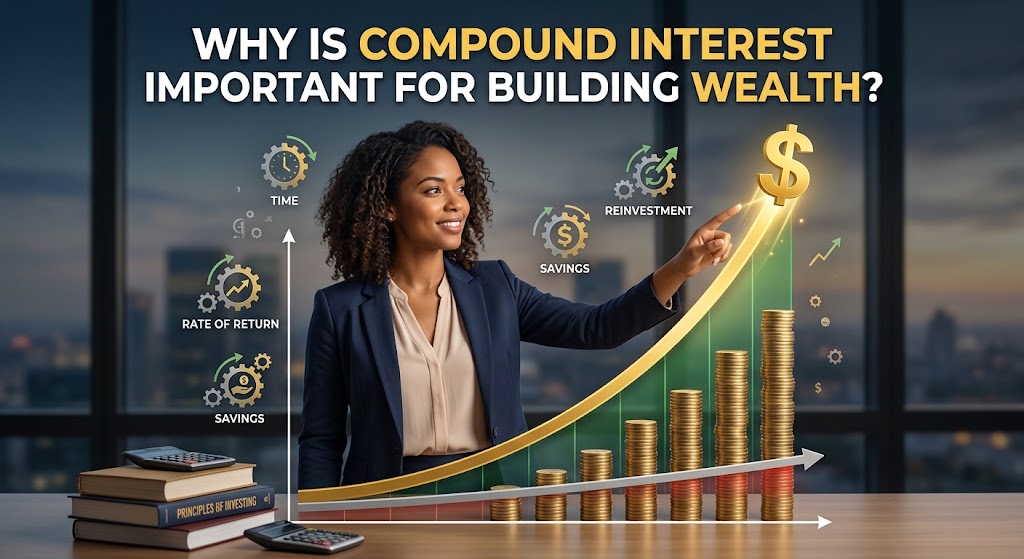
Why is compound interest important for building wealth?
If you have ever wondered why some people seem to build substantial wealth without making extraordinary amounts of money, one of the answers may be hiding in a simple financial concept: compound interest. Understanding why is compound interest important for building wealth can completely change the way you think about saving, investing and your financial future. Compound interest is one of the most powerful forces available to ordinary people who are willing to give their money enough time to grow.
At its simplest, compound interest means earning returns not only on the money you originally invested but also on the returns that money has already generated. Instead of your money producing returns that remain separate from the original amount, those returns are added to the growing balance, allowing future returns to be calculated on a larger amount.
This is what makes compound interest so different from simple interest. With simple interest, returns are generally calculated only on the original principal. With compound interest, the accumulated returns become part of the amount capable of generating additional returns. The result can be powerful over long periods because growth begins building on previous growth.
The most important word when discussing compound interest is probably “time”. Many people focus heavily on how much money they can invest while overlooking how long that money can remain invested. Yet time can be just as important as the amount of money you contribute.
Imagine two people. One begins investing at age 25 and contributes consistently for several decades. Another waits until age 40 before becoming serious about investing but attempts to contribute larger amounts to compensate for the lost years. The second person may eventually invest substantial sums, but the first person has something that cannot be purchased later: additional time for compounding to work.
This is why understanding why is compound interest important for building wealth is especially valuable for young people. Starting early does not necessarily require starting with a large amount of money. It means giving relatively small amounts more time to grow.
Suppose you invest £1,000 and it earns an average return of 8 percent annually, with all returns remaining invested. After the first year, the account would have grown to approximately £1,080. The following year’s return would be calculated on £1,080 rather than the original £1,000. After another year, the balance would grow again, and the process would continue.
The difference may initially appear insignificant. The first few years might not produce spectacular results. This is one reason people sometimes underestimate compound interest. Early growth can feel slow because the investment base is still relatively small.
But as the balance becomes larger, the same percentage return represents a larger monetary amount. Eventually, the growth generated by the accumulated money can become much more significant than the original contributions.
This creates a snowball effect.
A small snowball rolling downhill does not look particularly impressive at the beginning. As it accumulates more snow, however, its size and momentum can increase. Compound growth behaves similarly. The early stage may require patience because the visible results are modest, but sustained growth can become increasingly powerful.
This is also why consistency matters. You do not need to predict exactly which year will produce the biggest investment return. Instead, the objective is to keep contributing, remain invested according to your strategy and allow compounding to continue working over time.
For example, someone who consistently invests £200 every month for decades could potentially accumulate a substantial portfolio, depending on investment returns, fees, taxes and market conditions. The investor is not relying solely on the original contributions. Over time, investment growth can become an increasingly important part of the overall balance.
The same principle applies regardless of whether your currency is pounds, naira, dollars, euros or another currency. The mathematics of compound growth does not care where you live. What changes are the available investment products, interest rates, inflation, taxes, fees, regulations and economic conditions.
For someone earning and investing in Nigeria, for example, understanding compound growth can be particularly useful when thinking about long term financial goals. However, it is important to distinguish between nominal growth and real growth. If an investment grows by a certain percentage while inflation is also high, the purchasing power of the final amount may be considerably different from the headline figure.
This brings us to another reason compound interest matters: it can help your money work alongside you.
Most people understand the concept of working for money. You provide labour, receive income and use that income to pay for your needs and wants. Investing introduces another possibility. Instead of relying entirely on your labour to generate future financial resources, you can put some of your existing capital into assets or accounts capable of generating returns.
Over a long period, those returns can themselves contribute to future growth.
That is the fundamental attraction of compounding.
However, compound interest should not be confused with guaranteed wealth. Investments can lose value. Returns vary. Some investments carry substantial risks. Inflation can reduce purchasing power. Fees can reduce returns. Taxes can affect the final amount. An investment that historically produced strong returns does not guarantee the same result in the future.
Therefore, the real lesson is not that compound interest magically turns everyone into a millionaire. The lesson is that time can amplify disciplined saving and investing when returns are reinvested.
Another important factor is reinvestment. Compounding works most effectively when returns remain invested rather than continually being withdrawn.
Suppose an investment generates income and you regularly remove that income to spend it. You may still receive returns, but you reduce the amount available to generate future returns. If instead the income is reinvested, the investment base can continue expanding.
This is why reinvesting dividends, interest or other eligible returns can be such an important part of long term wealth building, depending on the investment strategy being used.
Consider someone who receives a small return and thinks, “It is only a little money, so I might as well spend it.” That decision may seem harmless once. But repeated over twenty or thirty years, withdrawing returns can significantly reduce the potential effect of compounding.
The reverse is also true. Reinvesting relatively small returns consistently can allow them to become part of a much larger investment base.
Compound interest can also change how you think about financial decisions. Instead of asking only, “How much money can I make today?” you begin asking, “What could this money become if I leave it invested for many years?”
That question encourages long term thinking.
For example, spending £1,000 today means you enjoy whatever that £1,000 buys you now. Investing that £1,000 means giving up some present consumption in exchange for the possibility of having a larger amount in the future.
Neither decision is automatically right or wrong. Life requires spending. People have legitimate needs and deserve to enjoy their money. The important point is recognising the opportunity cost.
Money spent today cannot simultaneously compound in an investment account.
This does not mean you should become obsessed with saving every penny. Extreme financial behaviour can create its own problems. Instead, successful wealth building often involves finding a sustainable balance between enjoying the present and preparing for the future.
Compound interest is particularly powerful because it rewards patience, but patience is difficult in a world built around instant gratification.
Modern society encourages immediate consumption. Social media constantly displays new products, holidays, cars, gadgets, restaurants and lifestyles. Buy now. Upgrade now. Experience it now. Subscribe now.
Investing requires almost the opposite mindset.
It asks you to make a decision today for a benefit that may not become significant for many years.
That can feel frustrating because human beings naturally tend to value immediate rewards. The future is uncertain, while today’s purchase is tangible.
This is one reason financial discipline matters so much.
The person who understands compounding begins to see small financial decisions differently. A seemingly insignificant amount of money invested consistently can have a future value far greater than its current value, depending on the return achieved and the time involved.
This does not mean every small expense should be eliminated. It means repeated spending deserves attention.
A £5 purchase is not financially devastating by itself. But repeated unnecessary spending can become significant when viewed over months and years. More importantly, the money could potentially have been saved or invested instead.
This is where the concept of opportunity cost becomes powerful.
If you spend money, you are not simply losing the amount you paid. You may also be giving up whatever future value that money could have generated.
Again, this should not be taken to mean that spending money is always bad. Money exists to provide utility. Education, healthcare, family, experiences, housing, food and many other expenses can be extremely valuable.
The goal is conscious spending rather than mindless spending.
Understanding why is compound interest important for building wealth can therefore improve both investing and budgeting behaviour.
Another major advantage of compound interest is that it can reduce the pressure to achieve extraordinary investment returns. If you have several decades, you may not need to chase extremely risky investments in an attempt to become wealthy quickly.
Time can provide another path.
An investor who begins early, contributes consistently and earns reasonable long term returns may have a more sustainable wealth building strategy than someone who repeatedly takes excessive risks because they want rapid results.
This is especially important because the desire to get rich quickly can cause people to make poor financial decisions. Promises of guaranteed high returns, overnight wealth and effortless passive income should always be treated with caution.
Compounding is powerful precisely because it does not require magic.
It requires time, capital, reinvestment and reasonable returns.
There is another side to compound interest that consumers need to understand: compounding can work against you when it comes to debt.
The same mathematical principle that can help investments grow can make certain debts increasingly expensive.
If interest accumulates on unpaid debt and additional interest is charged on the growing balance, the amount owed can rise significantly. Credit card debt, certain loans and other high interest obligations can therefore become serious obstacles to wealth building.
This means one of the smartest financial decisions may sometimes be paying down expensive debt rather than immediately pursuing investments.
If you are paying a very high interest rate on debt while expecting a comparatively lower return from an investment, the mathematics may favour reducing the debt first, depending on your circumstances.
This is another reason financial literacy matters. Compound interest is neither inherently good nor bad. It is a mechanism. It can accelerate growth when applied to investments and accelerate costs when applied to certain forms of debt.
The person who understands that mechanism has a major advantage over someone who does not.
Compound interest also teaches an important lesson about financial consistency. You do not need to be perfect to benefit from long term investing. Missing one contribution does not destroy your financial future. The bigger issue is developing a sustainable habit.
Someone who invests a manageable amount every month for decades may ultimately be in a stronger position than someone who makes large investments occasionally but lacks consistency.
The key is sustainability.
If your investment contribution is so large that it prevents you from paying essential expenses or causes you to abandon the strategy after a few months, it may not be sustainable. A smaller amount that you can consistently maintain may be more useful.
Your income can also change over time. As your earnings increase, you can potentially increase your contributions. A person might start with a modest amount early in their career and gradually invest more as their income grows.
This creates two forces working together: increasing contributions and compounding returns.
The earlier you begin, the more time you give the process.
This is why delaying investment because you cannot afford to invest a large amount can be a mistake. You do not necessarily need to begin with a fortune. You need a realistic starting point and a plan that can evolve.
Of course, before investing, it is sensible to consider emergency savings, expensive debt, financial goals, risk tolerance and access to appropriate regulated investment products. The specific strategy should depend on your circumstances.
It is also important to remember that compound interest calculations often use assumed rates for illustration. Real world investments do not necessarily deliver a fixed return every year. Markets can rise and fall, and even assets that have performed well historically can experience periods of significant decline.
Therefore, projected compound growth should be treated as an illustration rather than a promise.
Despite these limitations, the principle remains powerful.
Time can transform ordinary contributions into meaningful wealth when growth is allowed to build upon previous growth.
Perhaps the most important lesson from understanding why is compound interest important for building wealth is that wealth building is usually less about finding one spectacular financial opportunity and more about repeatedly making sensible decisions.
Start saving.
Invest appropriately.
Reinvest returns where suitable.
Avoid unnecessary high interest debt.
Keep costs under control.
Increase contributions as income grows.
Give your money time.
Repeat.
The process may appear boring, especially at the beginning. Your account may not immediately look impressive. You may become tempted to stop because the progress feels too slow.
But compounding is not designed to impress you during the first few months.
Its greatest potential appears over long periods.
That is why starting early can be so valuable. Every year you delay is a year of potential compounding you cannot recover. You can increase your contributions later, but you cannot go back and create additional years.
The person who starts today with a modest amount may have an advantage over the person who plans to start with a much larger amount five or ten years from now.
Ultimately, compound interest is important for building wealth because it allows your existing money and its accumulated returns to participate together in future growth. It transforms time from something that simply passes into a potential financial asset.
You cannot control everything that happens in the economy. You cannot guarantee investment returns. You cannot predict every market movement. You cannot eliminate inflation or financial uncertainty.
But you can control when you start, how consistently you save and invest, how much unnecessary debt you take on and whether you allow suitable returns to remain invested.
That is the real power behind compounding.
You do not have to become wealthy overnight.
You need to give your money enough time and discipline to potentially become more valuable than it was when you started.
So, why is compound interest important for building wealth?
Because wealth does not always grow through dramatic financial decisions. Sometimes it grows quietly, repeatedly and almost invisibly while you continue living your life. A contribution made today may appear insignificant. A return earned this year may look small. But when those returns are allowed to generate further returns over many years, the mathematics can become remarkably powerful.
The biggest advantage may therefore belong not to the person who starts with the most money, but to the person who understands the value of starting early and staying consistent.
Time cannot be deposited into a bank account.
It cannot be borrowed from the future.
It cannot be recovered once it has passed.
But when you combine time with disciplined saving, appropriate investing and reinvested returns, you give compound growth an opportunity to work.
And that is why compound interest remains one of the most important concepts anyone serious about building long term wealth should understand.

EarnSmartOnline.com.ng is dedicated to helping readers make smarter financial decisions through practical guides on online income, personal finance, technology, digital business, and wealth creation. Our goal is to provide reliable, easy-to-understand, and actionable content that empowers individuals to earn smarter, build sustainable income streams and achieve long-term financial success.
Recommended: Start Earning Online
- Ultimate Affiliate Marketing Program — learn affiliate marketing with a done-for-you sales system ($15). Check it out
- The Newbie Affiliate Guide — the beginner-friendly starter guide (~$6.68). Check it out
- Easy Dollar Maker — earn in dollars uploading AI images and videos from your phone ($17). Check it out
Disclosure: These are affiliate links. If you buy through them, I may earn a commission at no extra cost to you.



