
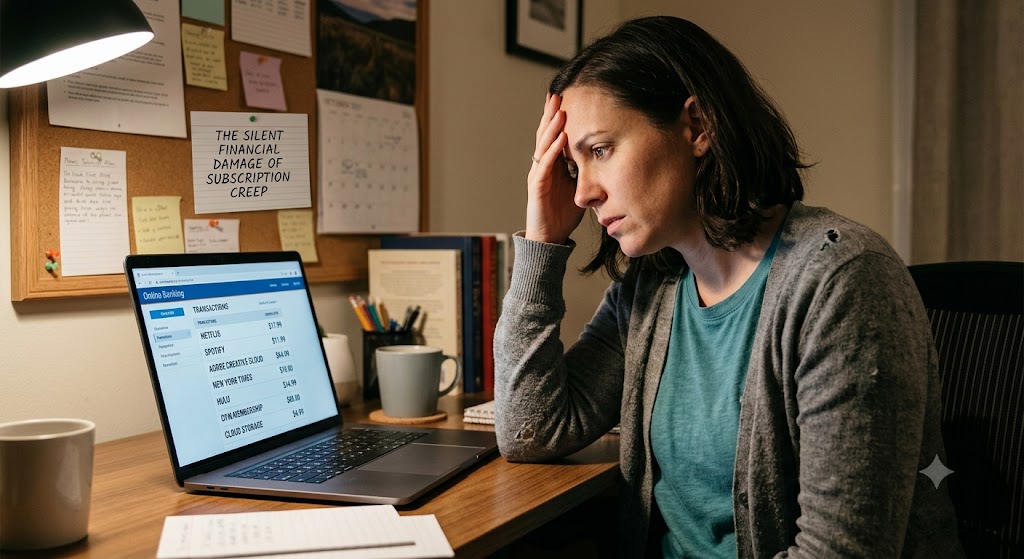
The Silent Financial Damage of Subscription Creep
There was a time when buying a product meant paying once and owning it. Today, life has quietly shifted into a subscription economy where people no longer purchase many of the things they use. Instead, they pay monthly, quarterly, or yearly fees for entertainment, software, cloud storage, fitness apps, music, television, learning platforms, gaming services, security software, productivity tools, and even household products. At first glance, each subscription appears harmless because the individual cost is often small. Five dollars here, ten dollars there, another fifteen somewhere else. None of these amounts seems significant enough to trigger concern. Yet hidden beneath these tiny recurring payments is a financial problem that millions of people fail to recognize until they examine their bank statements closely. This growing problem is known as subscription creep, and its financial damage is often silent, gradual, and surprisingly expensive.
The silent financial damage of subscription creep begins with the way the human mind processes small recurring expenses. Most people react strongly when they see a large one-time purchase because it immediately affects their bank balance. Spending one thousand dollars in a single transaction feels painful and demands careful consideration. However, paying ten dollars every month rarely receives the same level of scrutiny, even though that payment continues indefinitely. The brain treats recurring micro-payments differently from large purchases, allowing them to blend into everyday life. This psychological blind spot makes subscription services incredibly profitable for businesses while quietly reducing consumers’ financial flexibility.
One of the biggest reasons subscription creep becomes dangerous is automation. Once a payment method is connected to a service, renewals happen automatically without requiring fresh approval. Every month, the money disappears before the customer has another opportunity to reconsider whether the service is still valuable. This convenience benefits both businesses and consumers, but it also removes an important financial checkpoint. Without consciously making the purchase again, people gradually lose awareness of where their money is going.
Many individuals sign up for services with genuine intentions. A fitness application promises better health. An online learning platform offers career advancement. A premium music service eliminates advertisements. A cloud storage plan protects important files. Each decision appears reasonable in isolation. The problem emerges when these subscriptions accumulate over time. One becomes three. Three become eight. Eight become fifteen. Before long, an individual is paying hundreds of dollars every month for services they barely use.
Subscription creep rarely announces itself with dramatic warning signs. Instead, it grows quietly. A free trial converts into a paid plan because cancellation was forgotten. A family streaming platform remains active even after children leave home. An old software subscription continues despite switching to a different program. A forgotten domain renewal charges automatically each year. A premium mobile application renews long after its usefulness has expired. Each payment seems too small to investigate individually, but together they create a constant drain on financial resources.
This invisible drain creates opportunity costs that most people never calculate. Every dollar committed to an unnecessary subscription is a dollar unavailable for savings, investing, debt reduction, emergency funds, education, or business opportunities. The financial impact extends far beyond the subscription fee itself because money that could have generated future wealth instead disappears into services that may no longer provide meaningful value.
Consider someone paying one hundred and fifty dollars every month across multiple subscriptions they rarely use. That amounts to one thousand eight hundred dollars annually. Invested consistently over twenty years with reasonable returns, that same money could grow into tens of thousands of dollars. The real cost of subscription creep is therefore not only what people spend today but also the wealth they never create tomorrow.
Modern companies understand this reality exceptionally well. Many businesses intentionally design their pricing models around recurring revenue because predictable monthly income creates financial stability for the company. Instead of convincing customers to buy repeatedly, they convince them to forget they are buying at all. Features such as automatic renewal, stored payment information, free introductory periods, annual billing discounts, and complicated cancellation processes all contribute to keeping subscriptions active for as long as possible.
Free trials deserve particular attention because they exploit human psychology in subtle ways. A service advertises thirty days free with no immediate payment required. Signing up feels risk-free because there is no instant financial sacrifice. However, payment details are collected upfront, and once the trial ends, charges begin automatically unless cancelled beforehand. Busy schedules, forgetfulness, or simple procrastination often lead consumers to continue paying for services they never intended to keep.
Subscription creep also changes how people perceive affordability. Instead of asking whether they can truly afford a purchase, consumers increasingly ask whether they can afford the monthly payment. This shift dramatically alters spending behaviour. A product costing six hundred dollars may seem expensive, but framing it as fifty dollars per month makes it appear manageable. Businesses understand this psychological effect and increasingly promote monthly pricing because it reduces perceived financial resistance.
Digital services have expanded this phenomenon into nearly every area of life. Entertainment subscriptions provide endless films and television shows. Music platforms offer unlimited listening. Cloud services promise secure backups. Software companies replace permanent licences with monthly access fees. Gaming platforms encourage recurring memberships. Professional tools require continuous payments to remain functional. Educational websites offer premium learning libraries. Artificial intelligence services introduce monthly usage plans. Individually, these subscriptions appear beneficial. Collectively, they create a permanent financial obligation.
Another hidden danger involves emotional purchasing. People often subscribe during moments of excitement, optimism, or aspiration. A language-learning app represents the hope of becoming bilingual. A meditation platform symbolises a commitment to better mental health. A professional software package reflects ambitious career goals. Unfortunately, motivation naturally declines over time while the subscription continues charging automatically. Consumers frequently end up paying for the person they hoped to become rather than the habits they actually maintain.
Subscription creep also encourages fragmented financial thinking. Rather than evaluating total monthly commitments, people judge each expense individually. Five dollars feels insignificant. Seven dollars seems harmless. Twelve dollars appears reasonable. Twenty dollars sounds affordable. Yet combining twenty such subscriptions creates a substantial recurring financial obligation that rivals major household expenses.
Families often experience subscription duplication without realizing it. Different members subscribe separately to similar streaming platforms, productivity software, storage services, fitness applications, antivirus programs, or educational resources. Without coordination, households unknowingly pay multiple times for nearly identical services, significantly increasing monthly costs while receiving little additional value.
Businesses are not immune to subscription creep either. Companies frequently accumulate software licences for former employees, duplicate productivity platforms, unused marketing tools, abandoned project management systems, and forgotten cloud services. Because these expenses are spread across different departments and budgets, they may remain unnoticed for years. Small recurring charges quietly reduce profitability without attracting management attention.
Subscription creep affects financial confidence as well. Many people struggle to understand why their bank accounts never seem to grow despite earning reasonable incomes. They believe they control their spending because they avoid extravagant purchases. However, recurring subscriptions continuously reduce available cash flow. Without identifying these silent expenses, individuals may incorrectly assume they simply need higher incomes when, in reality, better expense management could significantly improve their financial position.
The psychological burden created by excessive subscriptions should not be underestimated. Every recurring payment represents an ongoing commitment. Even if individual amounts remain small, collectively they contribute to financial stress by increasing fixed monthly obligations. Higher fixed expenses reduce flexibility during emergencies because income must first satisfy existing commitments before addressing unexpected needs.
Subscription creep also weakens intentional spending. Financially successful individuals tend to direct money toward priorities aligned with their long-term goals. Unchecked subscriptions gradually redirect money away from conscious choices toward automatic payments. Instead of intentionally deciding where money goes each month, automated systems make those decisions silently in the background.
Technology has made subscribing remarkably easy while making cancellation surprisingly difficult. Some companies require multiple confirmation screens, customer service interactions, retention offers, or hidden account settings before allowing cancellation. These obstacles increase the likelihood that consumers postpone cancelling, allowing additional payments to continue indefinitely.
Another overlooked consequence is subscription inflation. Initial prices often increase gradually over time. A service that originally cost five dollars monthly may eventually rise to eight, then twelve, then fifteen dollars. Because increases occur gradually, many customers accept them without reconsidering whether the service remains worthwhile. The subscription quietly becomes far more expensive than originally intended.
Social influence further contributes to subscription creep. People subscribe because friends recommend services, influencers promote premium memberships, colleagues discuss productivity tools, or social media creates fear of missing out. Consumers accumulate subscriptions not solely because of genuine need but because participation appears normal within their social circles.
Breaking free from subscription creep requires awareness before action. The first step involves conducting a complete subscription audit. Every recurring payment should be identified, regardless of size. Bank statements, credit card records, digital wallet histories, and payment platforms should all be reviewed carefully. Many people discover forgotten subscriptions they have not consciously used in months or even years.
After identifying subscriptions, each should be evaluated honestly. Does it provide consistent value? Is it used regularly? Would life become significantly worse without it? Could a free alternative accomplish the same purpose? Could multiple subscriptions be replaced by one comprehensive service? Honest answers often reveal surprising opportunities for savings.
One effective strategy involves creating intentional friction before subscribing. Instead of activating automatic renewals immediately, consumers can delay decisions by waiting a few days. This simple pause reduces impulse subscriptions driven by temporary excitement. Likewise, using calendar reminders before renewal dates encourages active evaluation rather than passive continuation.
Financial experts frequently recommend adopting a one-in, one-out subscription rule. Before adding a new recurring expense, cancel an existing one. This approach prevents uncontrolled subscription growth while encouraging thoughtful prioritisation. Every new commitment must justify replacing another.
Annual reviews are equally valuable. People’s needs change over time. Services that once delivered tremendous value may become unnecessary as careers evolve, hobbies change, or technology improves. Revisiting subscriptions at least once each year ensures recurring payments continue reflecting current priorities rather than outdated circumstances.
Consumers should also distinguish between convenience and necessity. Many premium services offer additional features that provide comfort rather than genuine value. Paying for convenience is not inherently wrong, but it should always be an intentional decision rather than an overlooked habit.
Building financial awareness transforms the conversation from asking, “Can I afford another subscription?” to asking, “What future opportunity am I sacrificing for this recurring payment?” This subtle shift encourages long-term thinking instead of short-term affordability. Every recurring expense competes with future investments, savings, business opportunities, travel experiences, and financial independence.
Subscription creep illustrates an important truth about personal finance. Financial success is rarely determined by avoiding only major mistakes. More often, it depends upon recognizing countless small decisions that quietly shape long-term outcomes. Tiny recurring expenses may appear insignificant individually, but together they possess extraordinary power to influence financial health.
The silent financial damage of subscription creep serves as a reminder that money rarely disappears dramatically. Instead, it often leaves quietly through unnoticed habits repeated month after month. Those habits gradually determine whether income creates lasting wealth or merely funds continuous consumption. The people who achieve strong financial stability are not necessarily those who earn the most. They are often those who consistently examine where their money goes, eliminate unnecessary financial leaks, and ensure every recurring expense serves a meaningful purpose.
Ultimately, subscription services are neither inherently good nor inherently bad. Many provide exceptional value, save time, improve productivity, deliver entertainment, or enhance professional performance. The danger arises when subscriptions accumulate without deliberate oversight. Financial freedom depends not merely on earning more but on maintaining conscious control over recurring commitments. By reviewing subscriptions regularly, questioning automatic renewals, resisting unnecessary additions, and aligning recurring expenses with genuine priorities, individuals can stop subscription creep before it silently erodes their financial future. The smallest monthly charges often carry the greatest long-term consequences because their true cost is measured not only in money spent today but in wealth that could have been built tomorrow.

EarnSmartOnline.com.ng is dedicated to helping readers make smarter financial decisions through practical guides on online income, personal finance, technology, digital business, and wealth creation. Our goal is to provide reliable, easy-to-understand, and actionable content that empowers individuals to earn smarter, build sustainable income streams and achieve long-term financial success.
Recommended: Start Earning Online
- Ultimate Affiliate Marketing Program — learn affiliate marketing with a done-for-you sales system ($15). Check it out
- The Newbie Affiliate Guide — the beginner-friendly starter guide (~$6.68). Check it out
- Easy Dollar Maker — earn in dollars uploading AI images and videos from your phone ($17). Check it out
Disclosure: These are affiliate links. If you buy through them, I may earn a commission at no extra cost to you.



