
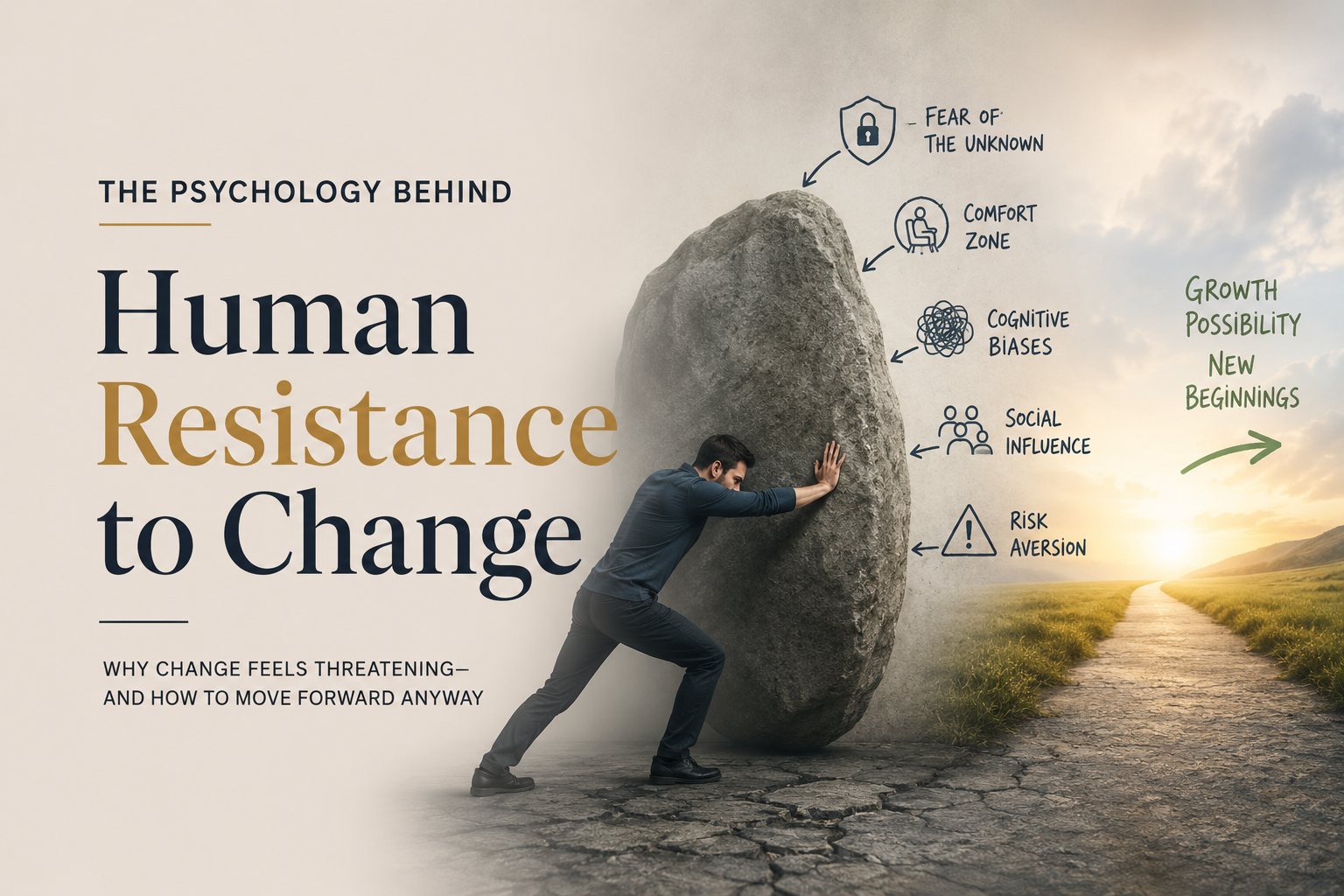
The Psychology Behind Human Resistance to Change
Change is one of the few constants in life. Technology changes, societies evolve, businesses adapt, and individuals move through different stages of life. Despite this reality, many people resist change even when it has the potential to improve their circumstances. Whether it is adopting a new habit, accepting a different way of thinking, switching careers, embracing technological advancements, or making lifestyle adjustments, resistance to change remains a deeply rooted human behavior. Understanding the psychology behind human resistance to change reveals why people often cling to familiar situations even when those situations are no longer serving their best interests.
At its core, resistance to change is closely tied to the human brain’s desire for safety and predictability. Throughout human history, survival depended heavily on recognizing patterns and avoiding unnecessary risks. Familiar environments, routines, and behaviors increased the chances of survival because they reduced uncertainty. As a result, the human brain evolved to favor what is known over what is unknown. Even in modern society, where physical survival is less dependent on routine, the brain continues to interpret uncertainty as a potential threat.
One of the strongest psychological forces behind resistance to change is the fear of the unknown. People often imagine worst case scenarios when confronted with unfamiliar situations. The mind tends to focus on what could go wrong rather than what could go right. A person considering a career change may worry about financial instability, failure, or disappointment. Someone trying to adopt healthier habits may fear losing comfort or social acceptance. Because the future cannot be predicted with complete certainty, the brain frequently fills the gaps with anxiety and caution.
Another major factor is the comfort zone. Human beings naturally develop routines that create a sense of stability and control. These routines reduce mental effort because they become automatic over time. Change often requires learning new skills, adjusting expectations, and investing energy into unfamiliar activities. The brain prefers efficiency and therefore tends to resist actions that require significant cognitive effort. Even when people recognize the benefits of change, the immediate discomfort associated with leaving their comfort zone can outweigh the perceived long term rewards.
Loss aversion also plays a significant role in resistance to change. Psychological research has shown that people tend to feel the pain of loss more intensely than the pleasure of equivalent gains. In simple terms, losing one hundred dollars feels worse than gaining one hundred dollars feels good. This tendency influences decision making in many areas of life. When faced with change, individuals often focus more on what they might lose rather than what they might gain. They may fear losing familiarity, status, relationships, routines, or a sense of identity. These perceived losses can create powerful emotional barriers that make change seem more threatening than beneficial.
Identity is another critical element in understanding resistance to change. People develop beliefs about who they are based on their experiences, habits, relationships, and achievements. These identities provide a sense of consistency and meaning. When change challenges an existing identity, resistance often follows. For example, someone who sees themselves as a traditional worker may resist entrepreneurship because it conflicts with their self image. Similarly, a person who identifies with a particular social group may resist ideas that challenge the group’s values or beliefs. In many cases, resistance is not about the change itself but about protecting a deeply held sense of self.
Social influence also contributes to human resistance to change. People are highly social creatures who seek acceptance and belonging. Communities, families, and social networks often establish norms that influence behavior. When a proposed change threatens these norms, individuals may experience pressure to conform. A person who adopts a different lifestyle, career path, or belief system may fear criticism, rejection, or isolation from their social circle. The desire to maintain social harmony can become a powerful force that discourages personal transformation.
Another psychological factor is the tendency to overvalue current circumstances. This phenomenon, often referred to as status quo bias, causes people to prefer existing conditions simply because they are familiar. The current situation may not be ideal, but it feels predictable. The uncertainty associated with change can make the status quo appear safer and more attractive than it actually is. As a result, people often remain in unsatisfying jobs, unhealthy relationships, or limiting environments because maintaining the current situation feels less risky than pursuing something new.
Past experiences can further strengthen resistance to change. Individuals who have experienced failure, disappointment, or negative consequences from previous changes may become more cautious about future opportunities. The human brain is designed to learn from experience, but it can sometimes overgeneralize lessons from the past. A person who failed in one business venture may conclude that entrepreneurship is not for them. Someone who experienced heartbreak may become resistant to new relationships. These conclusions can create mental barriers that limit growth and prevent individuals from embracing beneficial changes.
Emotions play an equally important role in shaping resistance. Change often triggers feelings of uncertainty, anxiety, stress, and vulnerability. These emotional responses can activate defensive mechanisms that encourage avoidance. When people feel overwhelmed, they may delay decisions, reject new ideas, or cling more tightly to familiar habits. Emotional discomfort can create the illusion that change itself is dangerous, even when the actual risk is relatively low.
The brain’s preference for immediate rewards also contributes to resistance. Many meaningful changes require short term sacrifices for long term benefits. Improving physical health may require giving up unhealthy foods. Building financial security may require reducing unnecessary spending. Developing new skills may demand time and effort without immediate results. Because the brain is naturally drawn toward immediate gratification, it often struggles to prioritize distant rewards over present comfort. This tendency makes it difficult for individuals to maintain motivation during periods of transition.
Cognitive biases further reinforce resistance to change. Confirmation bias causes people to seek information that supports their existing beliefs while ignoring evidence that contradicts them. This can make individuals resistant to new perspectives or opportunities. If someone believes they are incapable of success in a particular area, they may focus on examples that confirm this belief while dismissing evidence that suggests otherwise. Such biases create self reinforcing patterns that make change more difficult.
Interestingly, resistance to change is not always irrational. In some situations, caution can be beneficial. Not every change leads to improvement, and thoughtful evaluation is important when making significant decisions. However, problems arise when resistance becomes automatic and prevents individuals from adapting to evolving circumstances. In a rapidly changing world, excessive resistance can limit personal growth, career advancement, and overall well being.
Overcoming resistance to change begins with awareness. Recognizing the psychological mechanisms behind resistance allows individuals to approach change more objectively. Instead of viewing discomfort as a sign that something is wrong, people can learn to see it as a natural part of growth. Understanding that fear, uncertainty, and temporary discomfort are normal responses can reduce their influence over decision making.
Breaking large changes into smaller steps can also reduce resistance. The brain often reacts strongly to dramatic shifts but responds more positively to gradual adjustments. Small, consistent actions create momentum and build confidence over time. As individuals accumulate positive experiences, their perception of change becomes less threatening and more manageable.
Developing a growth mindset is another powerful strategy. People with a growth mindset believe that abilities, intelligence, and skills can be developed through effort and learning. This perspective encourages resilience and adaptability. Instead of viewing challenges as threats, individuals begin to see them as opportunities for improvement. A growth mindset reduces fear of failure and increases willingness to embrace change.
Building supportive relationships can further ease the transition process. Encouragement from friends, mentors, colleagues, or family members can provide reassurance during uncertain periods. Supportive environments help individuals maintain motivation and confidence while navigating unfamiliar situations.
Ultimately, the psychology behind human resistance to change reflects a complex interaction of evolutionary instincts, emotional responses, cognitive biases, social influences, and personal experiences. While resistance is a natural part of being human, it does not have to dictate one’s future. Growth, innovation, and progress often require stepping beyond familiar boundaries and embracing uncertainty. The individuals who learn to understand and manage their resistance are often the ones who unlock new opportunities, develop greater resilience, and achieve lasting personal transformation.
Change may never feel completely comfortable, but understanding the reasons behind resistance allows people to move forward despite their fears. By recognizing the psychological forces at work, individuals can make more intentional decisions, adapt more effectively to life’s challenges, and create a future that is not limited by the comfort of the past.

EarnSmartOnline.com.ng is dedicated to helping readers make smarter financial decisions through practical guides on online income, personal finance, technology, digital business, and wealth creation. Our goal is to provide reliable, easy-to-understand, and actionable content that empowers individuals to earn smarter, build sustainable income streams and achieve long-term financial success.
Recommended: Start Earning Online
- Ultimate Affiliate Marketing Program — learn affiliate marketing with a done-for-you sales system ($15). Check it out
- The Newbie Affiliate Guide — the beginner-friendly starter guide (~$6.68). Check it out
- Easy Dollar Maker — earn in dollars uploading AI images and videos from your phone ($17). Check it out
Disclosure: These are affiliate links. If you buy through them, I may earn a commission at no extra cost to you.



