
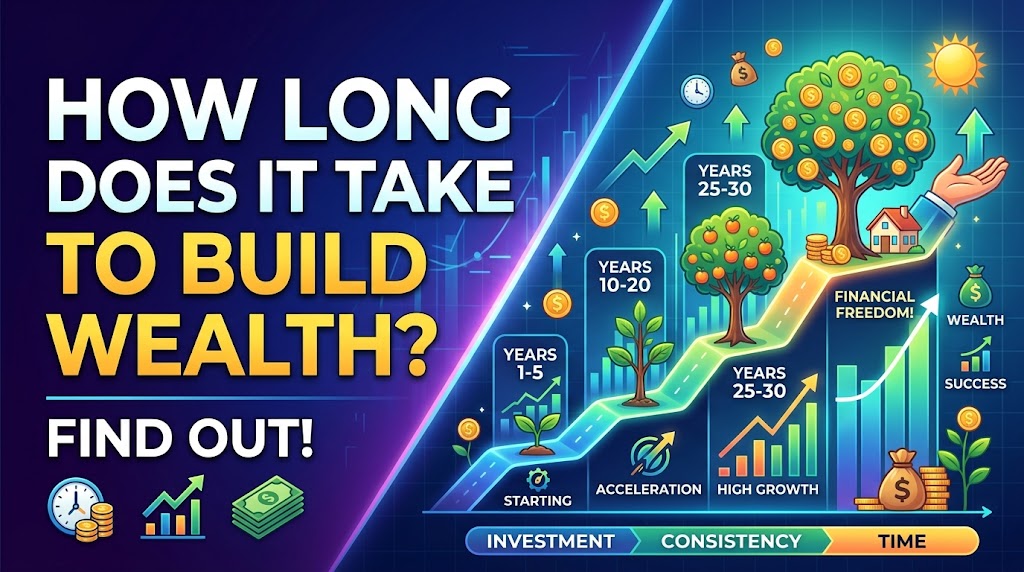
How long does it take to build wealth?
I used to think wealth was something that happened quickly to a lucky group of people. Whenever I saw stories about successful entrepreneurs, investors, or business owners, I assumed there was a secret shortcut they had discovered that ordinary people did not know about. Social media made it even worse. Every day I came across people claiming they made huge amounts of money in a few weeks, bought expensive cars overnight, or transformed their lives in what seemed like an instant. How long does it take to build wealth?
For a long time, those stories shaped my expectations. I believed that if I worked hard enough for a few months, I would see dramatic financial results. When those results did not come as quickly as I expected, I became frustrated. I questioned my ideas, doubted my abilities, and sometimes felt tempted to abandon projects that were actually making progress.
Over time, however, I learned a lesson that changed the way I think about money and success. The answer to the question, “How long does it take to build wealth?” is often much longer than most people expect. Wealth is usually not the result of a single event. It is more often the result of consistent effort, smart decisions, patience, and the willingness to keep going when visible results are still small.
One of the biggest misconceptions about wealth is that it is measured by income alone. Many people earn good salaries but struggle financially because they spend almost everything they make. Others may not earn extraordinary incomes, yet they gradually build substantial wealth because they save, invest, and create assets that continue producing value over time.
This was a difficult lesson for me to understand because I initially focused on money coming in rather than assets being built. I paid attention to immediate earnings instead of long term growth. When income was slow, I felt like I was failing. What I did not realise was that every article I wrote, every skill I learned, every customer relationship I developed, and every business process I improved was becoming part of a foundation that could generate future income.
The reality is that wealth often grows silently before it becomes visible. A tree does not produce fruit immediately after it is planted. Before anyone sees the fruit, roots are developing underground. The same principle applies to financial growth. There is usually a period where a person appears to be making little progress, yet important foundations are being established beneath the surface.
When people ask, “How long does it take to build wealth?” they often hope for a specific number. They want to hear that wealth can be achieved in one year, three years, or five years. While there are exceptional cases, there is no universal timeline because wealth depends on several factors. Income, expenses, investment habits, business decisions, market conditions, financial discipline, and personal circumstances all play significant roles.
However, one pattern appears repeatedly among people who successfully build wealth. They commit to a long term process. Many spend years developing expertise before they experience significant financial rewards. They understand that sustainable wealth rarely appears overnight.
I remember speaking with someone who had built a successful online business. From the outside, it looked as though success arrived suddenly. Their website was attracting large amounts of traffic, generating revenue, and receiving recognition. What most people did not see was the decade of effort behind the scenes. There were years of writing content that hardly anyone read, months spent learning technical skills, countless mistakes, and repeated failures before momentum finally arrived.
That conversation changed my perspective because it revealed something important. What looks like overnight success is often the result of years of invisible preparation.
The same principle applies to investing. Many people become discouraged because their investments seem small during the early years. They contribute consistently but feel disappointed when growth appears slow. What they may not realise is that compound growth becomes more powerful over time. The early stages often feel insignificant because the numbers are small. Later, the accumulated gains begin producing gains of their own, creating acceleration that was not visible at the beginning.
This is one reason patience is so valuable in wealth building. Patience allows you to stay committed long enough to experience the benefits of compound growth. Without patience, many people abandon strategies that could have transformed their financial future.
Another lesson I learned is that wealth building is often more about consistency than intensity. Many people start with tremendous enthusiasm. They work extremely hard for a short period and expect dramatic results. When those results fail to appear quickly, motivation fades.
Consistent effort produces a different outcome. Small actions repeated daily can create remarkable progress over time. Saving a portion of income every month may not seem exciting. Learning a new skill every day may not feel revolutionary. Publishing content consistently may not attract immediate attention. Yet these activities accumulate. Over months and years, they can create opportunities and financial outcomes that seem impossible at the beginning.
I have seen this principle in business. Some entrepreneurs focus entirely on quick wins. Others focus on building systems, relationships, and assets. The first group may experience occasional bursts of success, but the second group often creates something that continues generating value long after the initial work has been completed.
When I began paying closer attention to successful people, I noticed that many of them were asset builders. They created businesses, intellectual property, websites, investments, products, brands, or networks that continued producing value. Instead of constantly exchanging time for money, they gradually developed resources that could generate income independently.
This observation helped me understand why wealth often takes time. Building assets requires effort before rewards arrive. There is usually an upfront investment of time, energy, knowledge, or money. The benefits come later.
Consider a person building a website. During the first few months, traffic may be minimal. Revenue may be non-existent. The process can feel discouraging. Yet every article adds value to the site. Every improvement enhances the user experience. Every visitor provides insight. Over time, the website becomes an asset capable of attracting traffic and generating income.
The same principle applies to professional development. Learning valuable skills often requires years of practice. Yet those skills can increase earning potential for decades. What appears slow in the short term may become extraordinarily valuable in the long term.
One mistake many people make is comparing their beginning to someone else’s middle or end. Social media encourages this behaviour because people usually share results rather than journeys. We see the successful business, the beautiful house, the profitable investment portfolio, or the luxury lifestyle. We rarely see the years of sacrifice, uncertainty, and persistence that made those outcomes possible.
This comparison creates unrealistic expectations. It makes people feel behind when they are actually progressing normally. Wealth building is not a race against other people. It is a personal journey shaped by individual circumstances and decisions.
Another factor that influences how long it takes to build wealth is financial discipline. High income alone does not guarantee wealth. If spending increases every time income increases, wealth accumulation becomes difficult. On the other hand, individuals who consistently spend less than they earn create opportunities to save and invest.
I learned that wealth is often created through the gap between income and expenses. That gap provides the resources needed to acquire assets, invest in opportunities, and withstand financial challenges. Without it, even substantial earnings can disappear quickly.
Risk management also matters. Some people pursue wealth through highly speculative strategies. Occasionally these approaches produce impressive results, but they can also lead to significant losses. Sustainable wealth builders often focus on balancing opportunity with caution. They seek growth while protecting what they have already accumulated.
Looking back, I realise that one of the most valuable changes in my mindset was shifting from short term thinking to long term thinking. Instead of asking how much money I could make this month, I began asking what assets I could build this year. Instead of focusing only on immediate rewards, I started considering future opportunities.
This shift reduced frustration because progress became easier to recognise. Even when income growth was slow, I could see improvements in skills, systems, content, relationships, and business assets. These improvements represented real progress even if financial rewards had not fully arrived.
So, how long does it take to build wealth? For some people, meaningful progress may become visible within a few years. For others, the journey may take a decade or more. The timeline varies widely, but the underlying principles remain remarkably consistent. Wealth usually rewards patience, discipline, consistency, learning, and asset creation.
The encouraging news is that wealth building does not require perfection. People make mistakes. Markets fluctuate. Businesses face challenges. Plans change. What matters most is the willingness to continue learning and adapting while maintaining a long term perspective.
If I could go back and advise my younger self, I would say this: stop looking for shortcuts and start building assets. Focus less on appearing successful and more on becoming valuable. Invest time in skills that solve real problems. Create things that can continue generating value after the initial work is completed. Be patient enough to allow compound growth to work in your favour.
Most importantly, understand that wealth is not built in a single moment. It is built through thousands of decisions made over time. Every pound saved, every skill learned, every productive hour invested, and every asset created contributes to the process.
The reason many people underestimate how long it takes to build wealth is because they focus on the destination rather than the journey. They see the outcome without seeing the years of preparation behind it. Yet those years are where wealth is actually created.
Today, when someone asks me, “How long does it take to build wealth?” my answer is different from what it once was. Wealth takes as long as it takes to consistently create more value than you consume, accumulate assets that appreciate or generate income, and remain committed long enough for your efforts to compound. For some, that may be several years. For others, it may take much longer. The exact timeline matters less than the process itself.
The real secret is not finding a faster path. The real secret is staying on the path long enough. Those who continue building when results seem small are often the ones who eventually achieve financial freedom. Wealth is rarely a sprint. More often, it is a marathon that rewards endurance, wisdom, and persistence. Once I understood that truth, I stopped asking how quickly I could become wealthy and started focusing on becoming the kind of person capable of building wealth for the long term. That mindset alone changed everything.

EarnSmartOnline.com.ng is dedicated to helping readers make smarter financial decisions through practical guides on online income, personal finance, technology, digital business, and wealth creation. Our goal is to provide reliable, easy-to-understand, and actionable content that empowers individuals to earn smarter, build sustainable income streams and achieve long-term financial success.
Recommended: Start Earning Online
- Ultimate Affiliate Marketing Program — learn affiliate marketing with a done-for-you sales system ($15). Check it out
- The Newbie Affiliate Guide — the beginner-friendly starter guide (~$6.68). Check it out
- Easy Dollar Maker — earn in dollars uploading AI images and videos from your phone ($17). Check it out
Disclosure: These are affiliate links. If you buy through them, I may earn a commission at no extra cost to you.



