
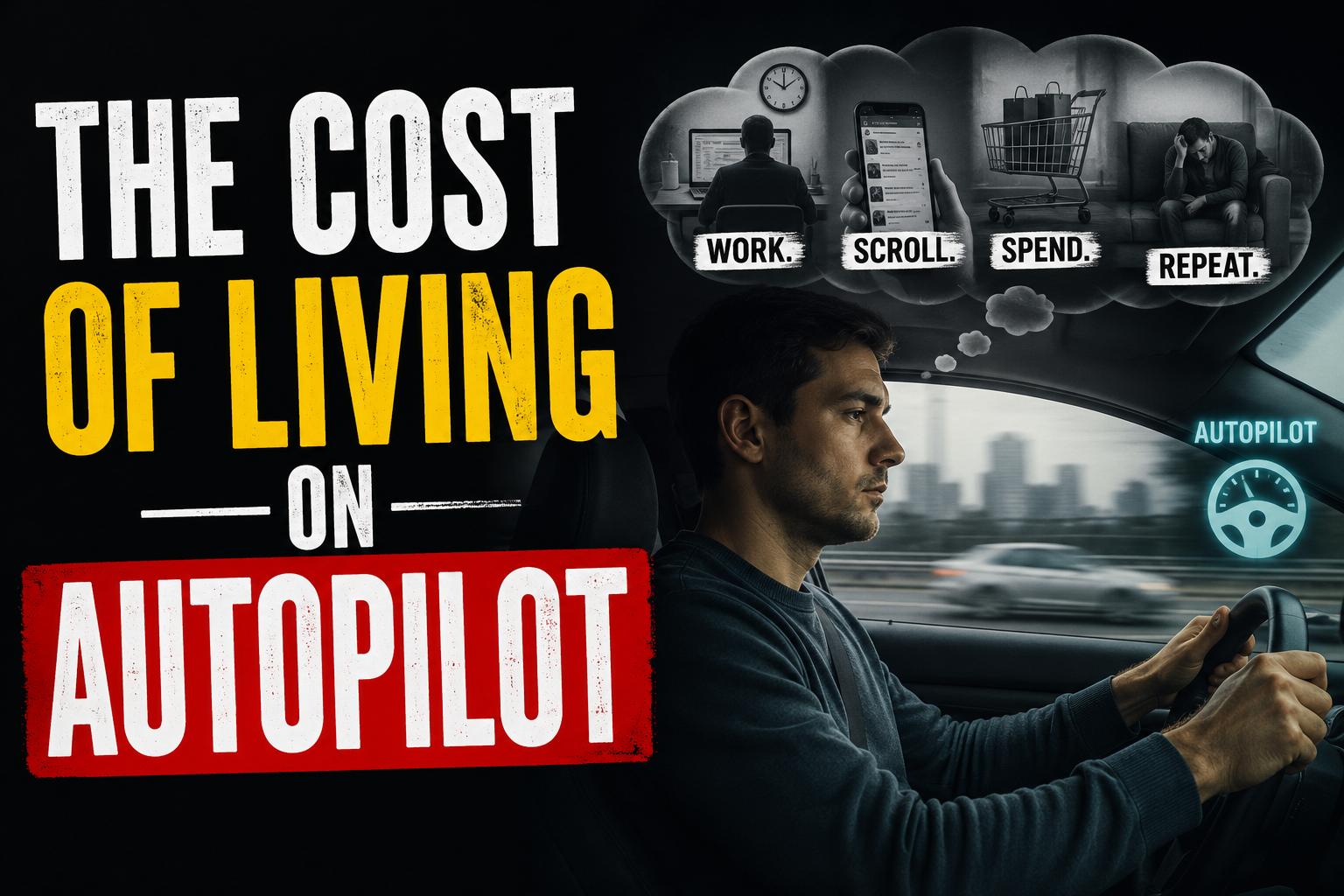
The Cost of Living on Autopilot
Most people move through life without ever truly questioning how they are living. Days blend into weeks, weeks into months, and months into years, all following the same familiar rhythm. Wake up, rush through responsibilities, respond to notifications, meet obligations, scroll through distractions, sleep, and repeat. On the surface, this feels normal and even productive. But beneath that surface, something deeper is happening. A quiet loss of direction, awareness, and intentional growth that slowly compounds over time. This is what it means to live on autopilot, and the cost is far greater than most people realize.
Living on autopilot is not about laziness. In fact, many people who live this way are extremely busy. They are constantly doing something, constantly reacting, and constantly occupied. The problem is not a lack of activity, but a lack of awareness behind that activity. When actions are driven by habit rather than intention, life becomes reactive instead of proactive. Instead of choosing direction, people follow patterns they never consciously selected. Over time, this creates a life shaped more by environment and circumstance than by personal design.
One of the most significant costs of living on autopilot is the loss of personal clarity. Clarity is what allows people to understand what truly matters to them. Without it, priorities become blurred. People begin to chase what is immediately available rather than what is genuinely valuable. They accept routines simply because they are familiar, not because they are meaningful. This lack of clarity slowly distances individuals from their real goals, even when they believe they are still moving forward.
Another major cost is the accumulation of wasted time. Time is one of the few resources that cannot be recovered once lost, yet autopilot living makes it feel abundant and unimportant. Hours are spent on low value activities without questioning their purpose. Social media scrolling, unnecessary comparisons, unproductive routines, and repetitive distractions consume large portions of attention. Individually, these moments seem harmless, but collectively they shape entire years of stagnation. The painful reality is that most people do not realize how much time they have lost until significant opportunities have already passed.
Living on autopilot also weakens decision making ability. When people are not actively engaged in their choices, they begin to rely on default reactions. Instead of evaluating situations critically, they fall back on comfort based decisions. This leads to repeated patterns of poor outcomes. Financial decisions become reactive rather than strategic. Career choices are made based on convenience instead of long term vision. Relationships are maintained out of habit rather than intention. Over time, this weakens the ability to think independently and confidently.
Another hidden cost is emotional numbness. When every day feels the same, the mind stops registering experiences deeply. Joy becomes less intense, curiosity fades, and even achievements begin to feel empty. This is because meaningful emotional engagement requires presence. Without presence, life loses its depth and becomes a sequence of mechanical actions. Many people mistake this numbness for maturity or stability, when in reality it is a sign of disconnection from experience.
Living on autopilot also limits growth. Growth requires conscious effort, reflection, and adaptation. When people operate on default patterns, they stop challenging themselves. They repeat what is comfortable instead of exploring what is necessary for development. Skills stagnate, perspectives remain unchanged, and potential remains untapped. The most dangerous part is that this stagnation is often invisible. Because life continues moving forward externally, it feels like progress is happening internally when it is not.
Relationships are also deeply affected by autopilot living. Many connections weaken not because of conflict, but because of neglect. Conversations become routine, presence becomes partial, and emotional investment decreases. People assume relationships will sustain themselves without intentional effort, but connection requires awareness and participation. When individuals are mentally absent, even while physically present, relationships slowly lose their strength and depth.
There is also a financial cost to living on autopilot. Without awareness, spending habits become automatic. People spend based on impulse, convenience, and emotional triggers rather than planning or strategy. Small daily financial decisions accumulate into long term consequences. Opportunities for saving, investing, and building wealth are often missed simply because there is no intentional financial direction. Over time, this leads to a cycle where income may increase, but financial freedom does not improve.
Perhaps one of the most overlooked costs is identity erosion. People who live on autopilot slowly lose touch with who they are and what they stand for. Identity becomes shaped by environment, social expectations, and repetition rather than conscious choice. Over time, individuals may find themselves living lives they never intentionally designed, but struggle to change because they no longer recognize the difference between habit and desire.
Breaking out of autopilot living begins with awareness. Awareness disrupts automatic behavior and introduces choice back into daily life. When people start questioning their routines, they begin to regain control over direction. Even small moments of reflection can create powerful shifts. Asking why a certain action is being taken or whether it aligns with long term goals can slowly rebuild intentional living.
Another important shift is slowing down mental reactions. Autopilot thrives on speed and repetition. When individuals slow down their thinking, they create space for evaluation. This does not mean doing less, but doing things with greater presence. Simple actions become more meaningful when they are performed with awareness rather than distraction.
Intentional living also requires redefining priorities. Many people think they know what matters to them, but their daily actions often reveal a different truth. Aligning behavior with values is a process that requires honesty and adjustment. It means removing unnecessary distractions and focusing energy on what actually contributes to long term fulfillment and progress.
The transition away from autopilot living is not immediate. It is a gradual process of reclaiming attention, rebuilding clarity, and restoring intentionality. It requires discomfort because it challenges familiar routines. However, the reward is a life that feels more directed, more meaningful, and more aligned with personal purpose.
Ultimately, the cost of living on autopilot is not just lost time or missed opportunities. It is the slow erosion of potential. It is the difference between a life that happens by default and a life that is consciously created. While autopilot living may feel safe and easy in the short term, its long term impact is a quiet form of limitation that many only recognize when significant portions of life have already passed.
The good news is that awareness changes everything. The moment a person realizes they are living on autopilot, they also gain the ability to change direction. Life does not require perfection, but it does require presence. And presence is the beginning of reclaiming control over time, decisions, and ultimately, the future itself.

EarnSmartOnline.com.ng is dedicated to helping readers make smarter financial decisions through practical guides on online income, personal finance, technology, digital business, and wealth creation. Our goal is to provide reliable, easy-to-understand, and actionable content that empowers individuals to earn smarter, build sustainable income streams and achieve long-term financial success.
Recommended: Start Earning Online
- Ultimate Affiliate Marketing Program — learn affiliate marketing with a done-for-you sales system ($15). Check it out
- The Newbie Affiliate Guide — the beginner-friendly starter guide (~$6.68). Check it out
- Easy Dollar Maker — earn in dollars uploading AI images and videos from your phone ($17). Check it out
Disclosure: These are affiliate links. If you buy through them, I may earn a commission at no extra cost to you.



