
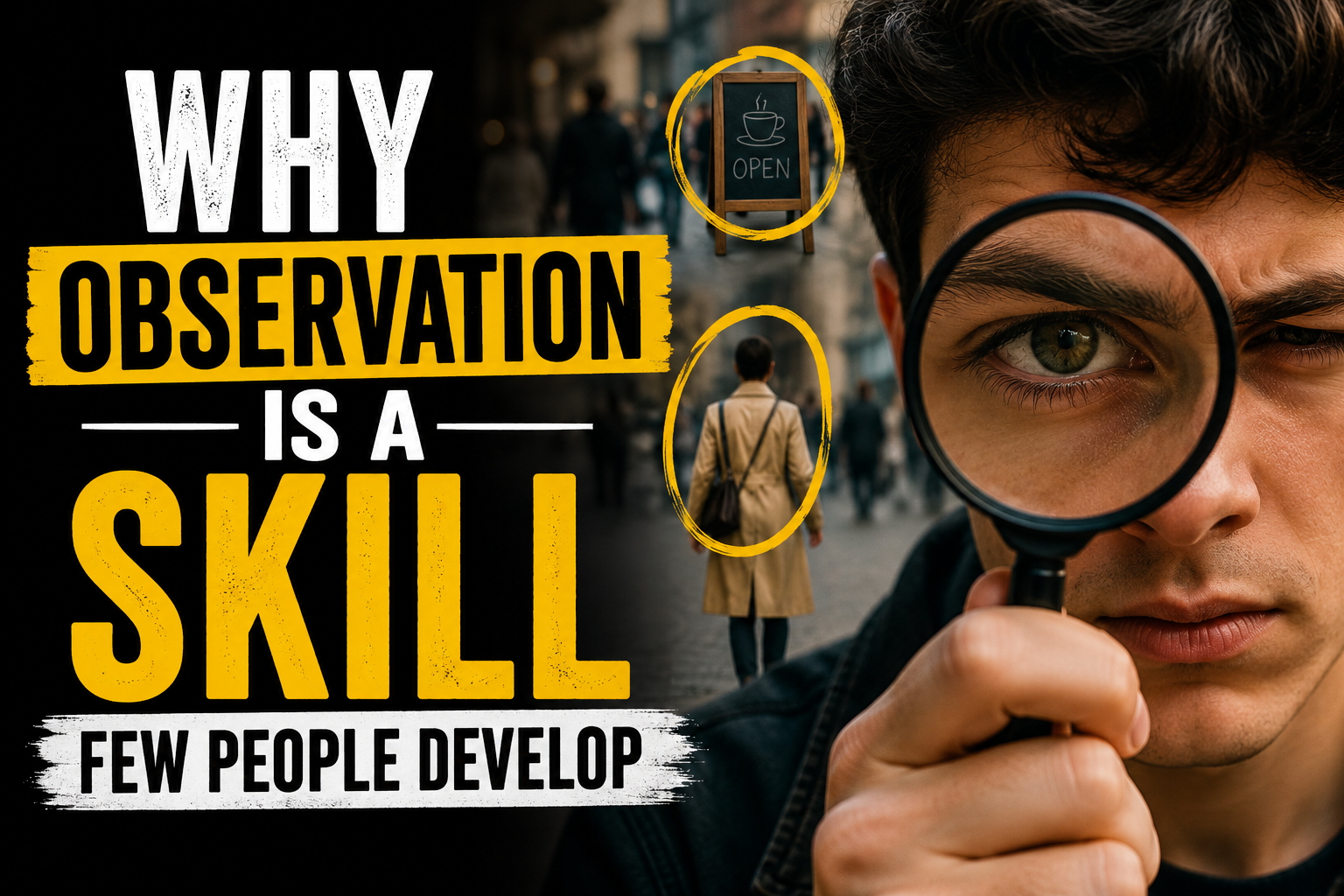
Why Observation Is a Skill Few People Develop
In a world where everyone is constantly looking for answers, very few people stop to realize that the real advantage is not just what you know, but what you are able to notice. Observation is one of the most underrated human skills, yet it quietly determines how well people understand life, solve problems, build relationships, and recognize opportunities. Most people assume they are observant because they can see things with their eyes, but true observation goes far beyond physical sight. It is the ability to notice patterns, changes, details, behaviors, and meaning that others overlook. This skill is rare not because it is impossible to learn, but because modern life actively discourages it.
One of the biggest reasons observation is so underdeveloped is the speed at which people consume information today. Attention has become fragmented. People scroll, swipe, and jump from one piece of content to another without pausing long enough to process anything deeply. When the mind is trained to move quickly, it stops registering detail. As a result, many individuals live in a state of partial awareness, where they experience everything but observe almost nothing. They may remember moments, but they fail to understand them. This constant distraction weakens the mental muscles required for careful observation.
Another reason this skill is rare is because most people are not taught how to observe. Education systems largely prioritize memorization and correct answers over awareness and perception. Students are rewarded for repeating information, not for noticing subtle differences or asking deeper questions about what they see. Over time, this creates a habit of looking for conclusions instead of examining processes. In real life, however, success often depends on noticing what others ignore rather than simply knowing what others already know.
Cognitive bias also plays a powerful role in limiting observation. People tend to see what they expect to see rather than what is actually in front of them. The brain filters reality based on beliefs, emotions, and past experiences. This means two people can witness the same situation and walk away with completely different interpretations. When someone strongly believes they already understand something, they stop observing it carefully. This creates blind spots that can persist for years without being noticed.
Emotional state further reduces observational ability. When people are stressed, anxious, or overly excited, their attention narrows. They focus only on what feels immediately important and ignore surrounding details. This survival-based mode of thinking is useful in emergencies but harmful in everyday life where clarity and awareness are required. A calm mind, on the other hand, is more capable of noticing subtle patterns and inconsistencies. This is why individuals who cultivate emotional stability often appear more insightful and aware of situations around them.
Observation is also weakened by overconfidence. Many people believe that quick judgment is the same as understanding. They see a situation, make an immediate assumption, and move on. However, real observation requires patience. It requires resisting the urge to conclude too early. When someone slows down and studies what is actually happening instead of what they think is happening, they begin to notice details that were previously invisible. These details often reveal the true nature of people, systems, and circumstances.
Interestingly, observation is not just about seeing external reality but also about understanding internal reactions. Highly observant individuals pay attention to how they respond to situations. They notice shifts in mood, thought patterns, and emotional triggers. This internal awareness allows them to make better decisions because they are not blindly reacting to life. Instead, they are interpreting both the environment and their own responses to it. This dual awareness creates a deeper level of intelligence that goes beyond surface-level thinking.
In practical terms, observation is a foundation skill that influences many areas of life. In relationships, it helps people understand unspoken emotions and hidden concerns. In business, it helps identify unmet needs and emerging trends before others notice them. In personal development, it helps individuals recognize habits that are either helping or harming their progress. The ability to observe accurately often determines whether someone reacts blindly or responds wisely. It is not exaggeration to say that observation shapes the quality of decisions a person makes every day.
Developing this skill requires intentional practice. One of the simplest ways to improve observation is to slow down interactions with the environment. Instead of rushing through daily routines, a person can begin to notice small details such as tone of voice, body language, patterns in behavior, or changes in surroundings. Over time, the brain begins to pick up on these details automatically. What once required effort becomes a natural way of engaging with the world.
Another powerful method is questioning assumptions. Whenever something appears obvious, an observant mind asks what might be missing. This does not mean becoming overly skeptical, but rather remaining open to alternative explanations. By refusing to accept the first interpretation, individuals train themselves to look deeper. This habit strengthens mental clarity and reduces the chances of misunderstanding situations or people.
Reflection also plays a critical role in strengthening observation. When people take time to review their day or recent experiences, they begin to notice patterns they missed in real time. Reflection turns random experiences into structured understanding. It allows the mind to connect dots that were previously scattered. Without reflection, observation remains incomplete because insight requires both seeing and processing.
Ultimately, observation is a skill that separates those who merely experience life from those who truly understand it. While many people move through the world reacting to events, observant individuals move through the world interpreting them. They see beyond surface appearances and recognize the deeper structure of situations. This gives them an advantage not because they see more, but because they see more clearly.
In a noisy and fast-moving world, the ability to observe has become rare and valuable. It is no longer enough to simply have access to information. The real power lies in noticing what that information actually means. People who develop strong observation skills gain clarity, better judgment, and improved decision-making. More importantly, they begin to understand life in a way that feels deeper and more intentional.
Observation may seem simple, but it is one of the most powerful intellectual habits a person can develop. It does not require special tools or formal education, only patience, awareness, and willingness to slow down. Those who learn to observe properly often discover that the world was always speaking to them; they were simply not paying attention.

EarnSmartOnline.com.ng is dedicated to helping readers make smarter financial decisions through practical guides on online income, personal finance, technology, digital business, and wealth creation. Our goal is to provide reliable, easy-to-understand, and actionable content that empowers individuals to earn smarter, build sustainable income streams and achieve long-term financial success.
Recommended: Start Earning Online
- Ultimate Affiliate Marketing Program — learn affiliate marketing with a done-for-you sales system ($15). Check it out
- The Newbie Affiliate Guide — the beginner-friendly starter guide (~$6.68). Check it out
- Easy Dollar Maker — earn in dollars uploading AI images and videos from your phone ($17). Check it out
Disclosure: These are affiliate links. If you buy through them, I may earn a commission at no extra cost to you.



