
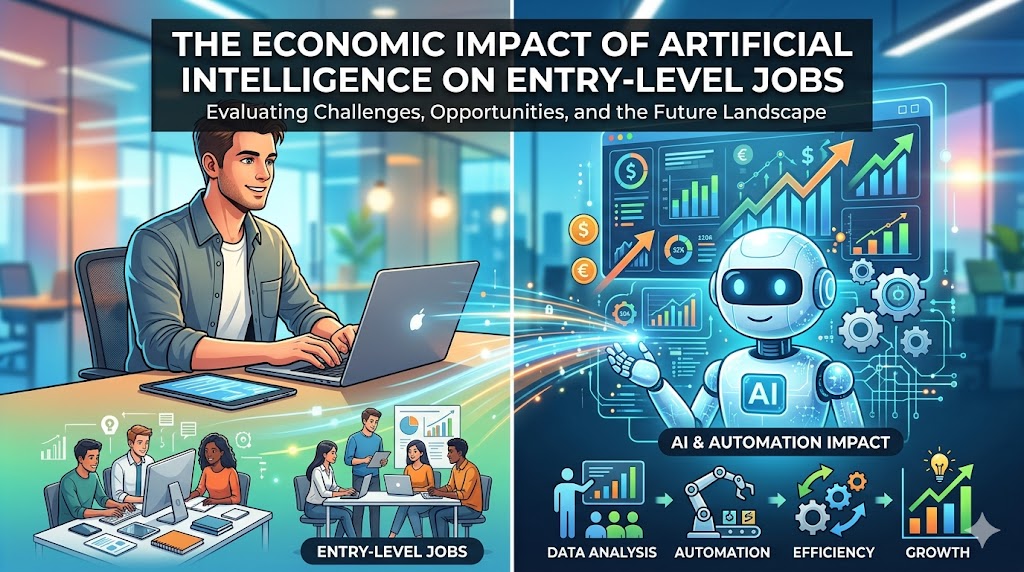
The Economic Impact of Artificial Intelligence on Entry-Level Jobs
The rapid rise of artificial intelligence is quietly reshaping the foundation of modern employment, and one of the most affected areas is entry level work. For decades, entry level jobs served as the starting point for millions of people entering the workforce, offering basic tasks, repetitive responsibilities, and gradual exposure to professional environments. These roles were not just about income, they were also training grounds where individuals learned discipline, communication, problem solving, and workplace culture. However, the introduction of increasingly capable AI systems is changing the structure of these opportunities in ways that many people are only beginning to notice.
One of the most immediate impacts of artificial intelligence is its ability to automate tasks that were traditionally assigned to beginners. Many entry level positions revolve around predictable and repeatable activities such as data entry, basic customer support, scheduling, simple reporting, and document processing. These tasks once required human effort because they demanded time and attention, even if they did not require advanced skill. Today, AI systems can perform these functions faster, more accurately, and at a lower cost. As a result, companies are increasingly reducing the number of entry level hires needed to handle such workloads.
This shift is not only about replacing jobs but also about restructuring how work is distributed. In many organizations, a single employee equipped with AI tools can now accomplish what previously required a small team of junior workers. This increases productivity for businesses but reduces the demand for traditional beginner roles. Instead of hiring multiple entry level staff members, companies now prefer fewer employees who can supervise AI systems, interpret outputs, and handle more complex decision making. This creates a gap where fewer opportunities exist for people trying to enter the job market for the first time.
The challenge becomes even more significant when considering that entry level jobs have historically been a pathway for skill development. Many professionals built their careers by starting with simple responsibilities and gradually progressing into more advanced roles. With fewer of these starting points available, new entrants into the workforce may struggle to gain the experience required to move forward. This creates a structural problem where experience is required to get a job, but jobs that provide experience are disappearing.
Artificial intelligence is also changing the expectations employers have for new workers. In the past, companies were willing to train entry level employees because the cost of doing so was justified by the value of their long term contribution. Today, however, AI reduces the need for extensive training because many foundational tasks are already automated. Employers now expect new hires to arrive with a higher level of competence, digital literacy, and adaptability. This raises the bar for entry level positions and makes it more difficult for individuals without specialized skills to secure employment.
Another important effect is the shift in the nature of available entry level roles. While traditional positions are declining, new categories of jobs are emerging, often centered around technology, data management, content supervision, and AI oversight. However, these roles are not always accessible to everyone. They often require familiarity with digital tools, analytical thinking, and in some cases, technical knowledge that many beginners do not yet possess. This creates a transition period where the old job structure is fading faster than the new one is fully accessible to the majority of job seekers.
Despite these challenges, artificial intelligence is not simply eliminating opportunities, it is transforming them. New entry level roles are being created in areas such as AI training, content validation, prompt management, customer experience monitoring, and digital operations. These positions may not resemble traditional jobs, but they still serve as starting points for career development. The difference is that they require a mindset shift. Instead of focusing on repetitive manual tasks, new workers must learn how to collaborate with intelligent systems and interpret automated outputs effectively.
The economic impact of this transformation extends beyond individual employment. It influences income distribution, social mobility, and the structure of the labor market as a whole. If fewer entry level opportunities exist, it becomes harder for individuals from lower income backgrounds to enter stable career paths. This can widen the gap between those who have access to education, technology, and training, and those who do not. Over time, this may lead to increased inequality unless new systems are developed to support skill acquisition at scale.
At the same time, businesses benefit significantly from the efficiency gains provided by artificial intelligence. Lower operational costs, faster output, and improved accuracy allow companies to scale more quickly than before. This can lead to economic growth, but it also concentrates value creation among those who own or control AI systems. In this environment, capital and technology become more powerful drivers of wealth than traditional labor, especially at the lower end of the employment spectrum.
For individuals entering the workforce today, adaptability has become more important than ever. The ability to learn continuously, understand digital systems, and develop problem solving skills is now essential for long term success. Entry level workers can no longer rely solely on repetitive tasks to build their careers. Instead, they must focus on developing transferable skills that remain valuable even as technology evolves. Communication, critical thinking, creativity, and technological fluency are becoming core requirements rather than optional advantages.
Education systems and training programs also face pressure to evolve in response to these changes. Traditional learning models that focus heavily on memorization and theoretical knowledge may no longer be sufficient. There is a growing need for practical, skill based education that prepares individuals for AI integrated workplaces. This includes exposure to real world tools, digital environments, and collaborative problem solving scenarios. Without such adaptation, many graduates may find themselves unprepared for the realities of modern employment.
In conclusion, artificial intelligence is fundamentally reshaping the landscape of entry level jobs by automating routine tasks, raising skill expectations, and redefining what it means to begin a career. While it reduces the availability of traditional starting roles, it also creates new opportunities for those who are willing to adapt and learn. The economic impact is complex, combining increased efficiency and growth with new challenges in accessibility and inequality. The future of entry level work will depend largely on how quickly individuals, institutions, and organizations adjust to this new reality where human potential is increasingly measured not by repetition, but by adaptability and the ability to work alongside intelligent systems.

EarnSmartOnline.com.ng is dedicated to helping readers make smarter financial decisions through practical guides on online income, personal finance, technology, digital business, and wealth creation. Our goal is to provide reliable, easy-to-understand, and actionable content that empowers individuals to earn smarter, build sustainable income streams and achieve long-term financial success.
Recommended: Start Earning Online
- Ultimate Affiliate Marketing Program — learn affiliate marketing with a done-for-you sales system ($15). Check it out
- The Newbie Affiliate Guide — the beginner-friendly starter guide (~$6.68). Check it out
- Easy Dollar Maker — earn in dollars uploading AI images and videos from your phone ($17). Check it out
Disclosure: These are affiliate links. If you buy through them, I may earn a commission at no extra cost to you.



