
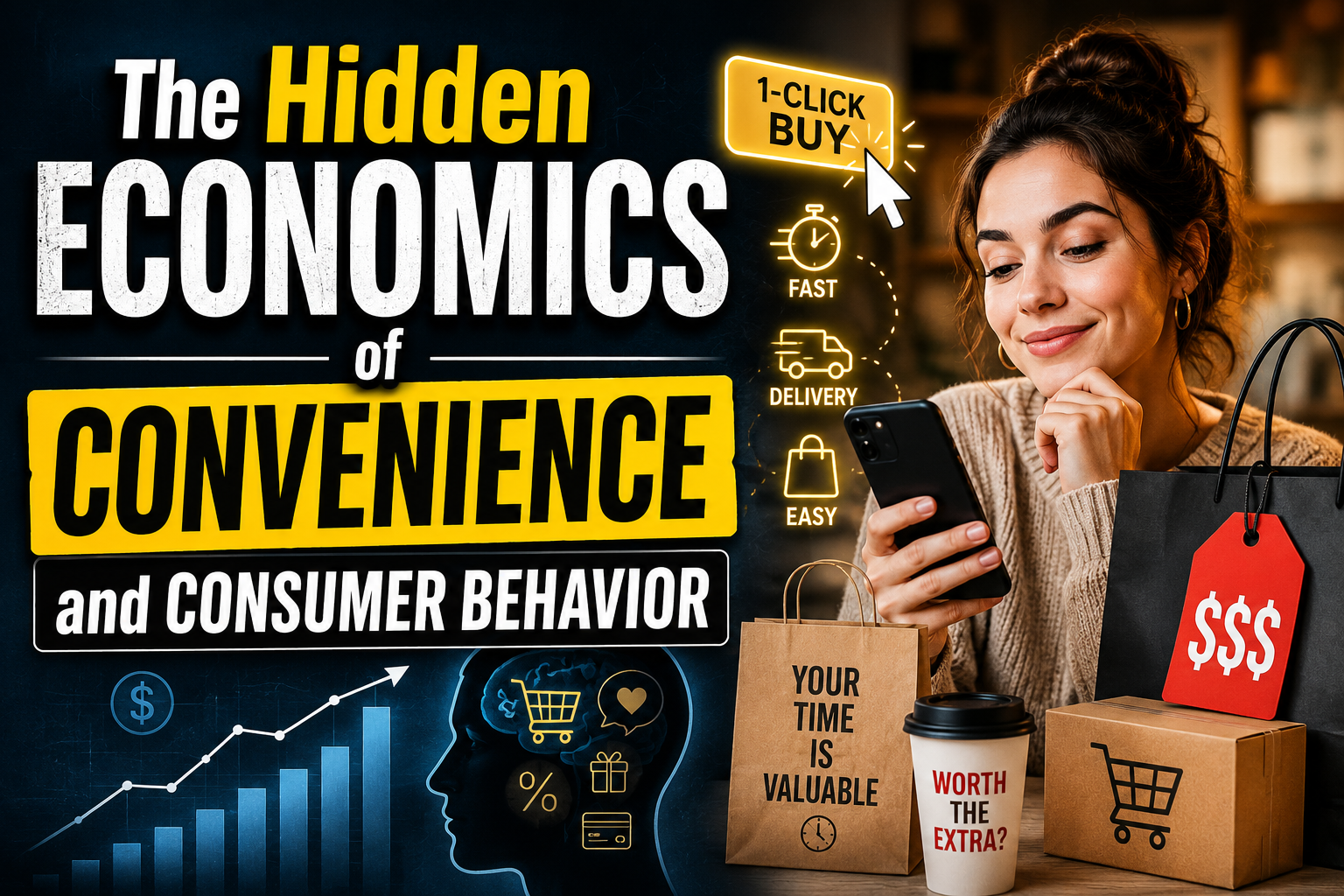
The Hidden Economics of Convenience and Consumer Behavior
Convenience has become one of the most powerful forces shaping modern economies. Every day, consumers make countless decisions based not only on price or quality but also on how easy it is to obtain a product or service. From food delivery apps and online shopping platforms to contactless payments and automated subscriptions, convenience influences spending patterns in ways many people rarely notice. Behind these seemingly simple choices lies a fascinating economic reality that affects businesses, markets, and personal finances.
The hidden economics of convenience and consumer behavior revolves around a simple principle: people place value on saving time, reducing effort, and avoiding discomfort. In economic terms, consumers are not merely purchasing products. They are often purchasing solutions that eliminate inconvenience. This is why many people willingly pay higher prices for services that make life easier. The value they receive is not necessarily found in the product itself but in the reduction of stress, uncertainty, and effort.
Time is one of the most limited resources available to human beings. Unlike money, time cannot be earned back once it is spent. As economies become more advanced and individuals become busier, the value attached to time increases significantly. This explains why a customer may choose to order groceries online rather than visit a supermarket, even when the online option costs more. The additional expense is viewed as a reasonable trade-off for the time saved.
Businesses understand this behavior extremely well. Many successful companies do not necessarily offer revolutionary products. Instead, they focus on reducing friction. Friction refers to any obstacle that makes a purchase more difficult. Long waiting times, complicated checkout processes, excessive paperwork, and confusing interfaces all create friction. Companies that eliminate these barriers often gain a competitive advantage because consumers naturally gravitate toward easier solutions.
The rise of digital technology has accelerated this trend dramatically. Consumers can now order meals, schedule transportation, transfer money, and purchase products with only a few taps on a smartphone. This level of convenience has transformed expectations. What was once considered a luxury has become a standard requirement. Businesses that fail to meet these expectations often struggle to retain customers, regardless of product quality.
Consumer behavior is heavily influenced by what economists call transaction costs. Transaction costs are the hidden costs associated with making a purchase beyond the actual price of the product. These may include travel time, waiting time, research effort, and mental energy. A product that costs slightly more but reduces transaction costs can become more attractive than a cheaper alternative that requires greater effort.
Consider the popularity of food delivery services. In many cases, customers pay significantly more for delivered meals than they would pay by dining in or collecting the food themselves. Yet millions of consumers continue to use these services regularly. The reason is simple. The convenience provided often outweighs the additional expense. Consumers are effectively paying for saved time and reduced effort rather than just the food itself.
The psychology behind convenience is equally important. Human beings naturally seek the path of least resistance. This tendency is deeply rooted in behavioral economics. When faced with multiple options, people often choose the one that requires the smallest amount of physical or mental effort. Businesses that understand this principle design products and services that simplify decision-making and reduce complexity.
Subscription services provide another excellent example. Streaming platforms, software services, and membership programs have become highly successful because they eliminate the need for repeated purchasing decisions. Once a consumer subscribes, access becomes automatic. The convenience of uninterrupted service often encourages customers to remain subscribed even when they do not fully utilize the service.
Convenience also influences impulse purchasing. The easier it becomes to buy something, the more likely consumers are to make spontaneous purchases. Online retailers have invested heavily in one-click purchasing systems because reducing the number of steps required to complete a transaction significantly increases sales. Small reductions in effort can lead to substantial increases in consumer spending.
The hidden economics of convenience extends beyond individual consumers and affects entire industries. Businesses compete not only on product quality and pricing but also on accessibility and ease of use. Companies that streamline operations, improve customer experiences, and reduce waiting times often gain larger market shares. In many cases, convenience becomes a more powerful differentiator than traditional competitive factors.
Consumer expectations continue to evolve as convenience becomes increasingly available. Once consumers become accustomed to a particular level of convenience, they rarely wish to return to less efficient alternatives. This creates pressure on businesses to continually innovate. A feature that once attracted customers may eventually become an industry standard, forcing companies to develop even more convenient solutions.
The transportation industry demonstrates this phenomenon clearly. Ride-hailing applications transformed urban transportation by making vehicle access faster and more predictable. Consumers no longer needed to search for available taxis or negotiate fares. The convenience of instant booking and transparent pricing altered consumer expectations and changed the competitive landscape.
Financial services have experienced similar transformations. Mobile banking applications allow consumers to perform transactions, pay bills, and manage accounts without visiting physical branches. The convenience provided by these digital services has reshaped customer behavior and reduced reliance on traditional banking methods. Financial institutions that embrace convenience often enjoy higher customer satisfaction and stronger retention rates.
Convenience can also create economic trade-offs. While consumers benefit from easier access to goods and services, they may unknowingly spend more money over time. The reduction of purchasing friction can encourage excessive consumption. When buying becomes effortless, individuals may make decisions with less consideration, leading to unnecessary spending and reduced financial discipline.
This phenomenon highlights the complex relationship between convenience and consumer welfare. On one hand, convenience improves quality of life by saving time and reducing stress. On the other hand, it can encourage behaviors that undermine long-term financial goals. Understanding this balance is essential for consumers seeking to make informed decisions.
Businesses frequently use convenience as a pricing strategy. Premium products often justify higher prices by offering faster service, easier access, or greater simplicity. Consumers are not merely paying for physical goods but for enhanced experiences. This explains why express shipping, premium memberships, and priority services remain highly profitable despite their additional costs.
The growth of convenience-based business models reflects broader economic trends. As incomes rise and lifestyles become increasingly demanding, consumers become more willing to exchange money for saved time. This shift creates opportunities for entrepreneurs who can identify and eliminate inefficiencies within existing markets. Many of the world’s most successful businesses have been built on the simple idea of making life easier for customers.
Convenience also influences brand loyalty. Consumers who become accustomed to a seamless experience are often reluctant to switch providers. The effort required to learn a new system or adapt to a different process creates a barrier to change. Businesses that prioritize convenience can therefore strengthen customer retention and generate recurring revenue.
The role of data and personalization further enhances the economics of convenience. Modern companies use consumer data to predict preferences and streamline experiences. Personalized recommendations, automated reminders, and customized interfaces reduce the effort required to make decisions. These features increase satisfaction while simultaneously driving higher engagement and spending.
The hidden economics of convenience becomes particularly evident during periods of social or technological change. Events that disrupt normal routines often accelerate the adoption of convenient alternatives. Consumers who initially embrace convenience out of necessity frequently continue using these solutions long after circumstances return to normal. This pattern contributes to lasting shifts in consumer behavior and market dynamics.
Understanding convenience provides valuable insights into human decision-making. Many purchasing choices that appear irrational at first glance become logical when viewed through the lens of time, effort, and psychological comfort. Consumers are not always seeking the lowest price. They are often seeking the highest overall value, which includes convenience as a significant component.
For businesses, recognizing the economic value of convenience can unlock substantial growth opportunities. Companies that focus on reducing friction, simplifying experiences, and saving customers time are often rewarded with increased loyalty and stronger financial performance. Convenience has evolved from a competitive advantage into a fundamental expectation across many industries.
For consumers, awareness of these economic forces can lead to better financial decisions. Understanding how convenience influences behavior makes it easier to distinguish between purchases that genuinely improve quality of life and those driven primarily by impulse. This awareness encourages more intentional spending and helps individuals balance convenience with long-term financial objectives.
The hidden economics of convenience and consumer behavior reveals an important truth about modern markets. People do not simply buy products. They buy time, simplicity, certainty, and comfort. Businesses that successfully deliver these benefits often thrive because they address needs that extend far beyond the physical characteristics of a product. As technology continues to evolve and consumer expectations continue to rise, convenience will remain one of the most influential forces shaping economic activity and purchasing behavior around the world.

EarnSmartOnline.com.ng is dedicated to helping readers make smarter financial decisions through practical guides on online income, personal finance, technology, digital business, and wealth creation. Our goal is to provide reliable, easy-to-understand, and actionable content that empowers individuals to earn smarter, build sustainable income streams and achieve long-term financial success.
Recommended: Start Earning Online
- Ultimate Affiliate Marketing Program — learn affiliate marketing with a done-for-you sales system ($15). Check it out
- The Newbie Affiliate Guide — the beginner-friendly starter guide (~$6.68). Check it out
- Easy Dollar Maker — earn in dollars uploading AI images and videos from your phone ($17). Check it out
Disclosure: These are affiliate links. If you buy through them, I may earn a commission at no extra cost to you.



