
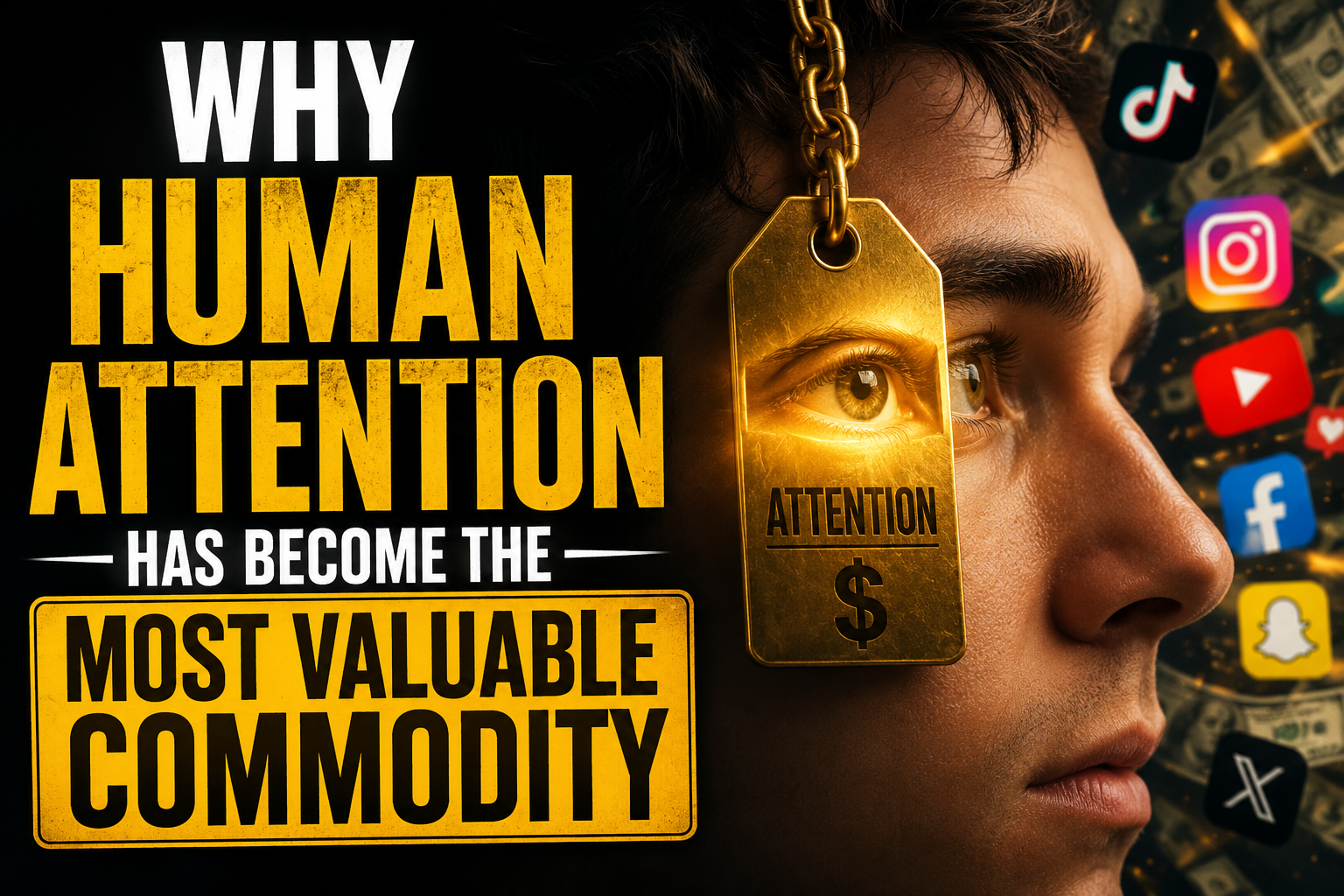
Why Human Attention Has Become the Most Valuable Commodity
For most of human history, land was considered the most valuable asset. Those who controlled land controlled food production, trade routes, wealth, and power. Later, during the Industrial Revolution, factories, machinery, and raw materials became the primary sources of economic influence. In the information age, knowledge emerged as the most sought-after resource. Today, however, a new commodity has quietly surpassed them all. That commodity is human attention.
Every day, billions of people wake up and immediately direct their attention toward smartphones, televisions, computers, advertisements, social media platforms, news outlets, and entertainment services. Companies, governments, organizations, and individuals are competing intensely for a limited resource that every person possesses but cannot increase beyond a fixed amount. That resource is attention.
Human attention has become the most valuable commodity because it is scarce, measurable, transferable, and capable of generating enormous economic value. While technology has dramatically increased the amount of information available, it has not increased the amount of attention people can give. There are still only twenty-four hours in a day, and every individual can focus on only a limited number of things at any given moment. As information continues to grow exponentially, attention becomes increasingly rare.
One of the reasons attention has become so valuable is because it influences decisions. Businesses understand that before they can sell a product, service, or idea, they must first capture attention. A person cannot buy something they do not notice. They cannot support a cause they have never heard about. They cannot follow a brand they have never encountered. Attention serves as the gateway through which all influence passes.
This reality explains why companies spend billions of dollars annually on advertising. The goal is not simply to promote products. The primary objective is to secure a few seconds of human attention. Whether it is a television commercial, a sponsored social media post, a billboard, or an online advertisement, businesses are essentially purchasing opportunities to enter people’s minds. The products may differ, but the competition remains the same. Everyone is fighting for attention.
Social media platforms have become some of the most valuable businesses in the world largely because they understand the economics of attention. Their business models are not based solely on technology. They are built on attracting, holding, and monetizing user attention. Every notification, recommendation, algorithm, and content feed is carefully designed to keep people engaged for as long as possible. The longer users stay on a platform, the more advertisements they see and the more revenue the platform generates.
In many ways, modern technology has transformed attention into a currency. People exchange their attention for entertainment, information, social interaction, and convenience. In return, companies collect valuable data, generate advertising revenue, and build influence. This exchange happens continuously, often without people fully realizing its significance.
The rise of digital media has intensified competition for attention unlike anything seen before. Decades ago, consumers had a limited number of television channels, radio stations, and newspapers from which to choose. Today, they face an endless stream of content available at all times. Videos, podcasts, articles, live streams, social media posts, and advertisements compete simultaneously for the same finite resource. As a result, capturing attention has become increasingly difficult and increasingly valuable.
Attention is valuable because it drives consumer behavior. People tend to buy products they frequently see. They trust brands they repeatedly encounter. They support ideas that consistently occupy their minds. Repetition and visibility shape perception, and perception often shapes reality. Businesses understand this principle and invest heavily in maintaining visibility in crowded markets.
The influence of attention extends beyond commerce. Politicians compete for public attention during elections. Activists seek attention to raise awareness about social issues. Nonprofit organizations require attention to attract donors and supporters. Content creators depend on attention to grow audiences. Even educational institutions compete for attention in a world filled with distractions. In every sector, attention functions as a critical resource that determines success or failure.
One reason attention has become more valuable than information itself is because information is abundant. The internet has made knowledge accessible to almost everyone. Millions of articles, books, videos, and tutorials are available instantly. The challenge is no longer finding information. The challenge is deciding what deserves attention. In an environment where information is limitless, attention becomes the true bottleneck.
This shift has created what many economists describe as the attention economy. In the attention economy, value is determined not by the availability of information but by the ability to attract and retain audience focus. The individuals and organizations that master this skill gain significant advantages. They can influence conversations, shape opinions, drive purchasing decisions, and generate substantial financial returns.
Content creators provide a clear example of this phenomenon. A person with millions of engaged followers can earn significant income through sponsorships, advertising, merchandise sales, and partnerships. The value is not merely in the content they produce. The value lies in the attention they command. Brands are willing to pay substantial amounts because they understand that attention can be converted into revenue.
The scarcity of attention becomes even more apparent when considering the number of demands placed upon people daily. Emails, text messages, phone calls, social media notifications, news updates, advertisements, and work responsibilities constantly compete for focus. As distractions multiply, uninterrupted attention becomes increasingly rare. This rarity increases its economic value.
Psychologically, human attention is powerful because it shapes thoughts, emotions, and behavior. What people consistently focus on influences their beliefs, priorities, and decisions. This is why attention is often described as the foundation of influence. Whoever captures attention gains an opportunity to affect perception and action.
Businesses recognize this power and design experiences specifically to maximize engagement. Streaming services automatically play the next episode. Social media feeds refresh endlessly. News websites continuously recommend related stories. These features are not accidental. They are designed to extend attention and increase user engagement.
The growing importance of attention has also changed how success is measured. In previous generations, influence was often determined by physical assets, financial capital, or institutional authority. Today, attention itself can create influence. A person with a large online audience may have greater impact than an organization with significant resources. Visibility has become a form of power.
This transformation explains why personal branding has become increasingly important. Professionals, entrepreneurs, creators, and businesses invest considerable effort into building online visibility because attention creates opportunities. The more people notice, remember, and trust an individual or organization, the greater their potential influence and earning power.
However, the attention economy also presents challenges. Constant competition for attention can encourage sensationalism, misinformation, and emotionally charged content. Since dramatic or controversial material often attracts more engagement, some creators prioritize attention over accuracy. This creates an environment where capturing attention sometimes becomes more important than providing value.
The modern attention economy has also affected productivity. Many people struggle to maintain focus because digital platforms are specifically designed to attract and retain attention. Frequent interruptions can reduce efficiency, increase stress, and make deep work more difficult. As a result, the ability to focus has become a valuable competitive advantage.
Individuals who can control their attention often achieve better outcomes in education, business, and personal development. Focus allows people to learn more effectively, make better decisions, and complete meaningful work. In a world filled with distractions, disciplined attention is becoming one of the most important skills a person can develop.
Attention is also directly connected to trust. When people consistently pay attention to a particular source, they become more familiar with it. Familiarity often leads to trust, and trust influences decision-making. This is why brands invest heavily in maintaining visibility even when immediate sales are not expected. They understand that attention today can become trust tomorrow and revenue in the future.
The future will likely make attention even more valuable. Advances in artificial intelligence, virtual reality, augmented reality, and digital communication will increase the volume of available content. As content becomes easier to create, the supply of information will continue expanding. Yet human attention will remain limited. This imbalance will make attention increasingly scarce and increasingly valuable.
The organizations and individuals that thrive in the future will not necessarily be those with the most information. They will be those who can effectively capture, maintain, and respect human attention. Success will depend on understanding how people engage with content, make decisions, and allocate their limited focus.
Ultimately, human attention has become the most valuable commodity because it sits at the center of influence, commerce, communication, and decision-making. Every advertisement, social media platform, news outlet, business strategy, and marketing campaign reflects the growing importance of attention in modern society. Information may be abundant, technology may continue evolving, and markets may change, but one fact remains constant. Human attention is finite. Because it is limited, powerful, and capable of generating enormous value, it has become one of the most sought-after resources in the world. In the modern economy, attention is no longer merely a psychological concept. It is a form of capital, a source of influence, and perhaps the most valuable commodity of all.

EarnSmartOnline.com.ng is dedicated to helping readers make smarter financial decisions through practical guides on online income, personal finance, technology, digital business, and wealth creation. Our goal is to provide reliable, easy-to-understand, and actionable content that empowers individuals to earn smarter, build sustainable income streams and achieve long-term financial success.
Recommended: Start Earning Online
- Ultimate Affiliate Marketing Program — learn affiliate marketing with a done-for-you sales system ($15). Check it out
- The Newbie Affiliate Guide — the beginner-friendly starter guide (~$6.68). Check it out
- Easy Dollar Maker — earn in dollars uploading AI images and videos from your phone ($17). Check it out
Disclosure: These are affiliate links. If you buy through them, I may earn a commission at no extra cost to you.



