
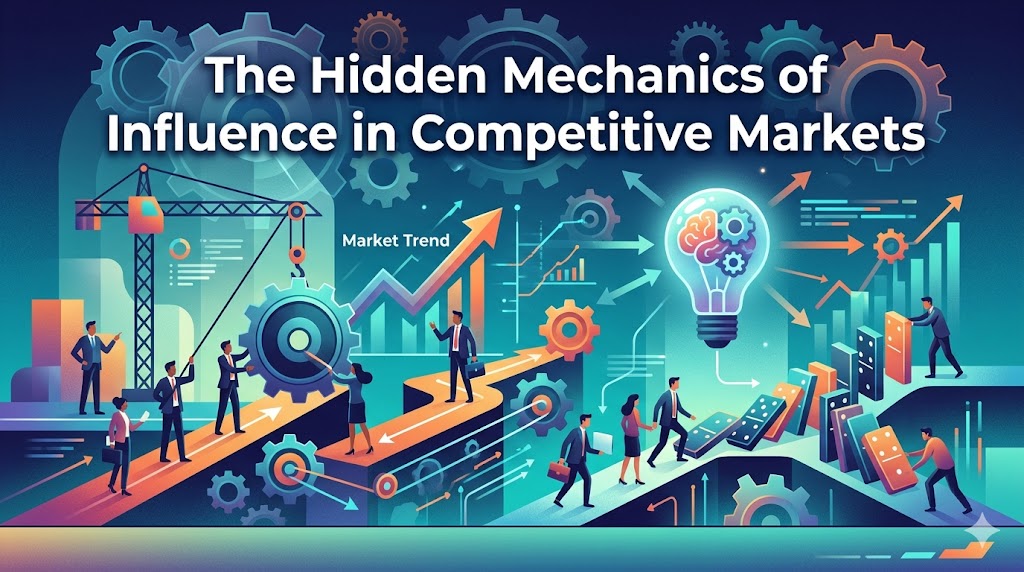
The Hidden Mechanics of Influence in Competitive Markets
In competitive markets, influence is not a soft concept or a vague social advantage. It is a structured force that determines who gets attention, who earns trust, who closes deals, and who disappears into noise. Most people assume influence is about charisma or popularity, but in reality it operates through deeper mechanics that shape how decisions are made at scale. Once you understand these mechanics, you begin to see that markets are not purely rational systems. They are perception driven environments where value is often assigned before anything is fully examined.
At the center of influence is attention. Attention is the first gate in any market because nothing happens without it. A product that is not seen cannot be judged. A message that is not heard cannot persuade. In modern markets, attention is fragmented and constantly contested. People are exposed to more information in a single day than previous generations experienced in months. This creates an environment where influence is not just about being present but about being noticeable. Those who understand how to capture attention consistently gain a structural advantage over those who simply try to compete on quality alone.
However attention alone is not enough. Influence requires trust, and trust is built through repetition and consistency. When people repeatedly encounter a signal from the same source, they begin to assign credibility to it, even before evaluating its content deeply. This is why repeated exposure often outperforms one time persuasion attempts. In competitive markets, trust reduces perceived risk, and reduced risk increases the speed of decision making. The faster someone feels safe choosing you, the more influence you gain over their choices.
Perception plays a central role in shaping influence. Markets do not respond to reality directly. They respond to interpreted reality. Two products with similar quality can receive completely different outcomes based on how they are perceived. One may be seen as premium while the other is seen as average, even if the difference is minimal. This happens because people rely on mental shortcuts when evaluating options. These shortcuts are shaped by branding, positioning, and context. Influence is therefore heavily dependent on how effectively you control the lens through which others interpret your value.
Scarcity is another powerful mechanic. When something appears limited, its perceived value increases. This is not just a marketing trick but a psychological response rooted in human decision making. People assign higher importance to things that feel rare or difficult to obtain. In competitive markets, scarcity can be real or perceived, but its impact remains strong either way. When combined with strong positioning, scarcity can shift demand rapidly in favor of one option over another, even in saturated environments.
Social proof amplifies influence further. Humans are naturally influenced by the behavior of others, especially in uncertain situations. When people see that others are choosing a product, service, or idea, they interpret it as a signal of safety and correctness. This reduces hesitation. In markets, social proof functions as a multiplier. It does not create value by itself, but it increases the visibility and credibility of existing value. This is why early momentum is often more important than perfect execution. Once social validation begins, it becomes easier to attract more attention and trust without proportional effort.
Positioning determines how influence is framed. If you are positioned as one of many similar options, your influence is diluted. If you are positioned as a distinct solution to a specific problem, your influence becomes concentrated. Positioning is not about what you do, but about how clearly others understand what you do and why it matters. In competitive markets, clarity beats complexity. People do not spend time decoding unclear offerings. They choose what is easiest to understand and easiest to justify.
Information asymmetry also plays a hidden role. Influence increases when one party understands something that others do not fully grasp. This does not require deception. It simply reflects differences in knowledge, insight, or timing. Those who understand market shifts earlier can position themselves advantageously before others react. By the time the majority catches up, the early movers have already shaped perception and established dominance. This creates a cycle where awareness itself becomes a competitive advantage.
Timing is another overlooked mechanic. Even strong ideas fail when introduced too early or too late. Markets have readiness levels. Influence is strongest when timing aligns with collective awareness or emerging demand. Many successful outcomes are not just the result of better ideas but better timing of those ideas. Understanding when a market is emotionally and practically ready for a message is as important as the message itself.
Networks amplify influence in ways that individual effort cannot match. Access to the right people, communities, and distribution channels can determine how far and how fast an idea spreads. In competitive markets, networks act as accelerators. They reduce friction, increase exposure, and create opportunities for validation. Influence often grows exponentially when it moves through connected systems rather than isolated efforts. This is why relationships and connections often matter more than raw output.
Narratives shape how influence is remembered and repeated. People do not only share facts. They share stories that make those facts meaningful. A strong narrative simplifies complexity and gives emotional structure to information. In markets, narrative determines whether something is forgettable or impactful. The same outcome can be interpreted in multiple ways depending on the story attached to it. Those who control narratives often control how value is perceived long after the initial interaction.
Pricing itself is also an instrument of influence. Price is not only a number. It is a signal. It communicates positioning, quality expectation, and market category. Higher prices can create the perception of higher value, while lower prices can create accessibility but sometimes reduce perceived quality. Influence in pricing comes from aligning cost with perceived value in a way that feels justified to the audience. When this alignment is strong, conversion becomes easier even in competitive environments.
Competitive markets are shaped by feedback loops. Once influence begins to work, it often reinforces itself. More attention leads to more trust. More trust leads to more adoption. More adoption leads to more visibility. This cycle continues until equilibrium is disrupted by innovation or change in perception. Understanding feedback loops helps explain why certain players grow disproportionately while others remain stagnant despite similar effort.
Digital environments have intensified all of these mechanics. Information spreads faster, competition is global, and attention is more fragmented than ever. This means influence is no longer gradual. It can shift rapidly based on small signals that scale quickly. A single piece of content, a single endorsement, or a single moment of visibility can alter market perception in a short time. This makes adaptability essential for maintaining influence over time.
At its core, influence in competitive markets is about alignment between perception and decision making. It is not enough to be valuable. That value must be recognized, understood, and trusted within the context of existing market beliefs. Influence bridges the gap between what something is and how it is interpreted. The stronger the bridge, the easier it becomes to guide decisions.
Ultimately, the hidden mechanics of influence are not mysterious. They are consistent patterns in human behavior applied at scale. Attention, trust, perception, scarcity, social validation, positioning, timing, networks, narratives, and feedback loops all interact to shape outcomes. Those who learn to work with these mechanics do not rely on force. They rely on structure. And in competitive markets, structure always outperforms randomness.

EarnSmartOnline.com.ng is dedicated to helping readers make smarter financial decisions through practical guides on online income, personal finance, technology, digital business, and wealth creation. Our goal is to provide reliable, easy-to-understand, and actionable content that empowers individuals to earn smarter, build sustainable income streams and achieve long-term financial success.
Recommended: Start Earning Online
- Ultimate Affiliate Marketing Program — learn affiliate marketing with a done-for-you sales system ($15). Check it out
- The Newbie Affiliate Guide — the beginner-friendly starter guide (~$6.68). Check it out
- Easy Dollar Maker — earn in dollars uploading AI images and videos from your phone ($17). Check it out
Disclosure: These are affiliate links. If you buy through them, I may earn a commission at no extra cost to you.



