
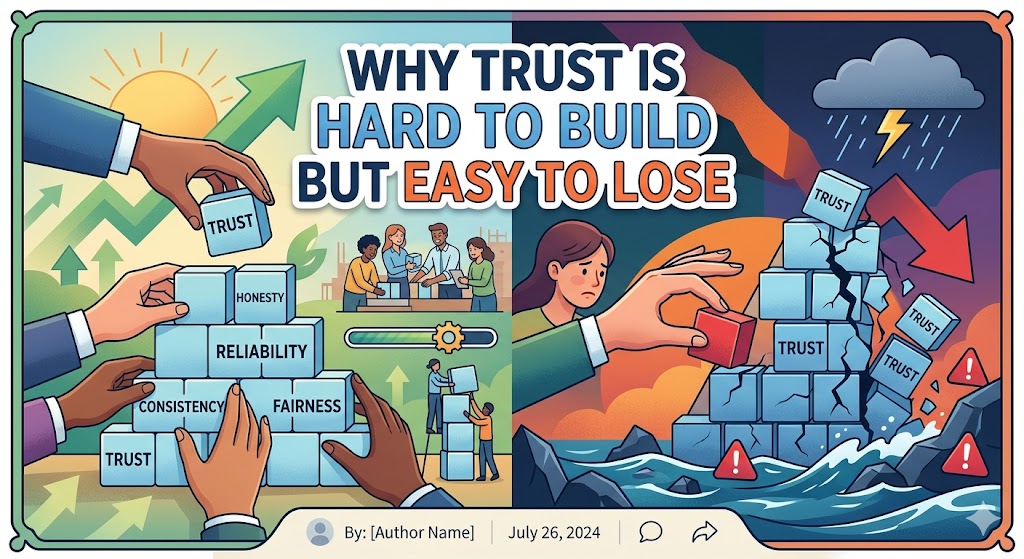
Why Trust Is Hard to Build but Easy to Lose
Trust is one of those invisible forces that quietly determines almost everything in human life, yet most people only notice it when it is missing or broken. It influences relationships, business deals, friendships, leadership, and even how societies function. People often assume trust is something that naturally exists once there is familiarity, but in reality, trust is carefully built over time through consistent behavior, honesty, and reliability. What makes it even more interesting is that while building trust can take months or years, destroying it can take only a single moment of poor judgment or dishonesty.
At its core, trust is a form of confidence. It is the belief that another person will act in a predictable, honest, and responsible way even when there is no immediate pressure forcing them to do so. This belief is not formed randomly. It is constructed from repeated observations of behavior. When someone keeps their word consistently, people begin to relax around them. When someone is transparent and truthful, others begin to lower their guard. Over time, these small signals accumulate into something powerful called trust. But because trust is built from patterns, it is also extremely sensitive to disruption. One contradiction in behavior can create doubt, and doubt is the first crack in the foundation.
The reason trust is hard to build is because human beings are naturally cautious. Every new interaction begins with uncertainty. We do not know the intentions of the other person, and we also do not fully know their character. Because of this uncertainty, people observe closely before they commit emotionally or practically. They look for consistency between words and actions. They look for reliability in small promises before they accept bigger ones. This process takes time because the mind is designed to protect itself from deception and disappointment. In many ways, trust is a slow permission that the brain grants after enough evidence has been collected.
Another reason trust takes time is because it requires emotional investment from both sides. It is not just about proving yourself trustworthy, but also about the other person being willing to open up and accept vulnerability. Vulnerability does not happen instantly. People need to feel safe, understood, and respected before they begin to lower their emotional defenses. This is why even in friendships or relationships where two people meet frequently, trust may still take a long time to fully develop. It is not just about proximity, but about emotional safety being reinforced over repeated interactions.
However, while trust requires time and consistency to build, it only requires inconsistency to weaken. This is where many people misunderstand its fragility. Trust is not destroyed only by major betrayals. Sometimes it is broken by small, repeated actions that signal unreliability. A promise not kept, a truth slightly distorted, or a pattern of behavior that does not match previous expectations can all create cracks. At first, these cracks seem small and harmless, but they accumulate. Eventually, the person on the receiving end begins to question everything, even things that were once considered reliable.
What makes trust especially fragile is the role of memory and emotion. Human beings are wired to remember negative experiences more strongly than positive ones. Psychologically, this is known as negativity bias. One painful experience often carries more weight than several positive ones. This means that even if someone has built trust over a long period, a single moment of betrayal can overshadow everything that came before it. The emotional impact of disappointment often rewrites the perception of the entire relationship.
Another important factor is expectation. The higher the level of trust, the higher the expectation becomes. When people trust someone deeply, they begin to assume consistency. They assume honesty, reliability, and loyalty as default behaviors. Because of this, any deviation from that expectation feels more severe than it actually is. For example, a small lie from someone you barely know might be ignored, but the same lie from someone you trust deeply can feel like a major betrayal. This is because trust raises the standard of accountability.
Trust also becomes harder to rebuild once it is broken. Even if forgiveness is given, the mind does not easily erase doubt. The person who was once trusted becomes someone who is now being evaluated more carefully. Their words are weighed more heavily, their actions are observed more critically, and their intentions are questioned more frequently. This shift in perception changes the entire dynamic of the relationship. What was once natural becomes cautious. What was once effortless becomes monitored. In many cases, this change is irreversible.
In professional environments, trust plays an even more critical role. Employers trust employees to deliver results, clients trust businesses to provide value, and partners trust each other to uphold agreements. When trust exists in a workplace, efficiency increases because there is less need for constant verification. But when trust is broken, systems slow down. People begin to double check work, communication becomes more formal, and collaboration becomes restricted. The cost of broken trust is not just emotional, it is operational and financial.
In personal relationships, trust forms the backbone of emotional security. Without trust, love becomes anxious. Communication becomes defensive. Even small misunderstandings can escalate because there is already an underlying sense of doubt. This is why relationships without trust often feel exhausting. People are not just dealing with present issues, but also carrying unresolved doubts from the past. When trust exists, however, relationships become lighter. There is room for mistakes, understanding, and growth because both sides believe in each other’s intentions.
One of the most overlooked truths about trust is that it is constantly being evaluated, even when people are not aware of it. Every interaction either reinforces trust or weakens it slightly. There is no neutral ground. Silence can weaken trust if it is perceived as avoidance. Delayed responses can weaken trust if they are interpreted as neglect. Inconsistency in behavior can weaken trust even if intentions are good. This is why maintaining trust requires awareness and intentionality. It is not something that can be built once and left untouched.
Another reason trust is fragile is because it is closely tied to predictability. Human beings feel safe when they can predict how someone will behave. Predictability creates comfort, and comfort strengthens emotional bonds. But when behavior becomes unpredictable, even without malicious intent, trust begins to weaken. This is why consistency is more important than occasional grand gestures. A single impressive action cannot compensate for repeated inconsistency.
At a deeper level, trust is also connected to identity. When someone trusts another person, they form a mental image of who that person is. When behavior contradicts that image, it creates cognitive dissonance. The mind struggles to reconcile the difference between expectation and reality. This discomfort often leads to doubt, and doubt gradually erodes trust. Once identity perception changes, rebuilding the original trust becomes extremely difficult because it requires not just behavioral change but also perceptual change.
Ultimately, trust is both powerful and delicate. It is powerful because it enables cooperation, intimacy, and progress. Without trust, society would struggle to function at any meaningful level. But it is also delicate because it depends on continuous reinforcement. It is not a one time achievement but an ongoing responsibility. Every action contributes to either strengthening it or weakening it.
Understanding this balance is important because it changes how people approach relationships and commitments. Trust should not be taken for granted. It should be treated as something valuable that requires care, attention, and consistency. While it takes time to build, it does not demand perfection, only reliability. But once it is broken, even perfection in the future may not fully restore it. That is what makes trust one of the most precious and fragile elements of human connection.

EarnSmartOnline.com.ng is dedicated to helping readers make smarter financial decisions through practical guides on online income, personal finance, technology, digital business, and wealth creation. Our goal is to provide reliable, easy-to-understand, and actionable content that empowers individuals to earn smarter, build sustainable income streams and achieve long-term financial success.
Recommended: Start Earning Online
- Ultimate Affiliate Marketing Program — learn affiliate marketing with a done-for-you sales system ($15). Check it out
- The Newbie Affiliate Guide — the beginner-friendly starter guide (~$6.68). Check it out
- Easy Dollar Maker — earn in dollars uploading AI images and videos from your phone ($17). Check it out
Disclosure: These are affiliate links. If you buy through them, I may earn a commission at no extra cost to you.



