
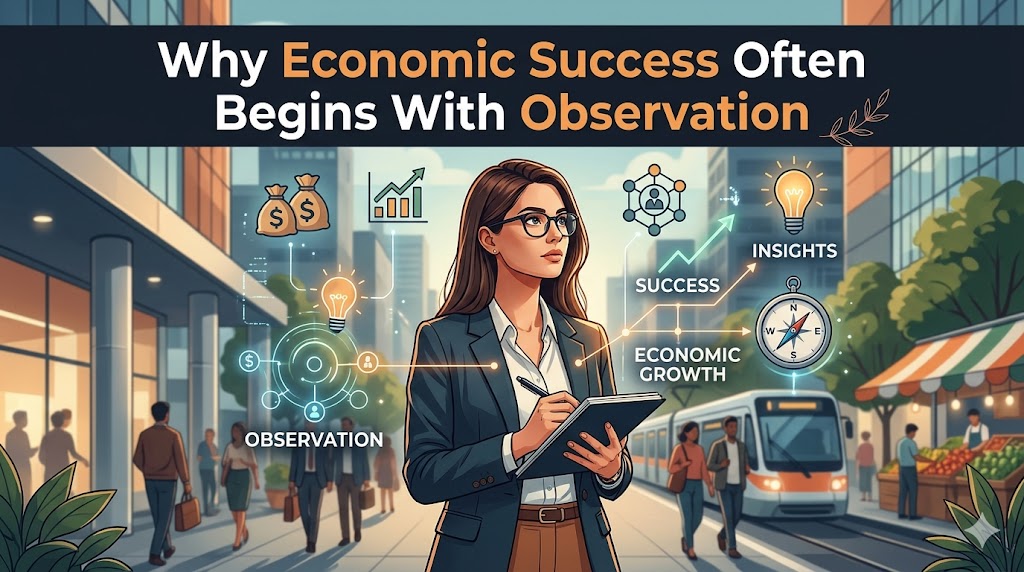
Why Economic Success Often Begins With Observation
Most people assume economic success begins with action, bold moves, or access to capital, but in reality it often begins much earlier in a quieter place. It begins with observation. Before any meaningful financial progress shows up in a person’s life, there is usually a phase where they are simply watching how things work. Watching how money moves, how people behave under pressure, what problems repeat themselves, and what kinds of value consistently get rewarded. Observation is not passive in the way people assume. It is actually one of the most active forms of learning because it trains the mind to recognize patterns that others miss while they are busy reacting emotionally or rushing into decisions.
When people observe carefully, they begin to notice that money is rarely random. It follows behavior, timing, demand, and perception. Someone who pays attention long enough will see that certain skills are consistently rewarded more than others, not because they are harder, but because they solve more urgent problems. They also begin to notice that people who seem “lucky” are often just positioned correctly within systems they studied for a long time before acting. Observation reveals structure behind what initially looks like chaos, and that understanding becomes the foundation for better decisions later on.
One of the most important things observation teaches is that human behavior is predictable in many economic situations. People tend to repeat emotional patterns when buying, selling, hiring, or investing. Fear and desire drive most decisions more than logic. Once someone begins to observe this consistently, they stop assuming markets are purely rational. Instead, they start to understand that value is often tied to perception, urgency, and trust. This shift in awareness alone can change how a person approaches opportunities, because they are no longer guessing blindly. They are responding to patterns they have already seen unfold multiple times.
Observation also exposes inefficiencies in everyday systems. Many people walk through life surrounded by problems they never mentally label as opportunities. A person who observes closely starts to see gaps everywhere. They notice where people complain repeatedly, where services fail to meet expectations, or where time and effort are being wasted unnecessarily. These gaps are often the early signals of economic opportunity. Before any business idea becomes profitable, it usually exists first as a repeated observation of something not working properly or not being optimized.
Another critical layer of observation is understanding competition and environment. People who rush into economic decisions often ignore context, but those who observe first begin to understand the landscape before entering it. They see why some individuals struggle in certain industries while others thrive. They see that success is not only about effort but also about alignment between skills, environment, and timing. Observation helps reduce unnecessary risk because it allows a person to learn from other people’s outcomes without paying the same cost in failure.
There is also a personal dimension to observation that is often overlooked. By observing their own behavior, spending habits, emotional triggers, and decision patterns, individuals start to understand why they repeatedly experience certain financial outcomes. Many economic problems are not external first, but internal. A person who cannot observe themselves will likely repeat financial mistakes without realizing the cause. Observation builds self-awareness, and self-awareness is one of the most powerful tools for breaking cycles that keep people stuck in the same financial position for years.
Over time, observation leads to better judgment. Judgment is what separates reactive individuals from strategic ones. When someone has observed enough patterns, they begin to make decisions with a sense of probability rather than impulse. They are no longer easily influenced by trends or pressure because they have seen similar cycles before. This is why experienced individuals often appear calm during uncertainty. It is not that they know everything, but that they have observed enough to recognize familiar situations even when they are disguised in new forms.
Economic success also depends heavily on timing, and timing cannot be mastered without observation. People who observe carefully begin to notice when demand is rising, when markets are shifting, or when behaviors are changing before those changes become obvious to everyone else. This ability to notice early signals is what creates advantage. While others are still debating whether something is important, the observer has already positioned themselves. They are not necessarily faster in action, but they are earlier in understanding.
Another important aspect of observation is learning from failure without experiencing it directly. Not every lesson has to be personally expensive. By watching others closely, individuals can see what leads to success and what leads to collapse. This includes businesses, careers, relationships, and financial decisions. The observer treats the world as a continuous case study. Every outcome becomes data. Over time, this builds a mental database that guides better decisions without requiring repeated personal loss.
Observation also changes how people interpret value. Instead of seeing value as something fixed, they begin to understand it as something dynamic. Value shifts based on context, demand, scarcity, and perception. This understanding is crucial in economic success because it allows individuals to adapt their approach depending on environment rather than relying on rigid thinking. Those who do not observe often assume value is obvious, but those who do realize that value is often constructed, communicated, and positioned.
At a deeper level, observation trains patience. In a world that rewards speed and instant results, patience becomes a competitive advantage. People who observe are less likely to rush into decisions because they are still gathering information. This delay is not weakness but precision. It reduces costly mistakes and increases the likelihood of entering opportunities with clarity rather than confusion. Many failed financial decisions happen not because people lack intelligence, but because they act before they understand.
Ultimately, economic success often begins with observation because observation builds the foundation for everything else that follows. It sharpens awareness, improves judgment, reveals opportunity, and reduces unnecessary risk. Action is important, but action without observation is often blind. The people who consistently succeed economically are not always the most aggressive or the most talented. They are often the ones who learned how to watch carefully before they moved. They understood that before you can win in any system, you must first understand how the system behaves when no one is rushing to interfere with it.

EarnSmartOnline.com.ng is dedicated to helping readers make smarter financial decisions through practical guides on online income, personal finance, technology, digital business, and wealth creation. Our goal is to provide reliable, easy-to-understand, and actionable content that empowers individuals to earn smarter, build sustainable income streams and achieve long-term financial success.
Recommended: Start Earning Online
- Ultimate Affiliate Marketing Program — learn affiliate marketing with a done-for-you sales system ($15). Check it out
- The Newbie Affiliate Guide — the beginner-friendly starter guide (~$6.68). Check it out
- Easy Dollar Maker — earn in dollars uploading AI images and videos from your phone ($17). Check it out
Disclosure: These are affiliate links. If you buy through them, I may earn a commission at no extra cost to you.



