
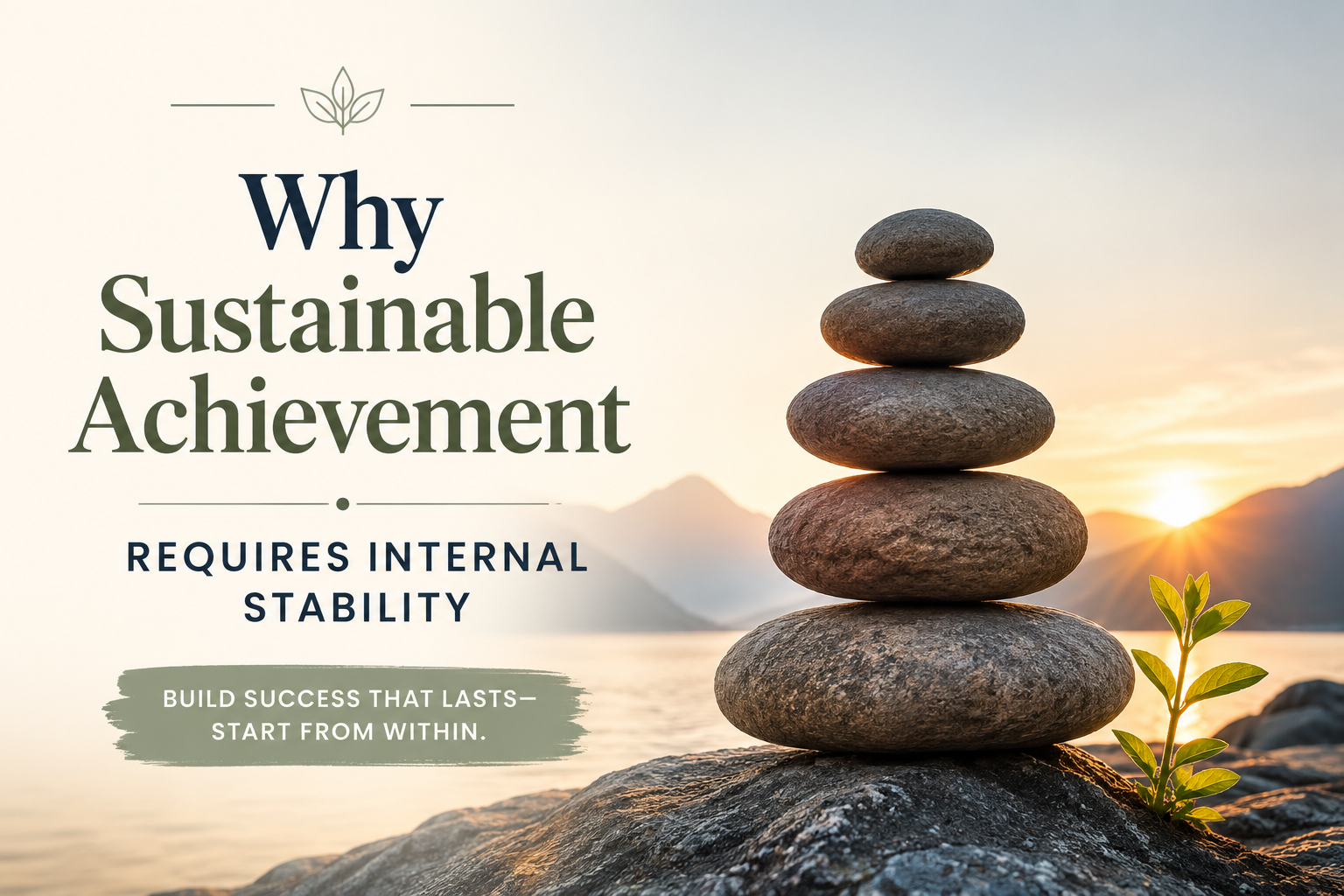
Why Sustainable Achievement Requires Internal Stability
Sustainable achievement is often misunderstood as a result of external advantages such as access to resources, timing, education, or connections. While these factors can influence outcomes, they are not the foundation of lasting success. At the core of every achievement that endures is something far less visible but far more powerful internal stability. This refers to a person’s ability to remain mentally, emotionally, and psychologically steady regardless of external conditions. Without it, even the most talented individuals tend to struggle with inconsistency, burnout, or eventual decline.
Internal stability begins with emotional regulation. Life is inherently unpredictable, and no level of planning can fully eliminate uncertainty. People who depend heavily on external validation or emotional highs often find themselves fluctuating between overconfidence and discouragement. This instability creates a cycle where progress is made in bursts but not sustained over time. On the other hand, individuals who learn to regulate their emotions develop a steady internal environment that allows them to keep moving forward even when circumstances are unfavorable. They are not easily derailed by failure, nor overly inflated by success.
Mental clarity is another essential component of internal stability. A cluttered mind filled with constant worry, comparison, and overthinking tends to produce scattered actions. When thoughts are unstable, decisions become reactive rather than intentional. Sustainable achievement requires the ability to think clearly under pressure and to maintain focus on long-term goals even when distractions are abundant. People who cultivate mental clarity are better able to prioritize what truly matters and avoid wasting energy on unproductive concerns.
Closely related to mental clarity is self-awareness. Many individuals move through life without fully understanding their own strengths, weaknesses, triggers, and patterns. This lack of awareness leads to repeated mistakes and inconsistent performance. Internal stability requires a deep level of self-understanding. When you know how you respond to stress, what motivates you, and where you tend to self-sabotage, you are in a better position to correct course early. Self-awareness acts as a stabilizing force because it reduces unpredictability in behavior and strengthens personal discipline.
Another dimension of internal stability is identity security. People who base their identity solely on achievements, titles, or external recognition often struggle when those elements change or disappear. This creates instability because their sense of self is constantly under threat. In contrast, individuals with a strong internal identity remain grounded regardless of external outcomes. They understand who they are beyond temporary success or failure. This internal grounding allows them to take risks, learn from mistakes, and continue progressing without fear of losing their sense of worth.
Discipline is often discussed in relation to achievement, but it is actually a byproduct of internal stability rather than its source. When a person is internally unstable, discipline becomes forced and short-lived. They rely on motivation, external pressure, or emotional bursts to act. However, when internal stability is present, discipline becomes natural and consistent. Actions are no longer dependent on mood but on internal alignment with long-term purpose. This is why some people are able to maintain productive habits for years while others struggle to sustain them for weeks.
Another important aspect is resilience. External success often involves setbacks, failures, and unexpected challenges. Internal stability determines how effectively a person can recover from these disruptions. A stable individual does not interpret failure as a final definition of their ability. Instead, they see it as feedback and continue adjusting their approach. Without internal stability, failure becomes emotionally overwhelming and often leads to withdrawal or abandonment of goals. With it, failure becomes a temporary phase in a continuous learning process.
Internal stability also influences decision-making quality. When a person is emotionally reactive or mentally scattered, decisions are often driven by fear, impatience, or external pressure. These decisions tend to produce unstable outcomes that reinforce further stress. However, when internal stability is strong, decisions are made from a place of calm evaluation. This leads to more consistent results over time because choices are aligned with long-term vision rather than short-term emotion.
Another overlooked factor is patience. Sustainable achievement rarely happens quickly. It requires time, repetition, and gradual refinement. Without internal stability, patience becomes extremely difficult because individuals begin to compare their progress with others or become discouraged by slow results. Internal stability allows a person to trust the process even when immediate results are not visible. This trust is not blind optimism but a grounded understanding that meaningful progress often happens beneath the surface before it becomes visible externally.
Internal stability also determines how a person handles success. Many individuals assume that success automatically leads to more success, but without stability, success can become destabilizing. Sudden recognition, financial gain, or increased responsibility can lead to poor decisions, overconfidence, or loss of direction. Stable individuals, however, are able to manage success with balance. They do not allow external achievements to distort their judgment or values. Instead, they integrate success into their long-term journey without losing perspective.
Focus is another outcome of internal stability. In a world filled with constant distractions, maintaining attention on one meaningful direction is increasingly difficult. People without internal stability often shift between goals, ideas, and strategies, never staying long enough in one direction to produce meaningful results. Stability creates focus by reducing internal noise. When the mind is not constantly reacting to emotional fluctuations or external comparisons, it becomes easier to concentrate deeply on one path.
It is also important to understand that internal stability is not a fixed trait but a developed skill. It is built through repeated experiences of managing discomfort, making intentional choices, and reflecting on outcomes. Over time, individuals learn how to remain steady even when circumstances are uncertain. This development requires intentional effort, especially in environments that encourage instant gratification and emotional impulsiveness.
One of the most powerful effects of internal stability is consistency. While talent and opportunity may create initial momentum, consistency determines long-term achievement. Stable individuals are able to show up repeatedly, even when conditions are not perfect. This consistency compounds over time, producing results that appear extraordinary to outside observers but are actually the result of steady internal discipline.
Internal stability also enhances relationships, which indirectly supports achievement. People who are emotionally unstable often experience conflict, miscommunication, or instability in their interactions with others. This can limit access to collaboration, mentorship, and support systems. Stable individuals tend to build stronger, more reliable relationships because they are predictable, trustworthy, and emotionally grounded. These relationships often become critical support structures in long-term success.
Another important dimension is adaptability. Stability does not mean rigidity. In fact, internal stability allows for better adaptation because decisions are not driven by panic or confusion. Instead, changes are assessed calmly and integrated strategically. This creates a balance between consistency and flexibility, which is essential in environments that are constantly evolving.
Ultimately, sustainable achievement is not defined by how fast someone rises, but by how long they are able to maintain progress without collapsing under pressure. External systems may provide opportunity, but internal stability determines longevity. Without it, achievement becomes temporary. With it, even modest beginnings can develop into long-lasting success.
In conclusion, internal stability is the unseen foundation of every meaningful and sustainable accomplishment. It shapes emotions, thoughts, discipline, resilience, focus, and decision-making. While it may not be as visible as external achievements, it is far more important in determining whether success will last or fade. Those who invest in building internal stability are not just pursuing achievement they are building the capacity to sustain it over a lifetime.

EarnSmartOnline.com.ng is dedicated to helping readers make smarter financial decisions through practical guides on online income, personal finance, technology, digital business, and wealth creation. Our goal is to provide reliable, easy-to-understand, and actionable content that empowers individuals to earn smarter, build sustainable income streams and achieve long-term financial success.
Recommended: Start Earning Online
- Ultimate Affiliate Marketing Program — learn affiliate marketing with a done-for-you sales system ($15). Check it out
- The Newbie Affiliate Guide — the beginner-friendly starter guide (~$6.68). Check it out
- Easy Dollar Maker — earn in dollars uploading AI images and videos from your phone ($17). Check it out
Disclosure: These are affiliate links. If you buy through them, I may earn a commission at no extra cost to you.



