
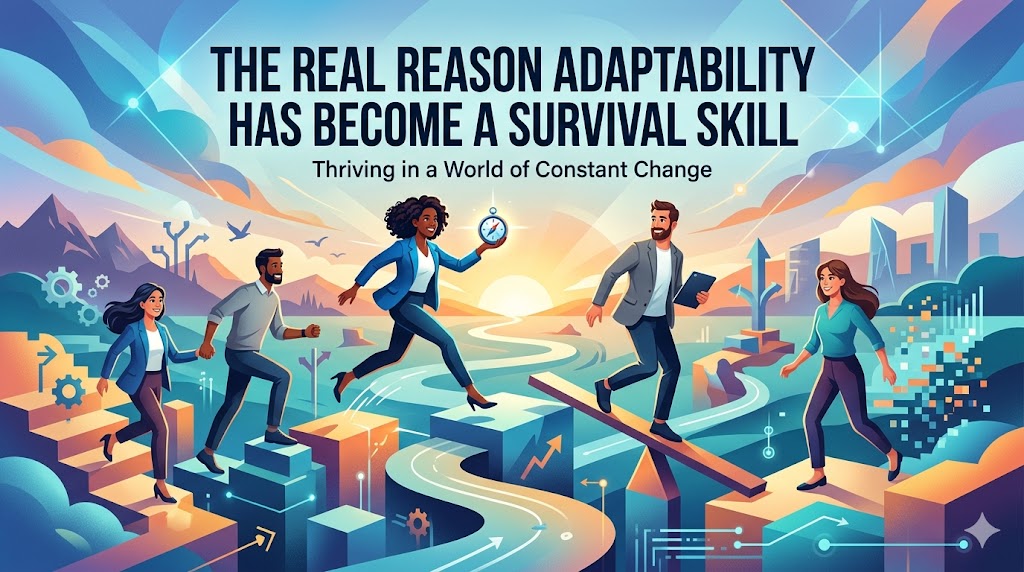
The Real Reason Adaptability Has Become a Survival Skill
The world has reached a point where stability is no longer the default condition of life. Change is no longer something that happens occasionally, it is something that happens constantly, sometimes quietly and sometimes violently. Technology shifts faster than people can learn it, industries transform before workers can fully settle into them, and social expectations evolve so quickly that yesterday’s advantage can become today’s disadvantage. In this kind of environment, adaptability has moved from being a useful trait to being a survival skill. Not in a dramatic sense of physical survival, but in the practical sense of being able to remain relevant, employed, financially stable, and mentally steady in a world that refuses to stay still.
For a long time, people were rewarded for specialization. If you learned one skill and mastered it, you could build a career around it for decades. A person could become a printer technician, a bank clerk, a factory worker, or a teacher and reasonably expect that the core of their work would remain the same for most of their life. The system was designed for repetition, not reinvention. But that structure has gradually collapsed. Automation, digital platforms, artificial intelligence, global competition, and remote work have reshaped how value is created. Now, the ability to adjust quickly matters more than the ability to perform a single task perfectly for a long period of time.
Adaptability matters because knowledge itself has changed its nature. In the past, knowledge was something you acquired and stored. Today, knowledge is something you constantly update. What you learned five years ago may already be partially outdated. What you learned ten years ago may no longer apply at all in certain fields. This does not mean education is useless, it means static education is no longer enough. The people who thrive are not necessarily the ones who know the most, but the ones who can learn, unlearn, and relearn without resistance. The ability to discard outdated thinking is now as important as the ability to gain new information.
Another reason adaptability has become essential is because the economy itself has become unpredictable at the individual level. Entire job roles disappear without warning, not because workers are failing, but because systems are evolving. Companies restructure, tools become automated, and consumer behavior shifts rapidly. A person who refuses to adapt may not fail immediately, but over time they become increasingly misaligned with the direction the world is moving. This misalignment slowly reduces opportunities until survival becomes difficult, even if effort remains high.
There is also a psychological layer to adaptability that many people overlook. Human beings naturally prefer certainty. The brain is wired to seek patterns, predict outcomes, and repeat familiar behaviors. Change disrupts this comfort system. It forces the mind into uncertainty, and uncertainty often feels like danger even when it is not. This is why many people resist adapting even when they logically understand its importance. The challenge is not intelligence, it is emotional resistance. Survival in the modern world requires not just new skills, but a new relationship with discomfort. Those who can act despite uncertainty gain an advantage over those who wait for clarity that never fully arrives.
Adaptability also determines financial survival more directly than most people realize. Income today is no longer tied only to effort, but to relevance. A person can work extremely hard in a field that is shrinking and still struggle financially, while another person with moderate effort but high adaptability can shift into growing opportunities and multiply their income. The difference is not effort alone, but direction. Adaptability allows people to move toward where value is increasing instead of staying where value is disappearing. This ability to reposition oneself is becoming one of the strongest predictors of financial stability.
In addition, adaptability has become critical because technology has changed the speed of competition. In previous eras, competitors were often local and limited. Today, competition is global and immediate. A skill you offer can be matched, replaced, or improved by someone on the other side of the world within a short time. This means standing still is equivalent to moving backward. To stay relevant, individuals must continuously adjust their skills, tools, and strategies. The ones who fail to do this often do not realize they are falling behind until the gap becomes too wide to close easily.
Social structures have also contributed to the need for adaptability. Career paths are no longer linear. People switch industries, combine multiple income streams, build online identities, and shift roles multiple times throughout their lives. The old model of one job, one company, one retirement plan is no longer the dominant reality. Instead, people are expected to navigate uncertainty, manage transitions, and create their own stability through flexibility. This requires a mindset that sees change not as disruption, but as a normal part of growth.
Another important dimension is that adaptability increases problem solving ability. When people are rigid in their thinking, they rely on fixed solutions. But when circumstances change, fixed solutions fail. Adaptable individuals learn to think in principles rather than rules. Instead of memorizing what worked once, they understand why it worked, which allows them to apply the principle in new situations. This deeper level of thinking is what allows them to respond effectively when conditions shift unexpectedly.
Adaptability also influences mental resilience. Life inevitably brings setbacks, whether financial, professional, or personal. Those who are rigid often interpret setbacks as permanent failures. But adaptable individuals interpret setbacks as feedback. They adjust their approach instead of giving up. This creates a cycle of continuous improvement rather than stagnation. Over time, this mindset builds emotional strength, because change becomes something to navigate rather than something to fear.
One of the most overlooked aspects of adaptability is its connection to opportunity recognition. Opportunities rarely announce themselves clearly. They often appear disguised as problems, confusion, or inconvenience. People who are rigid tend to avoid such situations, while adaptable individuals move toward them, analyze them, and adjust their approach until value is uncovered. This is why many breakthroughs in business and career growth come from moments of uncertainty rather than comfort. Adaptability allows people to see possibility where others see disruption.
Ultimately, adaptability has become a survival skill because the world no longer rewards permanence. It rewards motion, learning, and responsiveness. The ability to evolve continuously is no longer optional for those who want stability, it is the foundation of stability itself. In a paradoxical way, the more unpredictable the world becomes, the more important it is to remain flexible. Not because change is easy, but because resisting change has become far more costly than adapting to it.
In the end, survival in the modern sense is not about strength in the traditional form, but about responsiveness. It is about how quickly a person can adjust their thinking, their skills, and their direction when reality shifts. Those who understand this do not waste energy trying to preserve outdated systems. Instead, they focus on staying aligned with what is emerging. And in a world that never stops moving, alignment is no longer a luxury, it is the difference between progress and obsolescence.

EarnSmartOnline.com.ng is dedicated to helping readers make smarter financial decisions through practical guides on online income, personal finance, technology, digital business, and wealth creation. Our goal is to provide reliable, easy-to-understand, and actionable content that empowers individuals to earn smarter, build sustainable income streams and achieve long-term financial success.
Recommended: Start Earning Online
- Ultimate Affiliate Marketing Program — learn affiliate marketing with a done-for-you sales system ($15). Check it out
- The Newbie Affiliate Guide — the beginner-friendly starter guide (~$6.68). Check it out
- Easy Dollar Maker — earn in dollars uploading AI images and videos from your phone ($17). Check it out
Disclosure: These are affiliate links. If you buy through them, I may earn a commission at no extra cost to you.



