
Why Most People Underestimate the Power of Incremental Progress
Most people are constantly looking for big changes. Big breakthroughs. Big wins that suddenly transform everything overnight. There is something emotionally satisfying about the idea of a single moment that changes your life completely. It feels clean, dramatic, and memorable. But this mindset quietly blinds many people to one of the most powerful forces in human progress, incremental improvement. Why Most People Underestimate the Power of Incremental Progress.
Incremental progress is often ignored because it does not look impressive in the moment. It does not create excitement. It does not go viral. It does not feel like success when you are in the middle of it. It feels slow, almost invisible. Yet over time, it becomes the very thing that separates those who struggle from those who succeed. The strange truth is that most life changing outcomes are not created by one major action but by thousands of small ones that compound silently.
The human mind is not naturally wired to respect small improvements. If you improve by one percent today, it feels like nothing changed. If you study for twenty minutes more than yesterday, it feels insignificant. If you save a small amount of money instead of spending it, it does not feel like progress. Because of this, people tend to dismiss small efforts and wait for something bigger, something more obvious, something that feels worthy of attention. But this is where the misunderstanding begins.
What most people fail to realize is that life does not respond to dramatic effort alone. It responds to consistency. It responds to repetition. It responds to patterns over time. A small improvement repeated daily becomes something powerful not because each step is large, but because none of them are wasted. They stack. They accumulate. They build momentum in silence.
Think about how habits form. Nobody wakes up one day and suddenly becomes disciplined. Discipline is not a single decision. It is the result of repeated small choices. Waking up a little earlier. Avoiding one distraction. Completing one task before checking the phone. These actions seem minor, but they begin to shape identity. Over time, a person does not just act differently, they become different.
The same principle applies to skills. Nobody becomes highly skilled in a day. Every expert you admire once struggled with basic understanding. The difference between them and others is not talent alone but repetition. They stayed in the process long enough for small improvements to accumulate. Each practice session may have felt insignificant, but together they built mastery.
One of the reasons people underestimate incremental progress is because they compare early effort with finished results. They look at someone successful and assume the gap was crossed through a single leap. What they do not see are the countless small actions behind the scenes. The late nights. The repeated failures. The small adjustments that slowly improved performance. When only the outcome is visible, the process becomes invisible, and that invisibility creates false expectations.
This misunderstanding affects how people approach goals. Many start with enthusiasm but lose motivation quickly because they expect rapid results. When results do not appear fast enough, they assume the method is wrong or that they are not capable. In reality, they are simply underestimating how progress works. Growth rarely feels proportional to effort in the beginning. It only becomes visible after enough repetition has accumulated.
There is also a psychological bias that works against incremental progress. The brain prefers immediate rewards. It is designed to respond to visible outcomes, not long term accumulation. This is why people often choose short term comfort over long term benefit. Skipping a workout feels better in the moment than completing it. Spending money feels more rewarding than saving it. Watching entertainment feels easier than studying. But the consequences of these decisions are not immediate, so they are often ignored.
Incremental progress requires resisting this bias. It requires trusting outcomes that are not yet visible. This is difficult because the human mind wants proof. It wants confirmation that effort is working. But in many areas of life, proof arrives late. The early stages are quiet. Nothing seems to change. Yet beneath the surface, systems are being built.
Consider financial growth. People often expect noticeable improvement in a short time. But wealth is rarely built through sudden jumps. It is built through consistent financial behavior repeated over years. Saving small amounts regularly, avoiding unnecessary expenses, making better financial decisions repeatedly. Each action alone seems small, but together they create a completely different financial reality.
The same applies to health. A person does not become unhealthy in a single day, and they do not become fit in a single week. Health is shaped by repeated choices over time. What someone eats, how often they move, how well they sleep. Each decision may feel minor, but the accumulation determines long term outcomes. The difference between two people with very different health conditions is often not one dramatic decision but years of small ones.
Another reason incremental progress is underestimated is because it lacks emotional intensity. Big changes feel exciting. They create a sense of urgency and motivation. Small changes feel boring. They require patience and discipline. But emotional intensity is not a reliable indicator of effectiveness. In fact, many of the most effective processes in life are boring by design. They work not because they are exciting but because they are repeatable.
There is also a deeper identity shift that happens through incremental progress. When someone consistently performs small positive actions, they begin to see themselves differently. A person who writes daily starts to see themselves as a writer. A person who exercises regularly begins to identify as someone who takes care of their health. This identity shift is powerful because it reinforces behavior. Once identity changes, actions become easier to maintain.
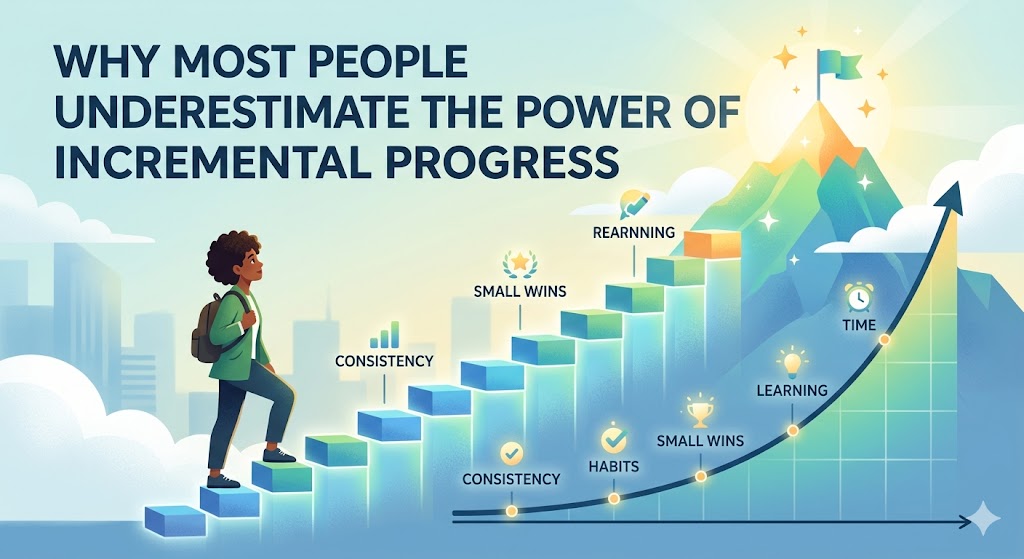
The compounding effect of incremental progress is what makes it so powerful. Just like compound interest in finance, small gains build upon previous gains. At first, the change is almost unnoticeable. But over time, the curve begins to shift. What looked flat suddenly rises sharply. This is why many people give up too early. They quit during the phase where progress is happening but not yet visible.
Understanding this pattern changes how you approach effort. Instead of expecting immediate transformation, you begin to value consistency. You stop looking for dramatic proof and start trusting the process. You realize that progress is not always loud. Sometimes it is quiet, invisible, and gradual, until one day it becomes undeniable.
This mindset also reduces frustration. Many people feel stuck not because they are not improving, but because they are expecting improvement to look different. When expectations are reset, patience increases. And patience is one of the most important requirements for long term success.
Incremental progress also creates resilience. When improvement is small and consistent, setbacks become easier to handle. A bad day does not erase progress because progress is not dependent on one moment. It is distributed across time. This makes long term goals more stable and less fragile.
There is a hidden advantage in small improvements that most people overlook. They are sustainable. Large changes are often difficult to maintain because they require extreme effort. Small changes, however, can be maintained almost effortlessly. This sustainability is what allows them to accumulate over time. Something that lasts long enough will eventually become powerful.
At its core, incremental progress teaches a different way of thinking about success. It shifts focus from intensity to consistency. From speed to direction. From immediate results to long term accumulation. It replaces the illusion of sudden transformation with the reality of gradual construction.
The truth is that most meaningful achievements in life are not the result of one defining moment. They are the result of countless small decisions made in the right direction. The people who understand this do not rely on motivation alone. They rely on systems, habits, and repetition. They trust that small steps, when maintained long enough, will eventually lead to significant change.
In a world obsessed with quick results, incremental progress feels almost too simple to be powerful. But simplicity is often what makes it effective. It does not require special conditions. It does not require perfect timing. It only requires persistence. And over time, persistence becomes transformation.
What looks small today is often the foundation of something much larger tomorrow. The challenge is not in starting, but in continuing long enough to see the effect. Those who underestimate incremental progress quit too early. Those who respect it quietly build outcomes that seem extraordinary to others, even though they were created through ordinary repeated actions.
In the end, incremental progress is not just a strategy. It is a way of understanding how change actually works. It is the recognition that greatness is not a single act, but a collection of small ones that refused to stop.

EarnSmartOnline.com.ng is dedicated to helping readers make smarter financial decisions through practical guides on online income, personal finance, technology, digital business, and wealth creation. Our goal is to provide reliable, easy-to-understand, and actionable content that empowers individuals to earn smarter, build sustainable income streams and achieve long-term financial success.
Recommended: Start Earning Online
- Ultimate Affiliate Marketing Program — learn affiliate marketing with a done-for-you sales system ($15). Check it out
- The Newbie Affiliate Guide — the beginner-friendly starter guide (~$6.68). Check it out
- Easy Dollar Maker — earn in dollars uploading AI images and videos from your phone ($17). Check it out
Disclosure: These are affiliate links. If you buy through them, I may earn a commission at no extra cost to you.



