
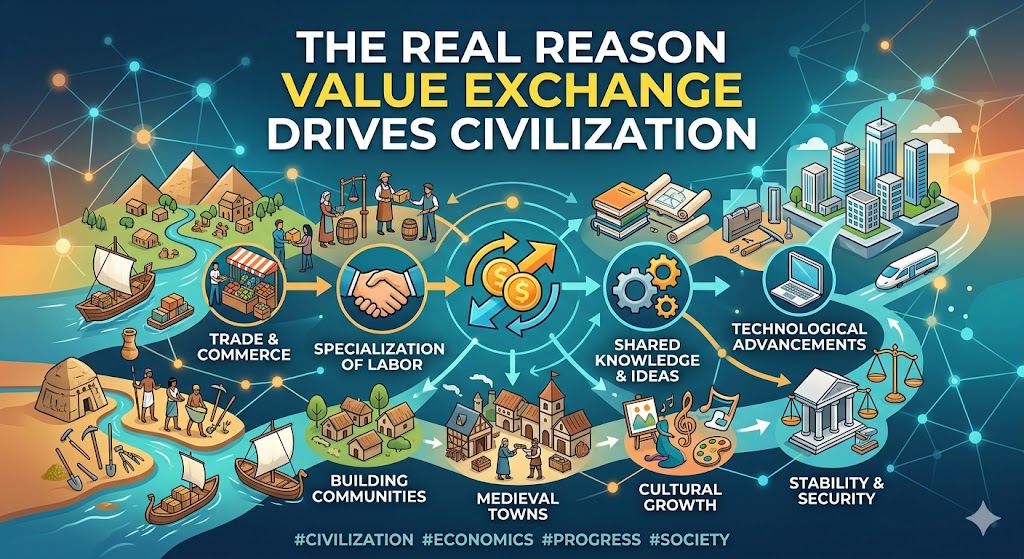
The Real Reason Value Exchange Drives Civilization
The foundation of every functioning society is not built on money, technology, or even laws, but on something far more fundamental that often goes unnoticed in everyday life. It is the constant, invisible process of value exchange. From the earliest human settlements to modern global economies, civilization has always advanced through people trading what they have for what they need, and more importantly, what they value. This exchange is not just economic, it is deeply social, psychological, and structural. It determines how trust is formed, how systems grow, and how progress becomes possible at scale.
At its core, value exchange is simple. One person offers something useful, whether a skill, product, service, idea, or resource, and receives something they perceive as more beneficial in return. But simplicity should not be mistaken for weakness. This basic mechanism is what allowed humans to move beyond survival-based living into organized societies. Without value exchange, every individual would be forced into self-sufficiency, which severely limits growth, innovation, and cooperation. Civilization begins the moment people realize they can specialize, trust others, and trade value instead of trying to produce everything alone.
As societies grow, value exchange becomes more complex and more powerful. Early barter systems evolved into structured currencies, financial systems, and digital economies, but the principle never changed. Whether someone is trading grain for tools in an ancient market or exchanging digital services across continents today, the same logic applies. Civilization expands because people can rely on systems that allow value to move efficiently between individuals who may never meet, yet still benefit from each other’s contributions.
One of the most important consequences of value exchange is specialization. When people are free to focus on what they do best and exchange the results of their effort, productivity increases dramatically. A society where everyone tries to do everything for themselves is inefficient and stagnant. But a society where individuals specialize in narrow areas of expertise becomes highly productive and innovative. This is why modern civilization can produce advanced medicine, engineering, communication systems, and entertainment at the same time. Specialization only works because value exchange ensures that no effort is wasted and every contribution can be rewarded.
Trust is another invisible pillar that makes value exchange possible. No system of exchange can function if people do not believe that they will receive fair value in return for what they offer. This is why laws, contracts, reputations, and institutions exist. They are all designed to reinforce trust in the exchange process. When trust is strong, transactions become easier and faster. When trust breaks down, societies become inefficient, conflict rises, and economic activity slows. Civilization, therefore, is not just built on exchange itself, but on the trust that sustains it.
Value exchange also shapes human behavior in powerful ways. People naturally gravitate toward actions and skills that are rewarded by society. If a skill is highly valued in the market, more people will learn it. If a behavior is rewarded socially or economically, it will spread. This feedback loop is one of the reasons civilization evolves over time. The things society values influence what people choose to become, and what people become reshapes what society can achieve. In this sense, value exchange does not just support civilization, it actively directs its evolution.
Another important dimension is the role of perceived value versus actual effort. Civilization does not reward effort alone. It rewards value as perceived by others. This is why some people can work extremely hard yet struggle financially, while others produce high perceived value with less visible effort and achieve greater success. The system is not unfair in a moral sense, it is simply structured around demand and usefulness. Understanding this distinction is crucial because it reveals why learning to create value in ways others recognize is more important than simply working hard.
As value exchange scales, it creates entire systems of interdependence. No modern individual can survive independently without relying on thousands of unseen exchanges. The food people eat, the electricity they use, the devices they hold, and even the information they consume are all products of complex exchange networks. Civilization becomes a vast web of mutual dependence where each person contributes a small part and benefits from the contributions of many others. This interconnectedness is what allows modern life to function at such a high level of convenience and productivity.
Technology has accelerated value exchange to an unprecedented level. Digital platforms, global markets, and instant communication have removed many of the traditional barriers to trade. Today, a single idea can be shared globally within seconds, and value can be transferred across continents almost instantly. This acceleration has increased opportunities but also intensified competition. The faster value moves, the more important it becomes to clearly understand what people truly need and how to deliver it effectively. Civilization continues to evolve as exchange becomes faster, broader, and more efficient.
At a deeper level, value exchange is also tied to human meaning and purpose. People derive a sense of significance when they feel their contributions are valued by others. Work is not just about survival, it is also about participation in a larger system of exchange. When individuals feel that what they offer has no value, they often experience disengagement or frustration. But when they see that their contribution is recognized and rewarded, it reinforces motivation and identity. Civilization depends not only on economic exchange, but also on the psychological fulfillment that comes from being part of it.
Ultimately, the real reason value exchange drives civilization is because it aligns individual interest with collective progress. Each person acts in their own self-interest, but through exchange, those actions contribute to a larger system that benefits everyone. This alignment is what makes civilization sustainable. It transforms individual effort into collective advancement without requiring centralized control over every action. As long as people continue to exchange value, societies will continue to grow, adapt, and evolve.
In the end, civilization is not just a structure of buildings, governments, or technologies. It is a living system of continuous exchange, where value flows between individuals in countless forms. The more efficiently and fairly this exchange occurs, the more advanced and stable a society becomes. Understanding this truth reveals that progress is not random or accidental. It is the result of millions of small exchanges happening every day, each one contributing to the ongoing construction of human civilization.

EarnSmartOnline.com.ng is dedicated to helping readers make smarter financial decisions through practical guides on online income, personal finance, technology, digital business, and wealth creation. Our goal is to provide reliable, easy-to-understand, and actionable content that empowers individuals to earn smarter, build sustainable income streams and achieve long-term financial success.
Recommended: Start Earning Online
- Ultimate Affiliate Marketing Program — learn affiliate marketing with a done-for-you sales system ($15). Check it out
- The Newbie Affiliate Guide — the beginner-friendly starter guide (~$6.68). Check it out
- Easy Dollar Maker — earn in dollars uploading AI images and videos from your phone ($17). Check it out
Disclosure: These are affiliate links. If you buy through them, I may earn a commission at no extra cost to you.



