
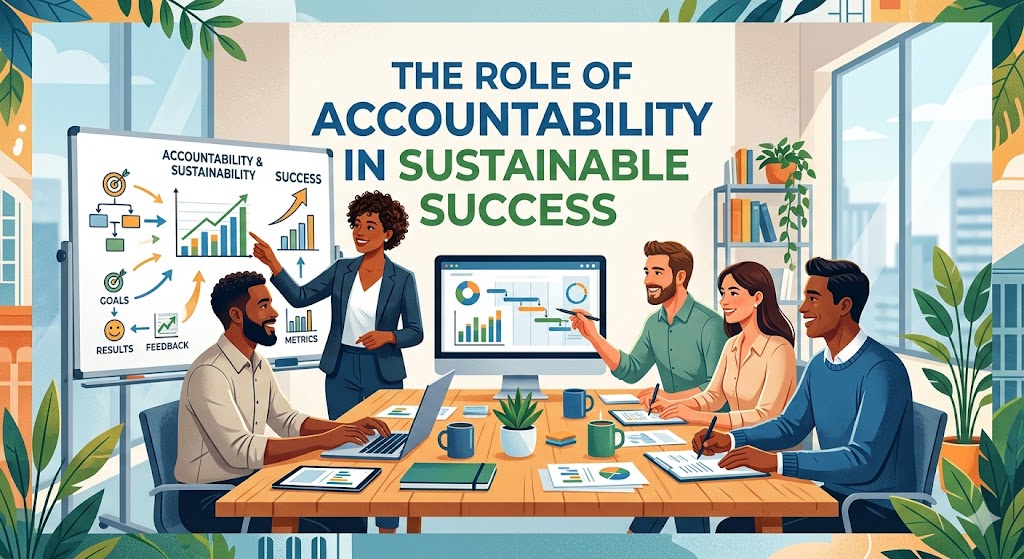
The Role of Accountability in Sustainable Success
Sustainable success is rarely the result of talent alone. It is not just about intelligence, access to opportunities, or even the amount of effort someone puts in at the beginning. What often determines whether success lasts or collapses over time is accountability. Accountability is the invisible structure that holds performance together when motivation fades, when pressure increases, and when external support is no longer available. Without it, even strong starts tend to fall apart because there is nothing steady guiding decisions beyond emotions or circumstances.
At its core, accountability is the ability to take responsibility for actions, outcomes, and decisions without shifting blame outward. It means acknowledging both progress and failure as personal responsibility, rather than attributing success solely to luck or blaming failure entirely on external conditions. This mindset creates a stable internal framework that helps individuals evaluate their behavior honestly. When people are accountable, they become more aware of the direct connection between what they do today and what they experience tomorrow. This awareness is the foundation of consistency, and consistency is one of the strongest predictors of long term success.
Many people begin their journey toward success with excitement and ambition, but over time, that initial energy fades. What remains determines whether they continue progressing or regress into old patterns. In most cases, the difference is accountability. Without accountability, it becomes easy to rationalize poor decisions. Delays are excused as timing issues. Mistakes are blamed on external systems. Lack of progress is attributed to unfair conditions. Over time, these justifications become habits, and habits shape outcomes more than intentions ever can.
Accountability changes this dynamic by forcing a person to confront reality directly. It removes the comfort of excuses and replaces it with clarity. While this can feel uncomfortable, it is also what makes growth possible. A person who is accountable does not waste time escaping responsibility. Instead, they use every result as feedback. If something works, they analyze why it worked so they can repeat it. If something fails, they examine their role in the failure so they can adjust. This constant feedback loop becomes the engine of improvement.
Sustainable success is not built on occasional wins but on systems that can withstand time. Accountability plays a key role in building these systems because it enforces discipline when external pressure is absent. Many people can perform well when they are being watched, supervised, or motivated by external rewards. However, true sustainability is tested in private moments when no one is watching and no immediate consequences are visible. In those moments, accountability acts as an internal supervisor that keeps behavior aligned with long term goals.
Another important aspect of accountability is its relationship with decision making. Every outcome in life is the result of accumulated decisions, both big and small. When individuals lack accountability, they tend to underestimate the impact of small decisions. They assume that minor compromises will not matter, but over time, these small choices compound into significant results. Accountability forces individuals to treat every decision as meaningful. It encourages careful thinking, delayed gratification, and awareness of long term consequences. This leads to better judgment and more stable progress.
Accountability also influences how people respond to failure. Failure is unavoidable in any meaningful pursuit, but the response to failure determines whether it becomes a stepping stone or a stopping point. Without accountability, failure is often externalized. People assume circumstances were unfair or that others created obstacles beyond their control. While external factors do exist, ignoring personal responsibility prevents learning. Accountability ensures that failure becomes an analytical experience rather than an emotional escape. It transforms setbacks into structured lessons that improve future performance.
In environments where accountability is weak, mediocrity tends to spread easily. When no one is responsible for outcomes, standards gradually decline. This applies to individuals, teams, and even organizations. On the other hand, when accountability is strong, performance becomes self regulating. People naturally elevate their behavior because they know their actions have consequences that they must personally answer for. This creates a culture of seriousness, focus, and continuous improvement that supports long term stability.
One of the less obvious benefits of accountability is emotional stability. People who lack accountability often experience cycles of frustration, blame, and disappointment because they feel life is happening to them rather than being shaped by them. This creates a sense of helplessness over time. Accountability reverses this pattern by restoring a sense of control. When individuals recognize their role in outcomes, they also recognize their ability to influence future outcomes. This sense of control reduces anxiety and increases confidence because life feels more manageable and predictable.
Accountability also strengthens discipline, which is essential for sustainable success. Discipline is not just about doing what is necessary when it is easy, but about maintaining effort when it is difficult or inconvenient. Without accountability, discipline becomes fragile because there is no internal mechanism enforcing consistency. Accountability acts as that mechanism. It creates a mental structure where breaking commitments feels personally significant, not just situationally inconvenient. This makes it easier to stay aligned with long term goals even when short term distractions are present.
Another important dimension of accountability is its impact on identity. People tend to act in alignment with how they see themselves. When someone sees themselves as accountable, they naturally begin to behave in more responsible ways. They become more careful with promises, more consistent with effort, and more intentional with their time. Over time, these behaviors reinforce the identity, creating a cycle of positive reinforcement. This is how accountability transforms from a behavior into a character trait that shapes every area of life.
Ultimately, sustainable success is not just about achieving results but about maintaining them over time without constant external pressure. Accountability is what makes this possible. It ensures that success is not accidental or temporary but built on a foundation of responsibility, awareness, and discipline. Without accountability, success often becomes unstable, dependent on external conditions or short bursts of motivation. With accountability, success becomes structured, repeatable, and self sustaining.
In a world where distractions are constant and shortcuts are tempting, accountability stands as one of the few reliable anchors for long term achievement. It demands honesty, encourages growth, and builds resilience. More importantly, it ensures that individuals remain active participants in their own progress rather than passive observers of their circumstances. Those who embrace accountability do not just achieve success once. They build the capacity to sustain it, refine it, and expand it over time.

EarnSmartOnline.com.ng is dedicated to helping readers make smarter financial decisions through practical guides on online income, personal finance, technology, digital business, and wealth creation. Our goal is to provide reliable, easy-to-understand, and actionable content that empowers individuals to earn smarter, build sustainable income streams and achieve long-term financial success.
Recommended: Start Earning Online
- Ultimate Affiliate Marketing Program — learn affiliate marketing with a done-for-you sales system ($15). Check it out
- The Newbie Affiliate Guide — the beginner-friendly starter guide (~$6.68). Check it out
- Easy Dollar Maker — earn in dollars uploading AI images and videos from your phone ($17). Check it out
Disclosure: These are affiliate links. If you buy through them, I may earn a commission at no extra cost to you.



