
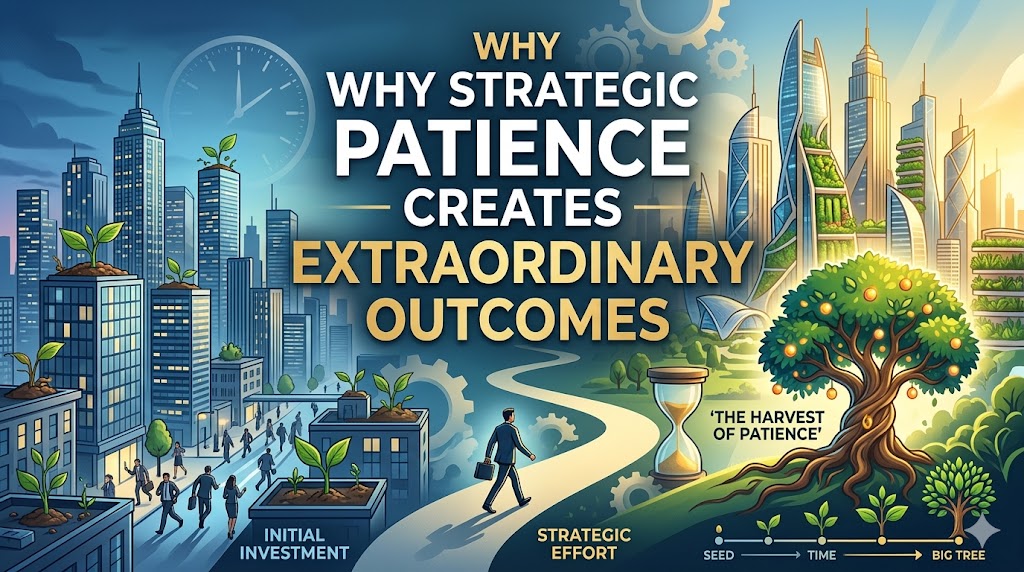
Why Strategic Patience Creates Extraordinary Outcomes
Most people are taught to value speed above almost everything else. Fast results, instant success, quick money, rapid growth. The modern world reinforces this idea daily through social media highlights, overnight success stories, and simplified narratives that hide years of quiet preparation. Because of this, patience has become underrated, almost treated like weakness. But in reality, the people who achieve extraordinary outcomes are rarely the fastest starters. They are usually the ones who understand how to wait strategically, act precisely, and let time amplify their decisions.
Strategic patience is not about doing nothing or delaying action. It is the ability to act at the right moment instead of reacting emotionally or impulsively. It is the discipline of allowing information, skills, relationships, and opportunities to mature before making critical moves. While others rush into decisions to feel progress, strategic thinkers are often observing, refining, learning, and positioning themselves for leverage that compounds later.
One of the clearest ways to understand strategic patience is through the idea of compounding. Most people think compounding only applies to money, but it applies to almost everything in life. Skills compound when you practice consistently over time. Relationships compound when trust is built gradually. Knowledge compounds when each new idea builds on previous understanding. Even reputation compounds when people repeatedly see your consistency. However, compounding only works when you stay long enough in the process. Strategic patience is what allows compounding to fully express itself.
The challenge is that early stages rarely feel rewarding. In fact, many meaningful pursuits feel slow and uncertain at the beginning. A person building a business may work for months without profit. A student learning a new skill may struggle for weeks without visible improvement. A content creator may post for a long time before gaining attention. This early silence is where most people quit. They mistake lack of immediate results for lack of progress. Strategic patience is the ability to recognize that progress is often happening beneath the surface before it becomes visible.
Impatience, on the other hand, creates fragmentation. People jump from one idea to another, one opportunity to the next, constantly resetting their progress. Every time they switch direction too early, they abandon accumulated effort. This creates a cycle where they are always starting but never building. The difference between someone who succeeds and someone who remains stuck is often not talent or opportunity, but the willingness to stay in one direction long enough for results to mature.
Strategic patience also changes the way decisions are made. Instead of asking what will give immediate reward, a strategic thinker asks what will matter most in five or ten years. This shift in thinking leads to better choices in education, career, investments, relationships, and personal development. Many of the most powerful advantages in life are delayed rewards. They require upfront effort with no guarantee of immediate return. Without patience, these opportunities look unattractive and are often ignored.
There is also a psychological benefit to patience that most people overlook. Impulsive action is often driven by emotional discomfort. People rush because they feel pressure, uncertainty, or fear of missing out. Strategic patience helps regulate these emotions by introducing clarity and structure. Instead of reacting to temporary feelings, decisions are made based on long-term alignment. This reduces regret and increases consistency, which is essential for meaningful achievement.
In competitive environments, patience becomes a form of hidden advantage. While others rush and make mistakes, the patient individual observes patterns, identifies inefficiencies, and waits for better positioning. This does not mean avoiding action, but rather choosing action carefully. In many cases, the best opportunities are not the first ones available but the ones that emerge after others have exhausted themselves. Strategic patience allows a person to enter at the point of maximum leverage instead of early struggle.
Another important aspect of strategic patience is timing. Timing is often more powerful than effort. The same action taken too early or too late can produce completely different results. A business idea launched before the market is ready may fail, while the same idea launched later can succeed massively. A skill learned before demand rises may seem useless, but becomes valuable when conditions change. Strategic patience is the ability to sense timing rather than force outcomes prematurely.
It is also important to understand that patience does not mean passivity. Many people confuse waiting with inactivity, but strategic patience is active preparation. While waiting for the right moment, a person is still improving skills, gathering resources, building networks, and strengthening systems. The waiting period is not empty; it is productive in a quieter way. This is why outcomes appear sudden to outsiders, even though they are the result of long invisible preparation.
One of the greatest misunderstandings in modern thinking is the assumption that success is linear. People expect effort to produce immediate and proportional results. But reality is often exponential rather than linear. For a long time, progress may look slow, then suddenly accelerate once certain thresholds are reached. Strategic patience is required to survive the slow phase long enough to reach the acceleration phase. Without patience, people exit just before the breakthrough point.
Strategic patience also builds emotional resilience. When individuals are not obsessed with immediate validation, they become less affected by short-term setbacks. Rejection, delay, or failure becomes part of the process rather than a final judgment. This emotional stability allows them to continue working even when results are not yet visible. Over time, this resilience becomes a competitive advantage because many others are emotionally eliminated before they reach success.
Ultimately, extraordinary outcomes are rarely the result of constant urgency. They are the result of aligned persistence over time. Strategic patience is what transforms effort into mastery, and mastery into impact. It allows individuals to operate with clarity instead of pressure, direction instead of confusion, and compounding instead of repetition. While the world continues to reward speed on the surface, the deeper reality remains unchanged. The most significant achievements in life belong to those who understand when to move, when to wait, and how to let time work in their favor.

EarnSmartOnline.com.ng is dedicated to helping readers make smarter financial decisions through practical guides on online income, personal finance, technology, digital business, and wealth creation. Our goal is to provide reliable, easy-to-understand, and actionable content that empowers individuals to earn smarter, build sustainable income streams and achieve long-term financial success.
Recommended: Start Earning Online
- Ultimate Affiliate Marketing Program — learn affiliate marketing with a done-for-you sales system ($15). Check it out
- The Newbie Affiliate Guide — the beginner-friendly starter guide (~$6.68). Check it out
- Easy Dollar Maker — earn in dollars uploading AI images and videos from your phone ($17). Check it out
Disclosure: These are affiliate links. If you buy through them, I may earn a commission at no extra cost to you.



