
What is the difference between stocks and bonds?
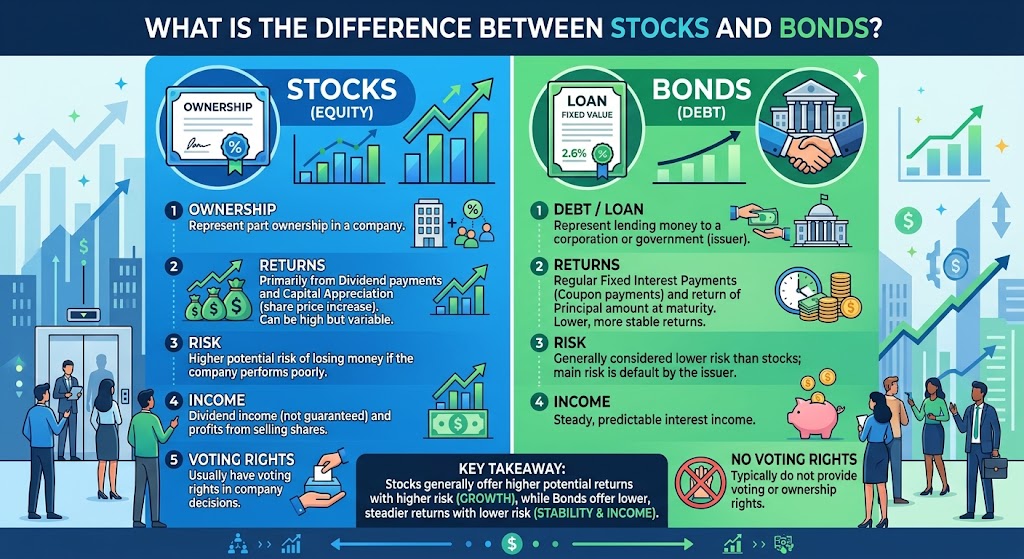
What is the difference between stocks and bonds? This is one of the most important questions beginners ask when they start learning about investing, and understanding the answer can make it much easier to make sensible investment decisions. Stocks and bonds are both common investment instruments, but they represent very different relationships between an investor and the organisation receiving the money. A stock generally represents ownership in a company, while a bond generally represents money lent to a company, government or other issuer. Because of this fundamental difference, stocks and bonds behave differently, carry different types of risks and can serve different purposes in an investment portfolio.
When you buy shares of a company, you are purchasing an ownership interest in that business. Your investment can increase in value if the company performs well and the market becomes more willing to pay a higher price for its shares. Some companies also distribute part of their profits to shareholders through dividends. However, shareholders are not guaranteed a particular return, and the value of their investment can fall substantially if the company performs poorly or investors become less confident about its future.
When you buy a bond, you are generally lending money to the issuer. The issuer agrees to pay interest according to the terms of the bond and repay the principal at maturity, assuming the issuer meets its obligations. Bonds therefore operate more like a lending arrangement than an ownership arrangement. A bondholder does not normally own part of the company simply because they purchased one of its bonds.
This basic distinction explains much of the difference between stocks and bonds. A stock investor is essentially saying, “I want to participate in the ownership and future performance of this business.” A bond investor is generally saying, “I am willing to lend money to this issuer in exchange for interest and the repayment of my principal under the agreed terms.”
The difference between stocks and bonds becomes especially important when considering potential returns. Stocks generally offer greater long term growth potential because shareholders participate in the economic success of the companies they own. If a company grows dramatically over many years, its shares can potentially increase significantly in value. However, that opportunity comes with greater price volatility and the possibility of losing a substantial portion or even all of the investment in an individual company.
Bonds generally have more limited upside because the investor’s return is primarily determined by the interest payments and repayment terms established when the bond is issued. If you lend money through a bond and the issuer successfully fulfils its obligations, your return is normally based on the agreed interest and the return of your principal rather than unlimited participation in the issuer’s profits.
This does not mean bonds are risk free. One of the biggest mistakes beginners make is assuming that bonds cannot lose money. Bonds have several risks, including credit risk, interest rate risk, inflation risk and, depending on the bond, liquidity risk and currency risk. A bond issued by a financially weak organisation can become less valuable if investors become concerned about whether the issuer will repay its debt.
Credit risk is particularly important. It refers to the possibility that the bond issuer will fail to make scheduled interest payments or repay the principal. Government bonds issued by financially stable governments may have relatively low credit risk compared with bonds issued by companies with weaker financial positions, but the level of risk depends on the specific issuer and circumstances.
Stocks have a different risk profile. Instead of primarily worrying about whether a borrower will repay a loan, stock investors are exposed to the performance and valuation of the underlying business. A company can experience falling sales, rising costs, increased competition, regulatory problems, management failures, technological disruption or other challenges that cause its share price to decline.
The stock market can also fall even when an individual company is performing reasonably well. Investor sentiment, interest rates, economic conditions, geopolitical events and expectations about future growth can influence stock prices. This means that owning a good company does not guarantee that its shares will always increase in value.
Another major difference between stocks and bonds is the way investors may receive income. Stocks can pay dividends, although companies are generally not obligated to pay dividends to shareholders. A company may choose to reinvest profits into expansion, research, acquisitions, debt reduction or other activities instead of distributing them to shareholders.
Bonds typically make scheduled interest payments according to their terms. The exact structure varies between bonds. Some pay interest periodically, while others may work differently. The important point is that bond payments are based on contractual obligations rather than being distributions of ownership profits.
This distinction can make bonds attractive to investors seeking a more predictable income stream, although predictability is never the same as certainty. The issuer must remain capable of meeting its obligations, and the actual value of a bond can fluctuate before maturity.
Another important difference between stocks and bonds is maturity. Stocks generally do not have a maturity date. When you buy shares in a company, you can continue holding them for as long as you wish, unless the company is acquired, liquidated or otherwise undergoes a structural change that affects the shares.
Bonds, however, normally have a maturity date. At maturity, the issuer is expected to repay the principal according to the bond’s terms. Before maturity, an investor may also sell the bond in the secondary market, where its market price can be higher or lower than the amount originally paid.
Interest rates are particularly important when understanding bond prices. Generally, when market interest rates rise, existing bonds with lower fixed interest rates can become less attractive, which can cause their market prices to fall. When market interest rates fall, existing bonds with comparatively higher fixed rates can become more attractive, potentially increasing their market prices.
This relationship can be confusing for beginners because it means that a bond can lose market value even when the issuer remains financially healthy. If an investor intends to hold a suitable bond until maturity and the issuer fulfils its obligations, short term price fluctuations may have a different significance than they would for someone planning to sell the bond before maturity. The specific terms and risks always matter.
Inflation is another factor that affects both stocks and bonds, but in different ways. Inflation reduces the purchasing power of money over time. If a bond provides a fixed interest payment and inflation rises significantly, the real purchasing power of those payments may decline.
Stocks can also be affected by inflation because rising prices can increase companies’ operating costs and influence consumer behaviour. However, companies with strong competitive positions may sometimes increase prices and grow revenues over time, potentially helping them cope with inflation. There is no universal guarantee, though, and different businesses respond to inflation differently.
Liquidity is another consideration. Liquidity refers to how easily an investment can be bought or sold without significantly affecting its price. Large, actively traded stocks can be highly liquid, while some bonds may trade less frequently. However, liquidity varies considerably among individual stocks and bonds, so investors should not assume that every stock is automatically more liquid than every bond.
There is also an important difference in how shareholders and bondholders are treated if a company gets into serious financial trouble. Bondholders are generally creditors of the company, while ordinary shareholders are owners. In a liquidation scenario, creditors generally have priority over shareholders when assets are distributed, although the exact order depends on the type of claim and applicable law. If the company’s assets are insufficient to satisfy its obligations, shareholders can potentially lose their entire investment.
This helps explain why stocks can offer higher potential returns than many bonds. Greater potential reward is connected to greater risk. Stockholders participate in the upside of a business but also stand behind creditors in the event of liquidation.
The difference between stocks and bonds also becomes clearer when considering why investors combine them. An investment portfolio does not necessarily have to consist entirely of stocks or entirely of bonds. Some investors hold both because the two asset classes can behave differently under different economic conditions.
Stocks may be used primarily for long term growth, while bonds may be used for income, diversification or capital preservation depending on the specific bonds selected. The appropriate balance depends on factors such as investment goals, time horizon, risk tolerance, income needs, financial circumstances and the investor’s ability to tolerate market declines.
For example, a young investor with a long investment horizon may be more comfortable accepting significant short term stock market fluctuations because they have many years before they need the money. Another investor approaching a major financial goal may place greater importance on reducing the risk of a large decline and therefore consider a different allocation.
However, age alone should not determine an investment strategy. Two people of the same age can have completely different financial responsibilities, incomes, goals and risk tolerances. The right portfolio is therefore not simply a matter of following a universal percentage.
Diversification is another reason investors may consider both stocks and bonds. Diversification means spreading investments across different assets, companies, industries, regions or other categories rather than relying heavily on one investment. The purpose is not to eliminate risk entirely. Instead, diversification can help reduce the damage that poor performance in one investment or category may cause to the overall portfolio.
It is also important to understand that owning many stocks does not automatically mean you have a properly diversified portfolio. If all your money is concentrated in one industry, one country or a small group of companies, you may still be exposed to substantial concentration risk.
The same principle applies to bonds. Owning several bonds does not necessarily eliminate risk if they are all issued by the same organisation or exposed to similar economic conditions.
For beginners, the biggest lesson is that stocks and bonds should not be viewed simply as competing products where one is good and the other is bad. They are different financial instruments designed around different relationships and risk characteristics.
A stock gives you an ownership stake. A bond generally represents a lending relationship. Stock investors typically seek growth and may receive dividends, while bond investors generally seek interest income and repayment of principal according to the bond’s terms. Stocks generally have greater growth potential and greater volatility, while bonds can offer more predictable contractual cash flows but remain exposed to several risks.
It is also worth understanding that there are many different types of stocks and bonds. Ordinary shares are different from preferred shares. Government bonds are different from corporate bonds. Short term bonds are different from long term bonds. High quality bonds are different from high yield bonds. International bonds can introduce currency and country specific risks.
Therefore, asking “What is the difference between stocks and bonds?” is only the beginning of understanding these investments. The next question should be, “Which specific stock or bond am I considering, and what risks come with it?”
Investment funds can also provide exposure to stocks and bonds without requiring an investor to select individual securities. A fund may hold a collection of stocks, bonds or both. This can provide diversification, although investors still need to understand the fund’s strategy, fees, risks and underlying holdings.
One common mistake is to assume that investing in stocks means gambling while investing in bonds means saving. Neither description is accurate. Both are investments, and both can involve risk. The key difference is the nature of that risk and the relationship between the investor and the issuer.
Another mistake is assuming that a higher priced stock is automatically more expensive than a lower priced stock. Share price alone tells you very little about the overall value of a company. Investors need to consider factors such as the number of shares outstanding, earnings, cash flow, assets, liabilities, growth expectations and valuation.
Similarly, the interest rate offered by a bond should not be considered in isolation. A higher yield may reflect greater credit risk, longer maturity or other factors. Investors should investigate why the yield is higher rather than assuming that a higher return automatically represents a better opportunity.
The difference between stocks and bonds also matters when thinking about investment time horizons. Money needed soon generally deserves greater caution because there may not be enough time to recover from a major market decline. Money intended for a distant financial goal can potentially tolerate more short term volatility, depending on the investor’s circumstances.
This is why investing should begin with the purpose of the money rather than the investment product. Before asking whether you should buy stocks or bonds, ask what the money is for, when you will need it, how much loss you can tolerate and what level of return you realistically require.
Personal finance is not about finding one investment that works for everyone. It is about matching financial decisions to individual circumstances.
Ultimately, the answer to “What is the difference between stocks and bonds?” can be reduced to one fundamental idea: stocks generally represent ownership, while bonds generally represent lending. From that distinction flow many of the other differences involving returns, risk, income, maturity, priority, volatility and portfolio roles.
Stocks give investors the opportunity to participate directly in the growth and profitability of businesses, but they can experience substantial price fluctuations and losses. Bonds generally provide contractual interest and repayment terms, but they can lose value because of changing interest rates, inflation, credit problems and other risks.
Understanding this difference is essential before investing because financial markets reward knowledge, patience and discipline, but they can punish decisions made without understanding what you actually own.
The goal should not be to choose stocks simply because they have historically offered strong long term growth, nor should you choose bonds simply because they appear safer. The goal is to understand what each investment does, what could go wrong, what return you need and how the investment fits into your broader financial plan.
Once you understand that stocks represent ownership and bonds generally represent lending, the investment landscape becomes much easier to understand. You can then begin evaluating risk, return, diversification and time horizon with a much clearer picture of what your money is actually doing.
For anyone beginning their investment journey, that understanding is far more valuable than simply memorising which asset class has performed better in a particular year. Markets change, economies change and individual investments change. A strong investor therefore does not simply ask what can make the most money. A strong investor also asks what is being purchased, why it is being purchased and whether the potential reward justifies the risks involved.
That is the real foundation of understanding stocks and bonds and, more broadly, building a sensible approach to personal finance.

EarnSmartOnline.com.ng is dedicated to helping readers make smarter financial decisions through practical guides on online income, personal finance, technology, digital business, and wealth creation. Our goal is to provide reliable, easy-to-understand, and actionable content that empowers individuals to earn smarter, build sustainable income streams and achieve long-term financial success.
Recommended: Start Earning Online
- Ultimate Affiliate Marketing Program — learn affiliate marketing with a done-for-you sales system ($15). Check it out
- The Newbie Affiliate Guide — the beginner-friendly starter guide (~$6.68). Check it out
- Easy Dollar Maker — earn in dollars uploading AI images and videos from your phone ($17). Check it out
Disclosure: These are affiliate links. If you buy through them, I may earn a commission at no extra cost to you.



