
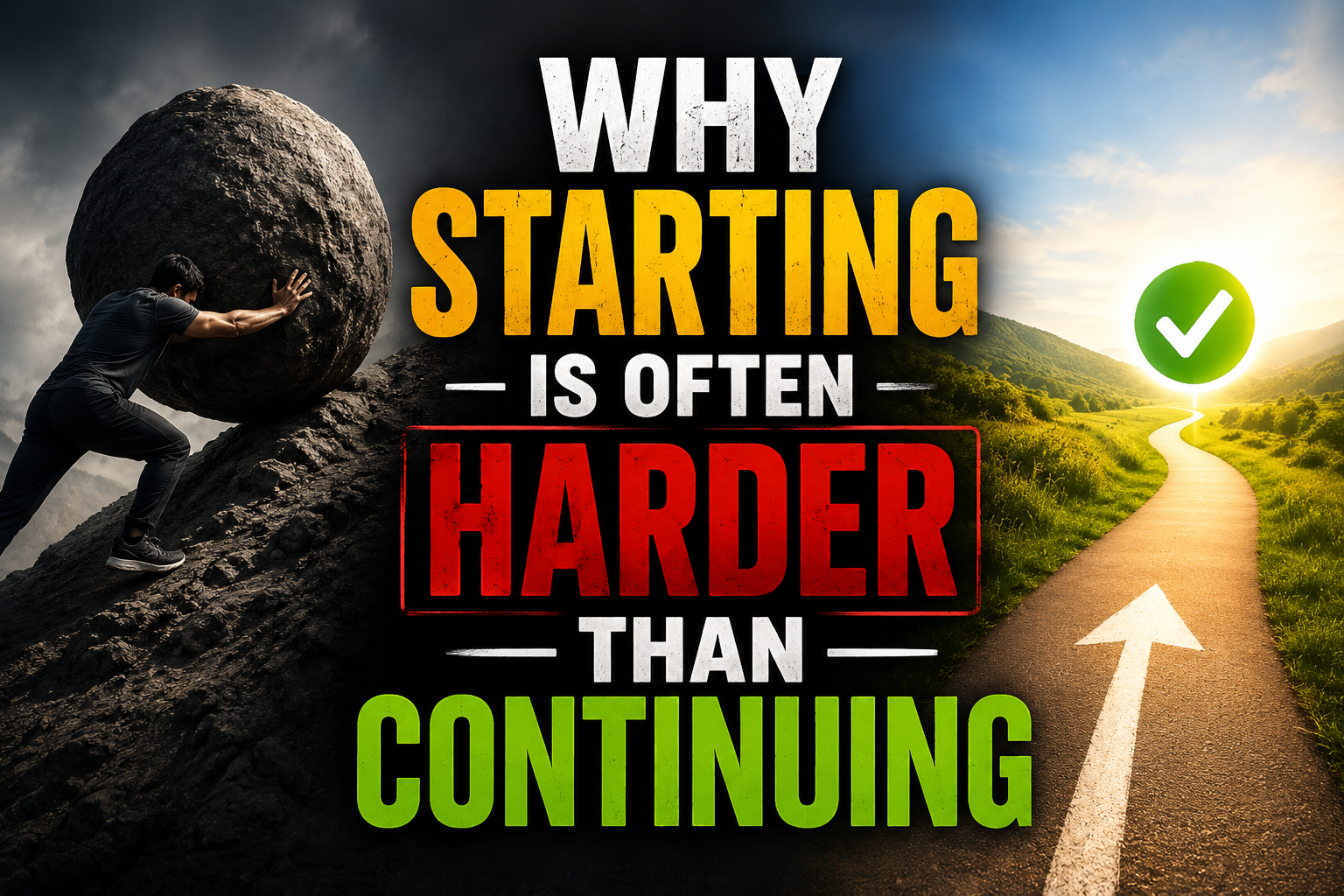
Why Starting Is Often Harder Than Continuing
Every meaningful achievement begins with a single step, yet that first step is often the most difficult one to take. Whether it is starting a business, beginning a fitness journey, writing a book, learning a new skill, investing money, or changing a bad habit, the beginning usually feels overwhelming. Interestingly, once people overcome the challenge of getting started, continuing often becomes much easier. This is not because the journey becomes effortless, but because the greatest resistance usually exists before momentum is created. Understanding why starting is often harder than continuing can help you break free from procrastination, build consistency, and achieve goals that once seemed impossible.
One of the biggest reasons starting feels so difficult is uncertainty. Human beings naturally prefer familiarity and predictability. When you decide to begin something new, your brain immediately encounters unknown territory. Questions begin to appear. What if I fail? What if I am not good enough? What if I waste my time? These unanswered questions create mental resistance that often becomes stronger than the desire to move forward. Ironically, most of these fears disappear only after you begin taking action because experience gradually replaces uncertainty with knowledge.
Perfectionism is another powerful obstacle that makes starting difficult. Many people believe they must have the perfect plan, the perfect timing, the perfect equipment, or the perfect knowledge before taking action. They spend weeks, months, or even years preparing instead of progressing. The truth is that perfection is rarely the starting point of success. Every expert was once a beginner. Every successful business started with imperfect decisions. Every bestselling author once wrote a rough first draft. Progress has always favored those who begin before they feel completely ready.
Fear of failure also plays a major role. Starting exposes you to possible mistakes, criticism, rejection, and disappointment. Many people avoid beginning because they want to protect themselves from emotional discomfort. However, avoiding action does not eliminate failure. It simply replaces temporary failure with permanent regret. Every successful person has experienced failure, but they understand that failure is information rather than a final destination. Each attempt teaches lessons that improve future decisions.
Another reason starting is difficult is because there are no visible results in the beginning. Human beings naturally enjoy rewards, but the early stages of any worthwhile journey often produce little or no immediate gratification. Someone who starts exercising may not notice physical changes for weeks. A new business owner may not make profits for several months. A blogger may publish dozens of articles before attracting significant traffic. During these early stages, motivation can quickly disappear because the effort seems disconnected from the reward. Continuing becomes easier later because progress eventually becomes visible, reinforcing the desire to keep going.
Momentum is one of the greatest psychological forces that explain why continuing is easier than starting. A stationary object requires more energy to move than an object already in motion. This principle applies not only in physics but also in human behavior. Once you establish a routine, your brain begins to automate certain actions. What once required conscious effort gradually becomes a habit. Instead of debating whether to act, you simply continue doing what has already become part of your daily life.
Habits reduce decision fatigue. Every decision consumes mental energy. Before starting a new habit, you must repeatedly decide whether today is the day to begin. Once the habit is established, fewer decisions are required. A person who exercises every morning rarely negotiates with themselves because exercise has become part of their identity. Someone who writes every day no longer waits for inspiration because writing has become routine. This automatic behavior dramatically reduces resistance.
Another factor that makes starting difficult is emotional attachment to comfort. Every new beginning demands leaving behind familiar routines. Even unhealthy habits often feel comfortable simply because they are familiar. Change forces people to confront discomfort, uncertainty, and temporary inconvenience. Unfortunately, many people mistake discomfort for danger. In reality, discomfort is often evidence that growth is taking place. Every meaningful improvement in life requires stepping beyond familiar boundaries.
Social comparison also discourages many beginners. Thanks to social media, people constantly compare their first chapter to someone else’s twentieth chapter. They see polished success stories but rarely witness the years of struggle behind those achievements. This unrealistic comparison creates discouragement before progress even begins. The wiser approach is to compare yourself only with your previous self. Personal improvement is a far more meaningful measure of success than competing with someone else’s journey.
Confidence is another misunderstood concept. Many people believe they must first become confident before taking action. In reality, confidence usually develops after repeated action. The first public speech feels terrifying. The tenth speech feels manageable. The hundredth speech feels natural. Confidence grows through evidence collected from experience rather than wishful thinking. Waiting for confidence before starting often guarantees that nothing ever begins.
Another reason continuing becomes easier is that every completed step builds evidence that success is possible. Small victories create positive feedback loops inside the brain. Completing your first workout makes the second workout feel more achievable. Publishing your first article makes writing the next one less intimidating. Saving your first amount of money makes future saving feel realistic. Each success strengthens belief in your own ability.
Identity also changes during the journey. Before starting, you may think of yourself as someone who wants to become a writer, entrepreneur, athlete, or investor. After consistent action, your identity gradually shifts. You no longer see yourself as someone trying to write. You become a writer. You stop trying to exercise and become someone who exercises. This identity transformation makes continuing much easier because your actions become consistent with who you believe you are.
Many successful people emphasize the importance of simply starting because action creates clarity. Most people believe clarity comes before action, but the opposite is usually true. You learn more during one month of practical experience than during one year of endless planning. Businesses discover customer needs by serving customers. Authors improve by writing. Speakers become better by speaking. Investors learn by investing responsibly. Experience teaches lessons that theory alone never can.
Another overlooked reason starting feels difficult is the weight of expectations. People often imagine the entire journey before taking the first step. They think about years of effort instead of today’s task. This mental overload creates unnecessary pressure. The secret is to focus only on the next action. A marathon is completed one step at a time. A book is written one page at a time. Wealth is built one wise financial decision at a time. Great accomplishments are simply collections of small, consistent actions.
Discipline eventually replaces motivation. Motivation is emotional and unpredictable. Some days you feel excited. Other days you feel tired, discouraged, or distracted. If your progress depends entirely on motivation, consistency becomes impossible. Discipline allows you to continue even when enthusiasm disappears. The more consistently you act, the less you depend on temporary emotional states.
The brain also rewards consistency. Each repeated action strengthens neural pathways, making behaviors easier over time. This biological process explains why learning a musical instrument, speaking a new language, or developing professional skills becomes less mentally demanding with repetition. What initially seemed impossible gradually becomes second nature because your brain adapts through continuous practice.
Fear itself often shrinks after starting. Before beginning, fear exists mostly in imagination. After taking action, fear becomes replaced by real experiences that are usually far less frightening than expected. Many entrepreneurs discover that starting a business was less terrifying than endlessly imagining it. Many students realize public speaking becomes manageable after several presentations. Reality often proves kinder than imagination.
There is also a practical advantage to starting early. Time becomes an ally. Small improvements compounded over months and years create extraordinary outcomes. Delaying action delays compounding. Whether you are learning, saving, investing, building a business, or improving your health, every day you postpone starting is a day that compounding cannot work in your favor.
The people who achieve extraordinary results are rarely those with the greatest talent. More often, they are the people who overcame the difficulty of beginning and refused to stop. They understood that success is less about dramatic breakthroughs and more about showing up consistently. They accepted imperfect beginnings because they recognized that excellence is built through repetition rather than instant mastery.
If you are waiting for the perfect moment, remember that perfect moments rarely arrive. Conditions will never be completely ideal. There will always be uncertainties, challenges, distractions, and reasons to postpone. The difference between those who succeed and those who remain stuck is not intelligence, luck, or resources. It is the willingness to begin despite uncertainty.
Every remarkable accomplishment in history once existed only as an uncomfortable first step. Every invention, every successful company, every bestselling book, every athletic achievement, and every personal transformation began with someone deciding to start before they felt fully prepared. The beginning may feel difficult, but it is temporary. Once momentum develops, continuing becomes part of who you are.
Why starting is often harder than continuing is ultimately a lesson about human psychology. The greatest obstacle is rarely the work itself but the resistance that exists before action. Once you move beyond fear, perfectionism, uncertainty, and self doubt, progress becomes increasingly natural. Momentum grows, confidence strengthens, habits form, and your identity evolves. The hardest part is often taking the first step, but that single decision has the power to transform the rest of your life. If there is something you have been postponing, start today. Your future self will almost certainly be grateful that you did.

EarnSmartOnline.com.ng is dedicated to helping readers make smarter financial decisions through practical guides on online income, personal finance, technology, digital business, and wealth creation. Our goal is to provide reliable, easy-to-understand, and actionable content that empowers individuals to earn smarter, build sustainable income streams and achieve long-term financial success.
Recommended: Start Earning Online
- Ultimate Affiliate Marketing Program — learn affiliate marketing with a done-for-you sales system ($15). Check it out
- The Newbie Affiliate Guide — the beginner-friendly starter guide (~$6.68). Check it out
- Easy Dollar Maker — earn in dollars uploading AI images and videos from your phone ($17). Check it out
Disclosure: These are affiliate links. If you buy through them, I may earn a commission at no extra cost to you.



