
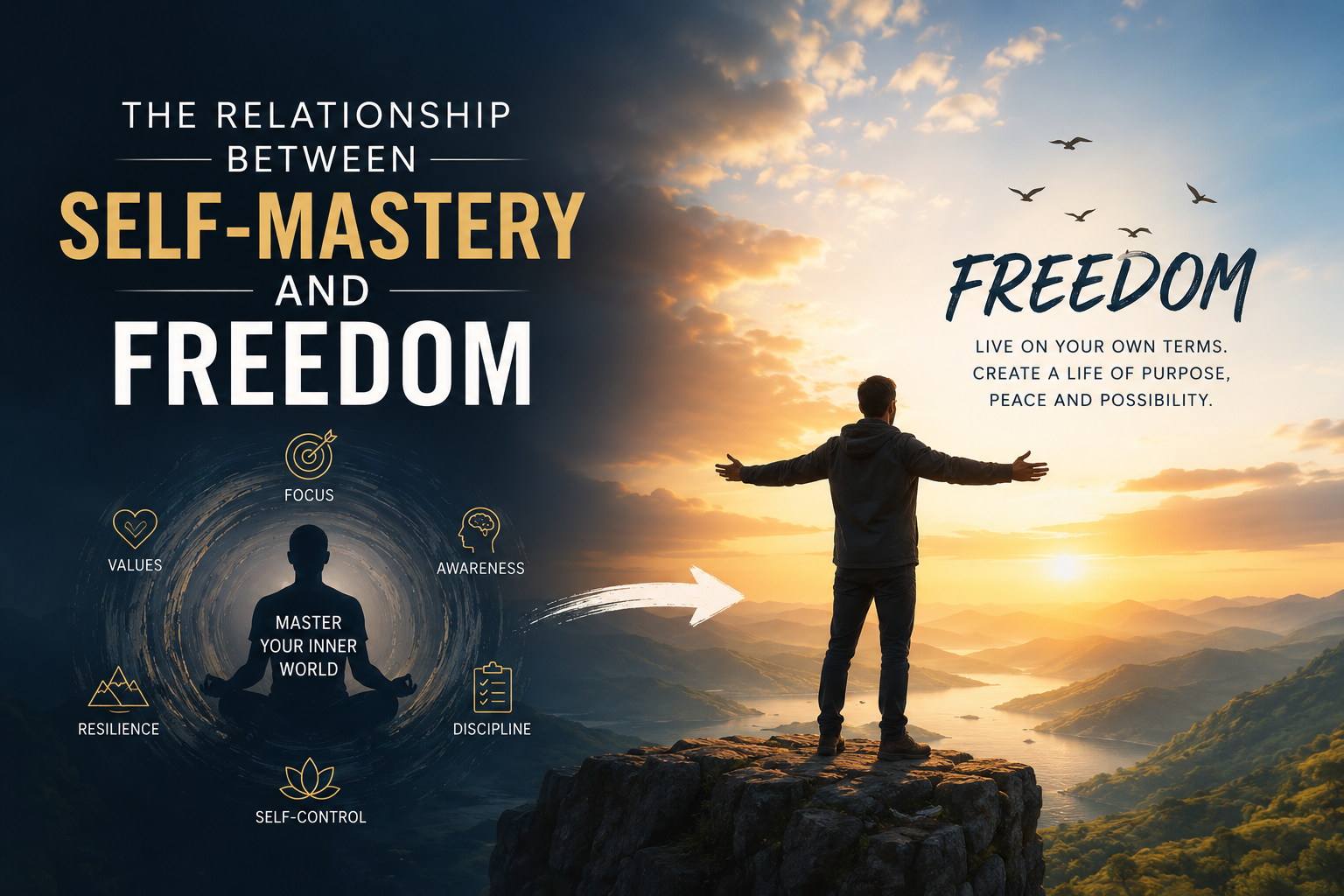
The Relationship Between Self-Mastery and Freedom
Freedom is one of the most desired experiences in human life. People want freedom from financial stress, freedom from toxic relationships, freedom from fear, freedom from limitations, and freedom to live life on their own terms. Yet, many people spend years chasing freedom without realizing that true freedom does not begin with external circumstances. It begins internally. The relationship between self-mastery and freedom is deeper than most people understand.
Many people assume that freedom means having no restrictions, no responsibilities, and no obligations. They imagine that freedom is the ability to do whatever they want whenever they want. However, history and everyday life show a different reality. The people who enjoy the greatest levels of freedom are often those who have developed the highest levels of self-control. Self-mastery is not the enemy of freedom. It is the foundation of it.
Self-mastery is the ability to govern your thoughts, emotions, habits, desires, impulses, and actions. It means being in control of yourself instead of being controlled by external circumstances or internal weaknesses. A person who has mastered himself does not allow temporary emotions to dictate permanent decisions. He does not become a slave to distractions, addictions, fear, laziness, anger, or greed. Instead, he develops the ability to choose his responses consciously and intentionally.
Freedom, on the other hand, is the ability to act according to your highest values and goals without being unnecessarily constrained. While many people think freedom comes from external power, true freedom often comes from internal power. A person may have wealth, status, and opportunities, yet remain imprisoned by his own weaknesses. Another person may have fewer resources but possess extraordinary freedom because he has learned to master himself.
One of the greatest misconceptions in modern society is the belief that self-discipline limits freedom. In reality, the opposite is true. Lack of discipline creates dependence. Dependence reduces freedom. Every addiction is a form of lost freedom. Every destructive habit is a form of captivity. Every uncontrolled impulse reduces a person’s ability to choose wisely.
Consider someone who cannot control his spending habits. He earns money but spends it recklessly. At first, it feels liberating to buy whatever he wants. However, over time, debt accumulates. Financial pressure increases. Opportunities disappear. Eventually, he discovers that his lack of self-control has reduced his freedom. What appeared to be freedom was actually the beginning of bondage.
The same principle applies to health. A person who refuses to control his eating habits may enjoy temporary pleasure, but years later he may face health challenges that limit his mobility, energy, and quality of life. In contrast, someone who practices discipline in diet and exercise may sacrifice short-term comfort but gains long-term freedom. The ability to move freely, think clearly, and live energetically becomes a reward for self-mastery.
This relationship between self-mastery and freedom can be seen in every area of life. Financial freedom requires mastering spending habits. Relationship freedom requires mastering emotions and communication. Career freedom requires mastering productivity and learning. Mental freedom requires mastering thoughts and perspectives. Spiritual freedom requires mastering desires and priorities.
Many people dream about freedom while resisting the process that creates it. They want financial freedom without financial discipline. They want healthy bodies without healthy habits. They want successful businesses without consistent effort. They want peaceful relationships without emotional maturity. Unfortunately, freedom cannot be separated from responsibility. The greater the freedom someone desires, the greater the level of self-mastery he must develop.
One reason self-mastery is so important is because life constantly presents distractions. Every day, people encounter temptations that pull them away from their goals. Social media, entertainment, impulsive purchases, negative influences, and endless distractions compete for attention. Without self-mastery, people drift wherever these influences lead them. They become reactive rather than intentional.
A person who lacks self-mastery often feels as though life is happening to him. Circumstances dictate his emotions. Other people’s opinions dictate his choices. Temporary feelings dictate his actions. As a result, he experiences little control over his direction. Freedom becomes difficult because he is constantly responding instead of leading.
Self-mastery changes this dynamic completely. It allows a person to become the captain of his own life. Rather than reacting impulsively, he learns to pause, evaluate, and choose the best course of action. This ability creates a powerful sense of personal freedom because he is no longer controlled by every external force that enters his environment.
The connection between self-mastery and freedom becomes especially clear when examining emotional control. Many people believe that freedom means expressing every emotion without restraint. However, uncontrolled emotions often create significant problems. Anger can destroy relationships. Fear can prevent opportunities. Jealousy can poison happiness. Impatience can ruin progress.
The person who masters his emotions gains a level of freedom unavailable to others. He is not controlled by every insult, setback, criticism, or disappointment. He can remain calm under pressure, focused during adversity, and optimistic during uncertainty. This emotional stability creates tremendous freedom because his happiness is no longer dependent on perfect circumstances.
Another important aspect of self-mastery is delayed gratification. Modern society encourages immediate satisfaction. People are constantly told to pursue comfort, convenience, and instant rewards. However, the ability to delay gratification remains one of the strongest predictors of long-term success and freedom.
When individuals learn to sacrifice short-term pleasure for long-term benefits, they position themselves for greater opportunities. Saving money instead of spending it immediately creates future financial freedom. Studying instead of procrastinating creates future career freedom. Exercising instead of remaining inactive creates future physical freedom. Every act of self-mastery becomes an investment in future freedom.
Freedom is often misunderstood because people focus exclusively on external conditions. While external freedom is valuable, internal freedom is far more powerful. External circumstances can change unexpectedly. Economies fluctuate. Jobs disappear. Relationships evolve. Markets shift. However, self-mastery remains a personal asset that cannot easily be taken away.
A person who has mastered himself can adapt to changing conditions more effectively than someone who depends entirely on favorable circumstances. He possesses resilience, discipline, emotional intelligence, and self-control. These qualities allow him to navigate uncertainty while maintaining stability. In many ways, self-mastery creates a form of freedom that transcends circumstances.
The world’s greatest leaders, entrepreneurs, athletes, thinkers, and innovators often demonstrate extraordinary levels of self-mastery. Their success is rarely the result of talent alone. It is usually the product of consistent discipline applied over long periods. They learn to control their focus, manage their emotions, maintain productive habits, and persevere through challenges.
This is why self-mastery can be viewed as a form of personal power. People often seek power over external things while neglecting power over themselves. Yet the ability to govern your own mind is one of the greatest forms of power available. When you control your thoughts, emotions, habits, and decisions, you become less vulnerable to manipulation and external influence.
The absence of self-mastery creates invisible chains. These chains may not be visible, but they can be just as restrictive as physical limitations. Addiction chains people to substances. Fear chains people to comfort zones. Laziness chains people to unrealized potential. Anger chains people to conflict. Procrastination chains people to missed opportunities.
The path to freedom requires identifying and breaking these chains. This process is not always easy. Self-mastery demands effort, awareness, and consistency. It requires individuals to confront uncomfortable truths about themselves. It demands personal responsibility and accountability. Yet the rewards are extraordinary.
As self-mastery increases, freedom expands. Decisions become wiser. Opportunities increase. Confidence grows. Relationships improve. Financial stability strengthens. Mental clarity develops. Life becomes more intentional and less chaotic.
Perhaps the greatest freedom of all is the freedom to become the person you were meant to be. Many people never reach their full potential because they remain trapped by their own limitations. Self-mastery removes these barriers. It creates space for growth, achievement, and fulfillment.
The relationship between self-mastery and freedom is therefore not accidental. It is fundamental. Freedom is not merely the absence of restrictions. It is the presence of control. It is the ability to direct your life according to your values rather than your impulses. It is the power to choose your actions rather than being controlled by your weaknesses.
Ultimately, every level of freedom requires a corresponding level of self-mastery. The more control you develop over yourself, the less control circumstances have over you. The more disciplined you become, the more opportunities become available. The more responsibility you embrace, the more freedom you earn.
True freedom does not begin when the world changes around you. True freedom begins when you gain mastery over yourself. The person who conquers his own mind, habits, emotions, and desires possesses a freedom that no circumstance can easily take away. That is why self-mastery remains one of the most valuable pursuits in human life and why the path to lasting freedom always begins within.

EarnSmartOnline.com.ng is dedicated to helping readers make smarter financial decisions through practical guides on online income, personal finance, technology, digital business, and wealth creation. Our goal is to provide reliable, easy-to-understand, and actionable content that empowers individuals to earn smarter, build sustainable income streams and achieve long-term financial success.
Recommended: Start Earning Online
- Ultimate Affiliate Marketing Program — learn affiliate marketing with a done-for-you sales system ($15). Check it out
- The Newbie Affiliate Guide — the beginner-friendly starter guide (~$6.68). Check it out
- Easy Dollar Maker — earn in dollars uploading AI images and videos from your phone ($17). Check it out
Disclosure: These are affiliate links. If you buy through them, I may earn a commission at no extra cost to you.



