
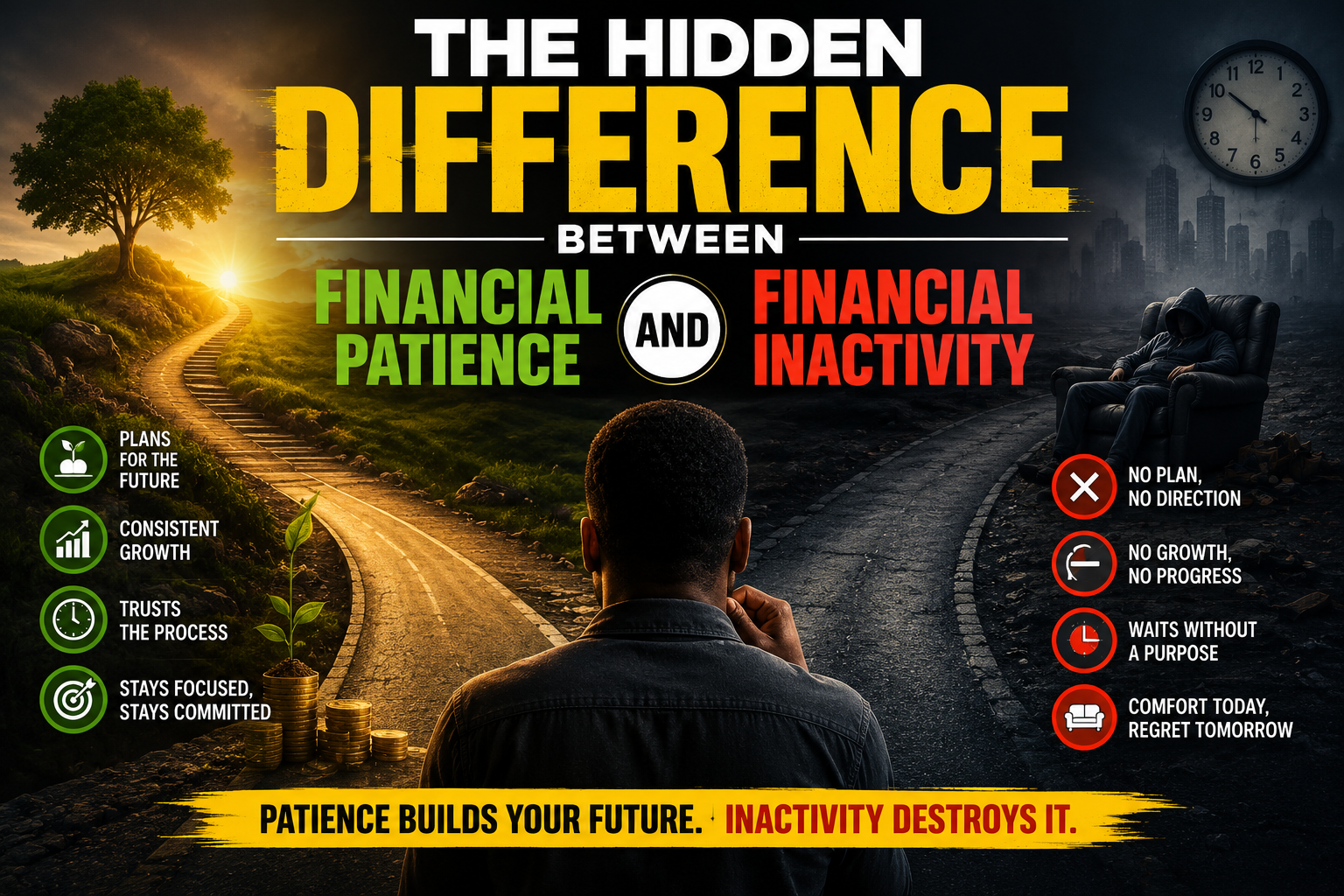
The Hidden Difference Between Financial Patience and Financial Inactivity
The Hidden Difference Between Financial Patience and Financial Inactivity is one of the most misunderstood concepts in personal finance. Every year, millions of people convince themselves that they are being patient with money when, in reality, they are simply standing still. They postpone important financial decisions, delay investing in themselves, avoid calculated risks, and watch opportunities pass by while believing that time alone will improve their financial future. At first glance, patience and inactivity may appear almost identical because both involve waiting. The crucial difference lies in what happens during that waiting period. Financial patience is active, intentional, and strategic, while financial inactivity is passive, fearful, and often disguised as caution.
Money has never rewarded movement alone, but it has consistently rewarded purposeful action combined with disciplined waiting. The world’s wealthiest individuals rarely become successful because they rushed every opportunity, nor did they become successful because they refused to move until every condition became perfect. Instead, they learned when to act and when to wait. This delicate balance separates financial progress from financial stagnation.
One of the greatest financial myths is that doing nothing is always the safest option. Many people believe they cannot lose money if they avoid investing, starting a business, learning a new skill, or making major financial decisions. Although avoiding action may protect them from immediate mistakes, it also guarantees that they miss opportunities that could have transformed their financial future. Inflation continues to reduce purchasing power, industries continue to evolve, technology continues to reshape employment, and new opportunities continue to emerge whether someone chooses to participate or not.
Financial patience is never about refusing to act. It is about acting wisely and allowing enough time for good decisions to produce meaningful results. A farmer who plants seeds today does not expect a harvest tomorrow. The farmer waters the crops, removes weeds, protects the field, and patiently waits because growth requires time. The farmer is not inactive. Every day involves work, observation, adjustment, and preparation. Financial success follows a remarkably similar pattern.
Imagine two people who both want to become wealthy over the next twenty years. The first person invests consistently every month, improves professional skills every year, studies financial literacy regularly, builds relationships, controls unnecessary spending, and patiently waits for compound growth to work. The second person keeps saying that the economy is uncertain, the timing is not right, opportunities will come later, and there will always be another chance. Twenty years later, the first individual may appear lucky to outsiders, but the difference was never luck. It was the difference between financial patience and financial inactivity.
Patience has become an excuse for many people who secretly fear change. They often use phrases such as “I am waiting for the perfect opportunity,” “I will invest when the economy improves,” “I will start my business after I save enough money,” or “I will learn new skills when life becomes less busy.” While these statements sound reasonable, they often hide fear rather than wisdom. The perfect moment rarely arrives because every generation faces uncertainty. Economic recessions, political changes, inflation, technological disruption, and market volatility have existed throughout history. Those who wait for complete certainty usually remain spectators while others move forward despite uncertainty.
Financial inactivity usually begins with comfort. Human beings naturally prefer familiar routines over unfamiliar challenges. Keeping money in a savings account feels comfortable. Staying in the same job for decades feels predictable. Ignoring investment opportunities avoids emotional stress. Unfortunately, comfort often carries invisible costs. Every year spent avoiding growth represents another year without additional knowledge, greater earning potential, or expanding assets.
One of the hidden characteristics of financial patience is continuous preparation. Patient investors continue studying markets. Patient entrepreneurs continue refining ideas. Patient professionals continue improving valuable skills. Patient business owners strengthen operations while waiting for expansion opportunities. Their waiting period is full of productive activity. They understand that success depends not only on timing but also on readiness.
Financial inactivity, on the other hand, is filled with excuses disguised as planning. Instead of learning, inactive individuals keep researching endlessly without implementation. Instead of testing ideas, they continue discussing possibilities. Instead of building assets, they keep imagining future wealth. They mistake information consumption for progress. Reading hundreds of books about investing without ever investing produces little financial benefit. Watching countless motivational videos without taking action changes nothing.
Another important distinction lies in emotional control. Financial patience is built upon confidence in long term principles. Financial inactivity is often driven by fear. Fear of failure. Fear of rejection. Fear of criticism. Fear of losing money. Fear of making mistakes. These fears quietly convince people that waiting is always the smarter decision. Unfortunately, every decision carries risk, including the decision to remain inactive.
Many people fail to recognize the enormous opportunity cost associated with inactivity. Opportunity cost refers to what someone sacrifices by choosing one option over another. Every year spent delaying an investment means another year without compound growth. Every year spent avoiding skill development means another year without increased earning potential. Every year spent postponing business ideas may allow competitors to dominate the market first. The cost of doing nothing is rarely visible immediately, which is why it becomes so dangerous.
History consistently rewards those who combine patience with action. Successful investors rarely panic during market declines because they understand long term trends. However, they also do not leave all their money idle forever. Successful entrepreneurs understand that building profitable companies takes years, but they still launch products, gather customer feedback, improve systems, and adapt continuously. Successful professionals understand that promotions require time, yet they continue building expertise rather than waiting passively for recognition.
One of the strongest examples of financial patience is compound interest. Compound growth rewards those who consistently invest and remain committed over extended periods. The individual who invests modest amounts consistently for decades often outperforms someone constantly chasing quick profits. Patience allows compounding to perform its extraordinary work. Inactivity never activates the power of compounding because nothing has been planted to grow.
Financial inactivity often disguises itself as perfectionism. Some individuals spend years trying to perfect business plans before launching. Others constantly revise investment strategies without investing. Some endlessly compare courses before learning any skill. They believe more preparation automatically creates better outcomes. While preparation is valuable, excessive preparation eventually becomes procrastination wearing professional clothing.
Modern technology has made financial inactivity easier than ever before. Endless news updates create fear. Social media encourages comparison. Online experts offer conflicting advice. The constant flood of information creates decision paralysis. Many people become overwhelmed by options and eventually choose none. Ironically, choosing nothing often becomes the most expensive decision.
Financial patience embraces uncertainty because uncertainty is unavoidable. Every worthwhile investment carries uncertainty. Every business idea contains unknown variables. Every career change involves risk. Waiting until uncertainty disappears is equivalent to waiting forever. Financial patience says, “I have gathered sufficient information. I have evaluated the risks. Now I will act wisely and allow time to do its work.”
Another overlooked difference involves responsibility. Patient individuals accept responsibility for their financial future. They understand that results depend upon habits, decisions, learning, discipline, and consistency. Inactive individuals frequently blame external conditions. They point to government policies, economic challenges, employers, family background, inflation, or bad timing. While these factors certainly influence financial outcomes, they do not eliminate personal responsibility.
Many successful investors experienced losses before achieving lasting success. Many entrepreneurs failed before building profitable companies. Many professionals faced rejection before advancing their careers. Their patience did not eliminate setbacks. Instead, patience gave them the resilience to continue despite temporary disappointments. Inactivity would have ended the journey before meaningful progress became possible.
Financial patience also requires discipline with expectations. Society often promotes overnight success stories, creating unrealistic standards. When progress appears slow, many people abandon sound financial strategies because immediate rewards are missing. Yet genuine wealth usually grows quietly. Assets appreciate gradually. Businesses expand steadily. Skills increase incrementally. Networks strengthen over time. Income improves through years of consistent effort rather than sudden miracles.
The hidden danger of financial inactivity is that it rarely feels dangerous. It feels safe. Comfortable. Responsible. Rational. Months quietly become years. Years quietly become decades. Eventually people look back wondering where the opportunities went. In reality, opportunities were always present. They simply required action before patience could produce meaningful rewards.
The financial world constantly changes, but one principle remains remarkably consistent. Action creates possibility. Patience multiplies results. Inactivity produces neither. The person who plants nothing cannot expect a harvest regardless of how patiently they wait. Likewise, the individual who never develops valuable skills, never builds productive assets, never pursues opportunities, and never improves financial habits cannot reasonably expect significant financial progress simply because time passes.
True financial patience begins after intelligent action has already been taken. It continues while learning, adapting, measuring results, correcting mistakes, and remaining committed to long term objectives. Financial inactivity begins before meaningful action ever starts and often ends with regret. Understanding this hidden difference may be one of the most valuable financial lessons anyone can learn because wealth is rarely created by waiting alone. It is created by purposeful action followed by disciplined patience, repeated consistently over many years until ordinary decisions become extraordinary results.

EarnSmartOnline.com.ng is dedicated to helping readers make smarter financial decisions through practical guides on online income, personal finance, technology, digital business, and wealth creation. Our goal is to provide reliable, easy-to-understand, and actionable content that empowers individuals to earn smarter, build sustainable income streams and achieve long-term financial success.
Recommended: Start Earning Online
- Ultimate Affiliate Marketing Program — learn affiliate marketing with a done-for-you sales system ($15). Check it out
- The Newbie Affiliate Guide — the beginner-friendly starter guide (~$6.68). Check it out
- Easy Dollar Maker — earn in dollars uploading AI images and videos from your phone ($17). Check it out
Disclosure: These are affiliate links. If you buy through them, I may earn a commission at no extra cost to you.



